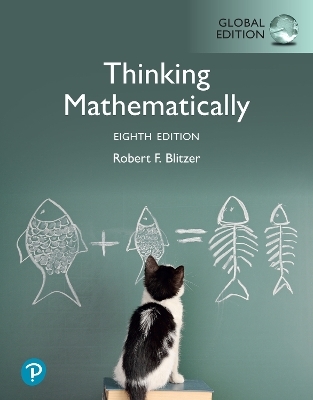
Thinking Mathematically, Global Edition
Pearson Education Limited (Verlag)
978-1-292-46954-6 (ISBN)
Bob Blitzer is a native of Manhattan and received a Bachelor of Arts degree with dual majors in mathematics and psychology (minor: English literature) from the City College of New York. His unusual combination of academic interests led him toward a Master of Arts in mathematics from the University of Miami and a doctorate in behavioral sciences from Nova University. Bob's love for teaching mathematics was nourished for nearly 30 years at Miami Dade College, where he received numerous teaching awards, including Innovator of the Year from the League for Innovations in the Community College and an endowed chair based on excellence in the classroom. In addition to Thinking Mathematically, Bob has written textbooks covering introductory algebra, intermediate algebra, college algebra, algebra and trigonometry, precalculus, and trigonometry.
(NOTE: Each chapter concludes with a Chapter Summary, Review, and Test.)
Problem Solving and Critical Thinking
1.1 Inductive and Deductive Reasoning
1.2 Estimation, Graphs, and Mathematical Models
1.3 Problem Solving
Set Theory
2.1 Basic Set Concepts
2.2 Subsets
2.3 Venn Diagrams and Set Operations
2.4 Set Operations and Venn Diagrams with Three Sets
2.5 Survey Problems
Logic
3.1 Statements, Negations, and Quantified Statements
3.2 Compound Statements and Connectives
3.3 Truth Tables for Negation, Conjunction, and Disjunction
3.4 Truth Tables for the Conditional and the Biconditional
3.5 Equivalent Statements and Variations of Conditional Statements
3.6 Negations of Conditional Statements and De Morgan's Laws
3.7 Arguments and Truth Tables
3.8 Arguments and Euler Diagrams
Number Representation and Calculation
4.1 Our Hindu-Arabic System and Early Positional Systems
4.2 Number Bases in Positional Systems
4.3 Computation in Positional Systems
4.4 Looking Back at Early Numeration Systems
Number Theory and the Real Number System
5.1 Number Theory: Prime and Composite Numbers
5.2 The Integers; Order of Operations
5.3 The Rational Numbers
5.4 The Irrational Numbers
5.5 Real Numbers and Their Properties; Clock Addition
5.6 Exponents and Scientific Notation
5.7 Arithmetic and Geometric Sequences
Algebra: Equations and Inequalities
6.1 Algebraic Expressions and Formulas
6.2 Linear Equations in One Variable and Proportions
6.3 Applications of Linear Equations
6.4 Linear Inequalities in One Variable
6.5 Quadratic Equations
Algebra: Graphs, Functions, and Linear Systems
7.1 Graphing and Functions
7.2 Linear Functions and Their Graphs
7.3 Systems of Linear Equations in Two Variables
7.4 Linear Inequalities in Two Variables
7.5 Linear Programming
7.6 Modeling Data: Exponential, Logarithmic, and Quadratic Functions
Personal Finance
8.1 Percent, Sales Tax, and Discounts
8.2 Income Tax
8.3 Simple Interest
8.4 Compound Interest
8.5 Annuities, Methods of Saving, and Investments
8.6 Cars
8.7 The Cost of Home Ownership
8.8 Credit Cards
Measurement
9.1 Measuring Length; The Metric System
9.2 Measuring Area and Volume
9.3 Measuring Weight and Temperature
Geometry
10.1 Points, Lines, Planes, and Angles
10.2 Triangles
10.3 Polygons, Perimeter, and Tessellations
10.4 Area and Circumference
10.5 Volume and Surface Area
10.6 Right Triangle Trigonometry
10.7 Beyond Euclidean Geometry
Counting Methods and Probability Theory
11.1 The Fundamental Counting Principle
11.2 Permutations
11.3 Combinations
11.4 Fundamentals of Probability
11.5 Probability with the Fundamental Counting Principle, Permutations, and Combinations
11.6 Events Involving Not and Or; Odds
11.7 Events Involving And; Conditional Probability
11.8 Expected Value
Statistics
12.1 Sampling, Frequency Distributions, and Graphs
12.2 Measures of Central Tendency
12.3 Measures of Dispersion
12.4 The Normal Distribution
12.5 Problem Solving with the Normal Distribution
12.6 Scatter Plots, Correlation, and Regression Lines
Voting and Apportionment
13.1 Voting Methods
13.2 Flaws of Voting Methods
13.3 Apportionment Methods
13.4 Flaws of Apportionment Method
Graph Theory
14.1 Graphs, Paths, and Circuits
14.2 Euler Paths and Euler Circuits
14.3 Hamilton Paths and Hamilton Circuits
14.4 Trees
| Erscheinungsdatum | 21.08.2024 |
|---|---|
| Verlagsort | Harlow |
| Sprache | englisch |
| Themenwelt | Mathematik / Informatik ► Mathematik |
| ISBN-10 | 1-292-46954-4 / 1292469544 |
| ISBN-13 | 978-1-292-46954-6 / 9781292469546 |
| Zustand | Neuware |
| Informationen gemäß Produktsicherheitsverordnung (GPSR) | |
| Haben Sie eine Frage zum Produkt? |
aus dem Bereich