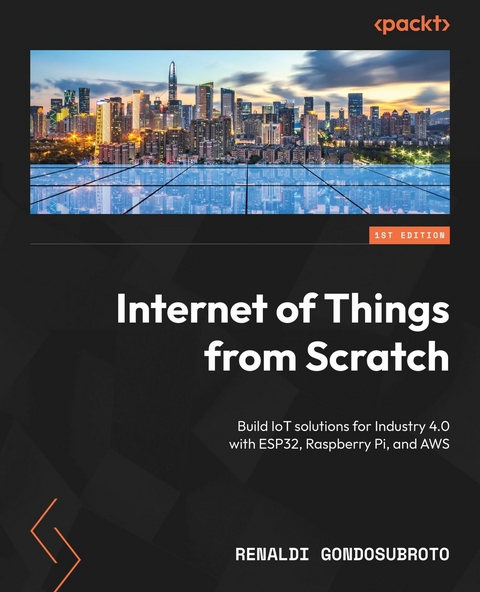
Internet of Things from Scratch (eBook)
438 Seiten
Packt Publishing Limited (Verlag)
978-1-83763-946-5 (ISBN)
Develop the skills essential for building Internet of Things solutions with this indispensable guide. In an era where industries heavily rely on IoT, this book will quickly familiarize you with its foundations, widespread use, implementation guided by best practices, and the crucial technologies that allow it to work effectively.
Starting with the use of IoT in real-life scenarios, this book offers comprehensive insights into basic IoT hardware, protocols, and technologies. You'll then learn about architecting and implementing solutions such as wireless sensor networks, cloud computing with AWS, and crucial security considerations. You'll understand how these systems are operated and monitored over time and work with simple to complex, industry-grade systems, adhering to best practices.
In later chapters, you'll be apprised of future IoT trends and strategies to manage the risks and opportunities that come with them. You'll also get to grips with a diverse set of tools, including hardware such as ESP32 and Raspberry Pi, and software such as Mosquitto and ChatGPT for generative AI capabilities.
By the end of this IoT book, you'll be able to independently build and design complex, industry-standard solutions fully aligned with best practices.
No detailed description available for "e;Internet of Things from Scratch"e;.
Preface
Greetings, fellow tech enthusiast! The Internet of Things (IoT) is rapidly reshaping the way we perceive and interact with our environment. From the convenience of our homes to the hustle of modern industries, the convergence of the physical and digital is bringing forth innovations that seemed futuristic not so long ago. This book is your comprehensive guide to navigating this dynamic landscape, broken down into four pivotal sections.
In Part One, we embark on an introductory journey, covering the foundational aspects of IoT. We explore the core architecture and real-life applications, delve deep into designing IoT networks, and study communication and connectivity technologies.
Part Two thrusts us into the world of smart environments. Here, we dissect wireless sensor networks, the marvels of edge computing, cloud-integrated IoT solutions, and the quintessential aspect of system interoperability.
In Part Three, the spotlight turns to the operational heart of IoT. From the meticulous nuances of monitoring IoT networks to harnessing data analytics, ensuring robust security and privacy, and pushing the boundaries with open source IoT, this section prepares you for the challenges and solutions to maintain and safeguard IoT networks.
Finally, Part Four catapults us toward the future, discussing the role of IoT in the digital transformation of Industry 4.0 and the intricacies of architecting complex IoT environments, and offering a contemplative look into what the future holds.
Drawing from my extensive experience, including innovative projects such as the GReS Envimo and the wireless, image machine-learning remote-controlled car, as well as insights from industry stalwarts, this book is packed with practical knowledge. It combines my hands-on projects with insights from current IoT deployments in the industry.
Who this book is for
This book caters to a broad spectrum, from beginner-level electronics engineers to seasoned IoT developers eager to deepen their insights. If you’re an embedded systems engineer, student, cloud enthusiast, or application developer aspiring to foray into the world of industry-based IoT applications, you’re in for a treat. While no prior knowledge of IoT is necessary, a basic familiarity with one or two programming languages will be advantageous. Throughout these pages, you’ll gain the knowledge, tools, and confidence to innovate and lead in the IoT domain. Dive in and let the journey begin!
What this book covers
Chapter 1, An Introduction to IoT Architecture, Hardware, and Real-Life Applications, introduces you to the big picture of IoT, discussing everyday use cases of it and the mindset that is needed to grasp the topics fully and effectively in the book.
Chapter 2, Understanding and Designing IoT Networks, discusses the common network technologies that have been used to deploy IoT networks, including 3G, 4G, LoRa, and WAN, and how to optimize network architecture based on them.
Chapter 3, Integrating Application Protocols, discusses the common application protocols for IoT, such as HTTP, MQTT, and CoAP, while exploring the benefits of each one, choosing between them, and integrating them into our network design based on the use case.
Chapter 4, Examining Communication and Connectivity Technologies, discusses common communication protocols and technologies for short- and long-range networks, while exploring the considerations of using each one depending on the needs of the user and how each network serves as a base guideline for them.
Chapter 5, Realizing Wireless Sensor Networks within Smart Spaces, introduces you to sensors, exploring how they fit within the architecture of wireless sensor network setups and how choosing the appropriate ones is done for specific contexts to monitor the system, physical, or environmental conditions.
Chapter 6, Creating Applications on the Edge, introduces building on edge network architecture and the theory related to how data travels within a network, as well as factors relevant to latency and costs, such as volume, traffic, and the distance that is traveled.
Chapter 7, Working with Cloud Computing to Power IoT Solutions, introduces you to a high-level overview of the capabilities of cloud computing to build your IoT network – in this case, utilizing AWS as the main cloud provider.
Chapter 8, Designing for Interoperability, discusses how interoperability has been an issue for some time in many IoT networks and explores the considerations of how interoperable design can be done efficiently, ensuring as many smart devices can interact with one another, thus furthering the concept of the smart home.
Chapter 9, Operating and Monitoring IoT Networks, discusses how IoT systems and networks are operated and maintained once put in place, and it looks at the tools that are used both on-premises and in the cloud as part of this.
Chapter 10, Working with Data and Analytics, discusses the analytics tools that can be used as part of managing current IoT network deployments and extracting data from them, such as Amazon CloudWatch. The chapter also explores how queries can also be built and set up to be run smartly, allowing you to analyze data on the go automatically instead of having to rely on manual analysis to do so.
Chapter 11, Examining Security and Privacy in IoT, discusses the security landscape for IoT, the currently emerging threats that many users will need to consider within the landscape, the privacy concerns for IoT, and how to build around these challenges to stay compliant with regulations.
Chapter 12, Exploring and Innovating with Open Source IoT, introduces open source work that has been done with the IoT and recommends work that you can build on for your own projects.
Chapter 13, Developing IoT Solutions for Digital Transformation within Industry 4.0, discusses how IoT can be brought into organizations that are not familiar with the concept and how to build around a smart ecosystem within the workplace as part of Industry 4.0, leveraging frameworks and standards from best practices within the industry.
Chapter 14, Architecting Complex, Holistic IoT Environments, looks at more complex IoT environments and the considerations that go into architecting and building them, allowing you to explore the threats and risks within such environments. The chapter also explores how factors such as multi-cloud deployments based on hybrid models can create many attack surfaces that have to be considered.
Chapter 15, Looking Ahead into the Future of IoT, discusses the future of IoT five years from now and how sustainable it can be, analyzing trends that have been popular so far and the challenges that come along with them, alongside the author’s own perspectives on the do’s and don’ts, based on best practices.
To get the most out of this book
No prior knowledge is assumed of this book, but familiarity with one or two programming languages will help you get through more of the practical exercises in this book faster.
| Software/hardware covered in the book | Operating system requirements |
| Amazon Web Services (AWS) | Windows, macOS, or Linux |
| Raspberry Pi 3 | Linux |
| Arduino | Windows, macOS, or Linux |
If you are using the digital version of this book, we advise you to type the code yourself or access the code from the book’s GitHub repository (a link is available in the next section). Doing so will help you avoid any potential errors related to the copying and pasting of code.
Download the example code files
You can download the example code files for this book from GitHub at https://github.com/PacktPublishing/IoT-Made-Easy-for-Beginners. If there’s an update to the code, it will be updated in the GitHub repository.
Conventions used
There are a number of text conventions used throughout this book.
Code in text: Indicates code...
| Erscheint lt. Verlag | 1.3.2024 |
|---|---|
| Sprache | englisch |
| Themenwelt | Mathematik / Informatik ► Informatik ► Netzwerke |
| ISBN-10 | 1-83763-946-9 / 1837639469 |
| ISBN-13 | 978-1-83763-946-5 / 9781837639465 |
| Informationen gemäß Produktsicherheitsverordnung (GPSR) | |
| Haben Sie eine Frage zum Produkt? |
 EPUB (Ohne DRM)
Digital Rights Management: ohne DRM
Dieses eBook enthält kein DRM oder Kopierschutz. Eine Weitergabe an Dritte ist jedoch rechtlich nicht zulässig, weil Sie beim Kauf nur die Rechte an der persönlichen Nutzung erwerben.
Dateiformat: EPUB (Electronic Publication)
EPUB ist ein offener Standard für eBooks und eignet sich besonders zur Darstellung von Belletristik und Sachbüchern. Der Fließtext wird dynamisch an die Display- und Schriftgröße angepasst. Auch für mobile Lesegeräte ist EPUB daher gut geeignet.
Systemvoraussetzungen:
PC/Mac: Mit einem PC oder Mac können Sie dieses eBook lesen. Sie benötigen dafür die kostenlose Software Adobe Digital Editions.
eReader: Dieses eBook kann mit (fast) allen eBook-Readern gelesen werden. Mit dem amazon-Kindle ist es aber nicht kompatibel.
Smartphone/Tablet: Egal ob Apple oder Android, dieses eBook können Sie lesen. Sie benötigen dafür eine kostenlose App.
Geräteliste und zusätzliche Hinweise
Buying eBooks from abroad
For tax law reasons we can sell eBooks just within Germany and Switzerland. Regrettably we cannot fulfill eBook-orders from other countries.
aus dem Bereich