Neural Networks with Model Compression (eBook)
260 Seiten
Springer Nature Singapore (Verlag)
978-981-99-5068-3 (ISBN)
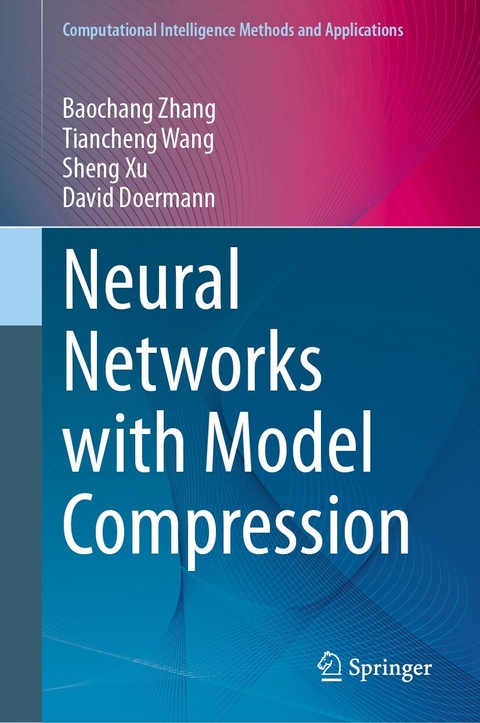
Deep learning has achieved impressive results in image classification, computer vision and natural language processing. To achieve better performance, deeper and wider networks have been designed, which increase the demand for computational resources. The number of floating-point operations (FLOPs) has increased dramatically with larger networks, and this has become an obstacle for convolutional neural networks (CNNs) being developed for mobile and embedded devices. In this context, our book will focus on CNN compression and acceleration, which are important for the research community. We will describe numerous methods, including parameter quantization, network pruning, low-rank decomposition and knowledge distillation. More recently, to reduce the burden of handcrafted architecture design, neural architecture search (NAS) has been used to automatically build neural networks by searching over a vast architecture space. Our book will also introduce NAS due to its superiority and state-of-the-art performance in various applications, such as image classification and object detection. We also describe extensive applications of compressed deep models on image classification, speech recognition, object detection and tracking. These topics can help researchers better understand the usefulness and the potential of network compression on practical applications. Moreover, interested readers should have basic knowledge about machine learning and deep learning to better understand the methods described in this book.
Deep learning has achieved impressive results in image classification, computer vision and natural language processing. To achieve better performance, deeper and wider networks have been designed, which increase the demand for computational resources. The number of floating-point operations (FLOPs) has increased dramatically with larger networks, and this has become an obstacle for convolutional neural networks (CNNs) being developed for mobile and embedded devices. In this context, our book will focus on CNN compression and acceleration, which are important for the research community. We will describe numerous methods, including parameter quantization, network pruning, low-rank decomposition and knowledge distillation. More recently, to reduce the burden of handcrafted architecture design, neural architecture search (NAS) has been used to automatically build neural networks by searching over a vast architecture space. Our book will also introduce NAS due to its superiority and state-of-the-art performance in various applications, such as image classification and object detection. We also describe extensive applications of compressed deep models on image classification, speech recognition, object detection and tracking. These topics can help researchers better understand the usefulness and the potential of network compression on practical applications. Moreover, interested readers should have basic knowledge about machine learning and deep learning to better understand the methods described in this book.
| Erscheint lt. Verlag | 5.2.2024 |
|---|---|
| Reihe/Serie | Computational Intelligence Methods and Applications | Computational Intelligence Methods and Applications |
| Zusatzinfo | IX, 260 p. 101 illus., 67 illus. in color. |
| Sprache | englisch |
| Themenwelt | Informatik ► Grafik / Design ► Digitale Bildverarbeitung |
| Informatik ► Theorie / Studium ► Künstliche Intelligenz / Robotik | |
| Mathematik / Informatik ► Mathematik ► Statistik | |
| Schlagworte | Artificial Intelligence • Binary Neural Network • computer vision • machine learning • Model compression |
| ISBN-10 | 981-99-5068-6 / 9819950686 |
| ISBN-13 | 978-981-99-5068-3 / 9789819950683 |
| Informationen gemäß Produktsicherheitsverordnung (GPSR) | |
| Haben Sie eine Frage zum Produkt? |
 PDF (Wasserzeichen)
DRM: Digitales Wasserzeichen
Dieses eBook enthält ein digitales Wasserzeichen und ist damit für Sie personalisiert. Bei einer missbräuchlichen Weitergabe des eBooks an Dritte ist eine Rückverfolgung an die Quelle möglich.
Dateiformat: PDF (Portable Document Format)
Mit einem festen Seitenlayout eignet sich die PDF besonders für Fachbücher mit Spalten, Tabellen und Abbildungen. Eine PDF kann auf fast allen Geräten angezeigt werden, ist aber für kleine Displays (Smartphone, eReader) nur eingeschränkt geeignet.
Systemvoraussetzungen:
PC/Mac: Mit einem PC oder Mac können Sie dieses eBook lesen. Sie benötigen dafür einen PDF-Viewer - z.B. den Adobe Reader oder Adobe Digital Editions.
eReader: Dieses eBook kann mit (fast) allen eBook-Readern gelesen werden. Mit dem amazon-Kindle ist es aber nicht kompatibel.
Smartphone/Tablet: Egal ob Apple oder Android, dieses eBook können Sie lesen. Sie benötigen dafür einen PDF-Viewer - z.B. die kostenlose Adobe Digital Editions-App.
Buying eBooks from abroad
For tax law reasons we can sell eBooks just within Germany and Switzerland. Regrettably we cannot fulfill eBook-orders from other countries.
aus dem Bereich