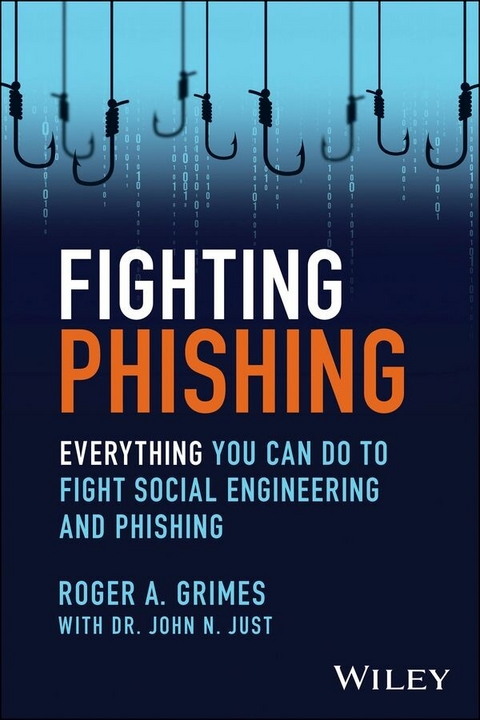
Fighting Phishing (eBook)
John Wiley & Sons (Verlag)
978-1-394-24921-3 (ISBN)
Keep valuable data safe from even the most sophisticated social engineering and phishing attacks
Fighting Phishing: Everything You Can Do To Fight Social Engineering and Phishing serves as the ideal defense against phishing for any reader, from large organizations to individuals. Unlike most anti-phishing books, which focus only on one or two strategies, this book discusses all the policies, education, and technical strategies that are essential to a complete phishing defense. This book gives clear instructions for deploying a great defense-in-depth strategy to defeat hackers and malware. Written by the lead data-driven defense evangelist at the world's number one anti-phishing company, KnowBe4, Inc., this guide shows you how to create an enduring, integrated cybersecurity culture.
- Learn what social engineering and phishing are, why they are so dangerous to your cybersecurity, and how to defend against them
- Educate yourself and other users on how to identify and avoid phishing scams, to stop attacks before they begin
- Discover the latest tools and strategies for locking down data when phishing has taken place, and stop breaches from spreading
- Develop technology and security policies that protect your organization against the most common types of social engineering and phishing
Anyone looking to defend themselves or their organization from phishing will appreciate the uncommonly comprehensive approach in Fighting Phishing.
ROGER A. GRIMES has 35 years of experience in computer security and has authored 13 previous books on the topic. He is the Data-Driven Defense Evangelist at KnowBe4, a security awareness education company, and a senior computer security consultant and cybersecurity architect.
Keep valuable data safe from even the most sophisticated social engineering and phishing attacks Fighting Phishing: Everything You Can Do To Fight Social Engineering and Phishing serves as the ideal defense against phishing for any reader, from large organizations to individuals. Unlike most anti-phishing books, which focus only on one or two strategies, this book discusses all the policies, education, and technical strategies that are essential to a complete phishing defense. This book gives clear instructions for deploying a great defense-in-depth strategy to defeat hackers and malware. Written by the lead data-driven defense evangelist at the world's number one anti-phishing company, KnowBe4, Inc., this guide shows you how to create an enduring, integrated cybersecurity culture. Learn what social engineering and phishing are, why they are so dangerous to your cybersecurity, and how to defend against them Educate yourself and other users on how to identify and avoid phishing scams, to stop attacks before they begin Discover the latest tools and strategies for locking down data when phishing has taken place, and stop breaches from spreading Develop technology and security policies that protect your organization against the most common types of social engineering and phishing Anyone looking to defend themselves or their organization from phishing will appreciate the uncommonly comprehensive approach in Fighting Phishing.
ROGER A. GRIMES has 35 years of experience in computer security and has authored 13 previous books on the topic. He is the Data-Driven Defense Evangelist at KnowBe4, a security awareness education company, and a senior computer security consultant and cybersecurity architect.
Introduction
Social engineering has been around since the beginning of humanity, and phishing has been around at least since the beginning of networked computers. I can remember my first brush with social engineering via computers in 1987. This was before most people had even heard of something called the Internet and before most people had personal computers. Many of us early adopters were on a precursor of the Internet called the FIDONet. Back in those days, you would use a 300 or 1200 BAUD or BPS (Bits Per Second) dial-up analog modem to call your local BBS (Bulletin Board System). This system would use a crude “store-and-forward” technology that would transmit and receive messages and files around the world in a day or so. We thought it all was pretty cutting-edge.
On one of the BBSs, I came across a downloadable text file named “How to Get a Free HST Modem.” HST modems, made by US Robotics, were the fastest and best modems available at the time. They ran at an incredible 9600 BPS. They were expensive enough that only a few lucky, monied, people had them. They were mostly only used by Fortune 500 companies and well-funded universities. This file promised to tell anyone who read it how to obtain a free one. It was too enticing to pass up.
I opened up the file and inside it contained only text that said, “Steal One!” “Well, that was disappointing!,” I thought. Then the very next keyboard key I pressed formatted (i.e., permanently erased) my hard drive and rendered my computer useless. Well, at least until I reinstalled the operating system and redid everything all over again. I lost all files.
It turns out the file was something called an “ansi-bomb.” It was a malicious file that took advantage of a feature of a legitimate operating system file called ansi.sys. Ansi.sys was a part of Microsoft's DOS operating system, which most of us ran at the time. Ansi.sys was an optional file that allowed users to have extended, “cool,” features for their screen and keyboard, such as displaying special graphics and characters on your screen. It also allowed savvy users to map sequences of commands to a single key on their keyboard. It was meant to allow people to create “macros”—an automated shortcut that triggered a longer sequence of key presses. You could hit one or two keys and automate what would otherwise be a bunch of other key presses. Some malicious jerk had created a malicious file that instructed ansi.sys to map all the keys on the user's keyboard to format the user's hard drive when the next key was pressed.
It was a lesson learned.
There are malicious people in the world who want to harm other innocent people for no other reason than they can. Not everyone in the world is friendly and helpful, especially to strangers.
Now, the impact of social engineering and phishing on cybercrime has been driven home to me tens of thousands of times during my career. Today, nearly everyone understands that social engineering and phishing are responsible for more cybercrime than any other single initial root cause method. No other root cause of hacking is even close. But just a decade ago, even though it was true then, it wasn't as well known by all cybersecurity defenders. I think everyone knew social engineering and phishing was a problem, but few knew exactly how big of a problem it was. Few defenders knew it was the number one problem by far. Even I didn't.
I worked as a Principal Security Architect for Microsoft Corporation for nearly 11 years, from 2007 to 2018. For much of that time, I did security reviews for customers and installed Public Key Infrastructures (PKI) and advanced security defense systems. I was promoted, usually well-liked by clients, and always installed systems on time and on budget, which isn't so normal in the computer industry. For years I felt like I was greatly helping to protect my customers.
Then I realized that every single customer I had, no matter what defenses we installed, was still falling prey to hackers and malware. This was despite installing the best computer security defense systems possible. Why? It was almost always due to social engineering (and, secondarily, unpatched software). Even though all my customers were spending hundreds of thousands to millions of dollars to protect themselves using the most advanced systems the industry could imagine and deliver, what was taking them down was the same things that were most often taking down companies since the beginning of computers—social engineering. And usually, phishing.
That realization occurred to me in about 2016. It made me depressed. Instead of seeing myself as part of the solution, I realized I wasn't really helping my clients to avoid hackers and malware. What I was doing was more smoke and mirrors. I was wasting their time and money. But it wasn't like I was alone. Most computer security companies and consultants did what I did, which was concentrating on everything but defeating social engineering and phishing, even though they were clearly the biggest problem by far. Still, it bothered me tremendously.
I eventually wrote the first edition of a book about my realization, A Data-Driven Defense: A Way to Improve Any Computer Defense (www.amazon.com/Data-Driven-Computer-Defense-Should-Using/dp/B0BR9KS3ZF) in 2018. The book sold over 50,000 copies (over three editions), and its premise—social engineering is most companies’ biggest cybersecurity threat—led me to work for my current employer, KnowBe4.
The CEO of KnowBe4, Stu Sjouwerman, was one of the first people to read my book and understood its value in not only recognizing the importance of fighting phishing and social engineering but also in creating an effective cybersecurity defense using data. In April 2018, Stu offered me a job and I accepted. I was delighted. Not only was I going to start working for a leading firm in security awareness training, which is one of the best ways to fight social engineering and phishing, but I was also going to be able to concentrate on helping customers fight the biggest weakness in their cybersecurity defense as my primary job. I was pretty elated and remain so to this day.
In the over five years since, as KnowBe4's Data-Driven Defense Evangelist, I have taught hundreds of in-person presentations and online webinars. You can see many of my webinars here: www.knowbe4.com/webinar-library. You can download and read many of my whitepapers here: www.knowbe4.com/security-awareness-whitepapers. And you can request that I do a presentation to your company here: www.knowbe4.com/security-awareness-training-advocates. You can see dozens of my presentations for free on YouTube. I speak about a lot of topics beyond social engineering, including multifactor authentication, quantum, ransomware, passwords, password managers, nation-state hacking, and cryptocurrencies, but most of my presentations include something about fighting social engineering and phishing even if that isn't the primary topic. I never miss a chance to educate listeners about the importance of focusing on preventing social engineering and phishing.
There is nothing else most organizations could do better to reduce their existing cybersecurity risk than to reduce social engineering and phishing threats. This book is the best advice for today's world to help you fight social engineering and phishing. I don't know of another source that has more coverage and suggestions. Not humbly, I think I can best teach anyone how to reduce their social engineering and social engineering risk. I break down many of the necessary critical lessons and processes into the simplest recommendations and charts you'll see anywhere. I cover every policy, technical defense, and best practice education practice you should be doing to best stop social engineering and phishing.
Do you want to know how to best reduce cybersecurity risk from social engineering and phishing? Read this book.
Who This Book Is For
This book is for anyone interested in fighting social engineering and phishing attacks—from entire organizations to single individuals, from dedicated anti-phishing employees to IT managers, and for any IT security practitioner. Because the book contains large, distinct, sections dedicated to policy and formal security awareness training programs, it can be argued that it is more appropriately focused on organizations, ranging in size from small businesses to the Fortune 500. But individuals and organizations of any size will benefit from learning the recommendations and best practices contained in this book. Many of the lessons in this book should be shared with friends and family, and many of them are universal. This is the book I wish I read when I first got into the industry.
What Is Covered in This Book
Fighting Phishing: Everything You Need to Know to Fight Social Engineering and Phishing contains 17 chapters separated into 4 parts.
- Part I: “Introduction to Social Engineering Security.” Part I will begin by introducing all the data and terminology associated with social engineering and phishing. There are dozens of distinct definitions that will help you better understand and talk about social engineering and phishing. Part I ends with a discussion about the three necessary components needed in any computer security defense, including one that fights social engineering and phishing.
| Erscheint lt. Verlag | 19.1.2024 |
|---|---|
| Sprache | englisch |
| Themenwelt | Mathematik / Informatik ► Informatik ► Netzwerke |
| Schlagworte | blue team book • Computer Science • cybersecurity • Cybersecurity book • data protection • data security book • Hacker • Informatik • John N Just • Malware • Networking / Security • Netzwerke / Sicherheit • personal cybersecurity • Personal Data Security • Phishing • phishing defense • Phishing Scam • social engineering • social engineering defense |
| ISBN-10 | 1-394-24921-7 / 1394249217 |
| ISBN-13 | 978-1-394-24921-3 / 9781394249213 |
| Informationen gemäß Produktsicherheitsverordnung (GPSR) | |
| Haben Sie eine Frage zum Produkt? |
 EPUB (Adobe DRM)
Kopierschutz: Adobe-DRM
Adobe-DRM ist ein Kopierschutz, der das eBook vor Mißbrauch schützen soll. Dabei wird das eBook bereits beim Download auf Ihre persönliche Adobe-ID autorisiert. Lesen können Sie das eBook dann nur auf den Geräten, welche ebenfalls auf Ihre Adobe-ID registriert sind.
Details zum Adobe-DRM
Dateiformat: EPUB (Electronic Publication)
EPUB ist ein offener Standard für eBooks und eignet sich besonders zur Darstellung von Belletristik und Sachbüchern. Der Fließtext wird dynamisch an die Display- und Schriftgröße angepasst. Auch für mobile Lesegeräte ist EPUB daher gut geeignet.
Systemvoraussetzungen:
PC/Mac: Mit einem PC oder Mac können Sie dieses eBook lesen. Sie benötigen eine
eReader: Dieses eBook kann mit (fast) allen eBook-Readern gelesen werden. Mit dem amazon-Kindle ist es aber nicht kompatibel.
Smartphone/Tablet: Egal ob Apple oder Android, dieses eBook können Sie lesen. Sie benötigen eine
Geräteliste und zusätzliche Hinweise
Buying eBooks from abroad
For tax law reasons we can sell eBooks just within Germany and Switzerland. Regrettably we cannot fulfill eBook-orders from other countries.
aus dem Bereich