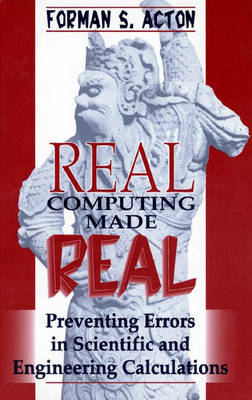
Real Computing Made Real
Princeton University Press (Verlag)
978-0-691-03663-2 (ISBN)
- Titel ist leider vergriffen;
keine Neuauflage - Artikel merken
For those engineers and scientists who use computers to solve their problems only to discover new, subtle problems in their results, this book is a welcome quick guide to trouble-shooting. Offering practical advice on detecting and removing the insidious bugs that plague finite-precision calculations, real Computing outlines techniques for preserving significant figures, avoiding extraneous solutions (those ridiculous "answers" that turn up all too often), and finding efficient iterative processes for solving nonlinear equations. Anyone who computes with real numbers (for example, floating-point numbers stored with limited precision) tends to pick up a few computing "tricks"--techniques that increase the frequency of useful answers. But where there might be ample guidance for a computor grappling with linear problems, there is little help for someone negotiating the nonlinear world--and it is this need that Forman Acton addresses. His book presents a wealth of examples and exercises (with answers) to help a reader develop problemformulating skills--thus learning to avoid the common pitfalls that software packages seldom detect.
It presumes some experience with standard numerical methods--but for beginners in real computing, it will lend a touch of realism to topics often slighted in introductory texts.
Forman S. Acton is Professor Emeritus of Computer Science at Princeton University.
ACKNOWLEDGMENTS IX AN EXHORATION XI Make fewer errors! (Errors are hard to find.) We need help--but much software obscures!--A kind of Kyrie. Chapter 0 TOOLS OF THE TRADE 3 A brief collection of those useful numerical aids that may by now have faded slightly in your memory. A WORKSHOP FOR PRACTICE IN SKETCHING FUNCTIONS 33 ... to refresh your skills at getting realistic pictures of your equations (and their parts). Sketching an equation before an algorithm is chosen will prevent more computational disasters than any other effort. Try some! (We give our own at the end of this chapter.) GLOOMY MUSINGS 63 Correctness, Efficiency and Responsibility ... How can we get into the habit of thinking carefully about our computations before writing our programs? How can we be sensitized to preventing errors without becoming paralyzed into inaction? Can we ever learn to distrust software even while using it?--a Dies Irae! Chapter 1 NONLINEAR EQUATIONS 69 We seek rearrangements of the equation to permit iterations that approach roots from one side. A picture will usually lead to an algorithm that does not degenerate into futile repetitions. (It may also show that you are about to seek a solution that you really don't want!) Chapter 2 PRESERVING SIGNIFICANT DIGITS 107 When significant digits disappear, pay heed--for your algorithm is often about to break down! Searching for these places will lead you to trouble spots and allow you to fix them before they rise to bite you. This error-prevention dividend is far more important than the digits that could be lost. We illustrate various techniques, and include a real-life problem. Chapter 3 QUADRATURES 141 A field where it often pays to alter the problem to fit the algorithm: How to remove singularities that can spawn monumental algorithmic inefficiencies. Chapter 4 RECURRENCE RELATIONS 173 A hands-on introduction to a delightfully simple and efficient class of algorithms--that don't always work! A world where molehills really do sometimes become mountains. Chapter 5 CHOOSING AND TUNING AN ALGORITHM 189 We follow a straightforward small problem thru our search for suitable algorithms--and are pehaps surprised to find the process rather convoluted. ANSWERS TO MOST OF THE EXERCISES 205 Dona Nobis Pacem! INDEX
| Zusatzinfo | 4 halftones, 76 line illustrations |
|---|---|
| Verlagsort | New Jersey |
| Sprache | englisch |
| Maße | 197 x 254 mm |
| Gewicht | 595 g |
| Themenwelt | Mathematik / Informatik ► Informatik ► Theorie / Studium |
| Mathematik / Informatik ► Mathematik ► Angewandte Mathematik | |
| Mathematik / Informatik ► Mathematik ► Computerprogramme / Computeralgebra | |
| ISBN-10 | 0-691-03663-2 / 0691036632 |
| ISBN-13 | 978-0-691-03663-2 / 9780691036632 |
| Zustand | Neuware |
| Informationen gemäß Produktsicherheitsverordnung (GPSR) | |
| Haben Sie eine Frage zum Produkt? |
aus dem Bereich