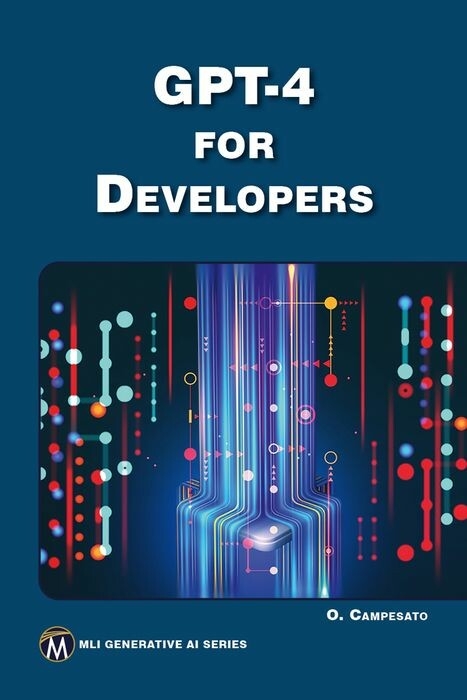
GPT-4 for Developers (eBook)
215 Seiten
Mercury Learning and Information (Verlag)
978-1-5015-1902-4 (ISBN)
- Extensive Python 3.x code samples generated using ChatGPT and GPT-4, covering diverse programming tasks and challenges.
- Comprehensive exploration of data visualization techniques using popular Python libraries such as Matplotlib and Seaborn.
This resource is designed to bridge the gap between theoretical understanding and practical application, making it a useful tool for software developers, data scientists, AI researchers, and tech enthusiasts interested in harnessing the power of GPT-4 in Python environments. The book contains an assortment of Python 3.x code samples that were generated by ChatGPT and GPT-4. Chapter 1 provides an overview of ChatGPT and GPT-4, followed by a chapter which contains Python 3.x code samples for solving various programming tasks in Python. Chapter 3 contains code samples for data visualization, and Chapter 4 contains code samples for linear regression. The final chapter covers visualization with Gen AI (Generative AI) and DALL-E. Companion files with source code and figures are available for downloading.
Extensive Python 3.x code samples generated using ChatGPT and GPT-4, covering diverse programming tasks and challenges. Comprehensive exploration of data visualization techniques using popular Python libraries such as Matplotlib and Seaborn. This resource is designed to bridge the gap between theoretical understanding and practical application, making it a useful tool for software developers, data scientists, AI researchers, and tech enthusiasts interested in harnessing the power of GPT-4 in Python environments. The book contains an assortment of Python 3.x code samples that were generated by ChatGPT and GPT-4. Chapter 1 provides an overview of ChatGPT and GPT-4, followed by a chapter which contains Python 3.x code samples for solving various programming tasks in Python. Chapter 3 contains code samples for data visualization, and Chapter 4 contains code samples for linear regression. The final chapter covers visualization with Gen AI (Generative AI) and DALL-E. Companion files with source code and figures are available for downloading.
| Erscheint lt. Verlag | 15.12.2023 |
|---|---|
| Sprache | englisch |
| Themenwelt | Mathematik / Informatik ► Informatik ► Office Programme |
| Mathematik / Informatik ► Informatik ► Programmiersprachen / -werkzeuge | |
| Informatik ► Theorie / Studium ► Künstliche Intelligenz / Robotik | |
| Technik | |
| ISBN-10 | 1-5015-1902-6 / 1501519026 |
| ISBN-13 | 978-1-5015-1902-4 / 9781501519024 |
| Informationen gemäß Produktsicherheitsverordnung (GPSR) | |
| Haben Sie eine Frage zum Produkt? |
 PDF (Wasserzeichen)
DRM: Digitales Wasserzeichen
Dieses eBook enthält ein digitales Wasserzeichen und ist damit für Sie personalisiert. Bei einer missbräuchlichen Weitergabe des eBooks an Dritte ist eine Rückverfolgung an die Quelle möglich.
Dateiformat: PDF (Portable Document Format)
Mit einem festen Seitenlayout eignet sich die PDF besonders für Fachbücher mit Spalten, Tabellen und Abbildungen. Eine PDF kann auf fast allen Geräten angezeigt werden, ist aber für kleine Displays (Smartphone, eReader) nur eingeschränkt geeignet.
Systemvoraussetzungen:
PC/Mac: Mit einem PC oder Mac können Sie dieses eBook lesen. Sie benötigen dafür einen PDF-Viewer - z.B. den Adobe Reader oder Adobe Digital Editions.
eReader: Dieses eBook kann mit (fast) allen eBook-Readern gelesen werden. Mit dem amazon-Kindle ist es aber nicht kompatibel.
Smartphone/Tablet: Egal ob Apple oder Android, dieses eBook können Sie lesen. Sie benötigen dafür einen PDF-Viewer - z.B. die kostenlose Adobe Digital Editions-App.
Buying eBooks from abroad
For tax law reasons we can sell eBooks just within Germany and Switzerland. Regrettably we cannot fulfill eBook-orders from other countries.
aus dem Bereich