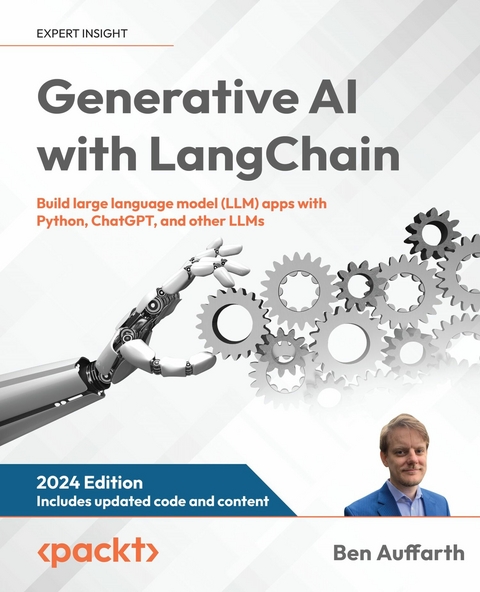
Generative AI with LangChain (eBook)
376 Seiten
Packt Publishing Limited (Verlag)
978-1-83508-836-4 (ISBN)

ChatGPT and the GPT models by OpenAI have brought about a revolution not only in how we write and research but also in how we can process information. This book discusses the functioning, capabilities, and limitations of LLMs underlying chat systems, including ChatGPT and Gemini. It demonstrates, in a series of practical examples, how to use the LangChain framework to build production-ready and responsive LLM applications for tasks ranging from customer support to software development assistance and data analysis - illustrating the expansive utility of LLMs in real-world applications.
Unlock the full potential of LLMs within your projects as you navigate through guidance on fine-tuning, prompt engineering, and best practices for deployment and monitoring in production environments. Whether you're building creative writing tools, developing sophisticated chatbots, or crafting cutting-edge software development aids, this book will be your roadmap to mastering the transformative power of generative AI with confidence and creativity.
2024 Edition - Get to grips with the LangChain framework to develop production-ready applications, including agents and personal assistants. The 2024 edition features updated code examples and an improved GitHub repository. Purchase of the print or Kindle book includes a free PDF eBook. Key FeaturesLearn how to leverage LangChain to work around LLMs inherent weaknessesDelve into LLMs with LangChain and explore their fundamentals, ethical dimensions, and application challengesGet better at using ChatGPT and GPT models, from heuristics and training to scalable deployment, empowering you to transform ideas into realityBook DescriptionChatGPT and the GPT models by OpenAI have brought about a revolution not only in how we write and research but also in how we can process information. This book discusses the functioning, capabilities, and limitations of LLMs underlying chat systems, including ChatGPT and Gemini. It demonstrates, in a series of practical examples, how to use the LangChain framework to build production-ready and responsive LLM applications for tasks ranging from customer support to software development assistance and data analysis illustrating the expansive utility of LLMs in real-world applications. Unlock the full potential of LLMs within your projects as you navigate through guidance on fine-tuning, prompt engineering, and best practices for deployment and monitoring in production environments. Whether you're building creative writing tools, developing sophisticated chatbots, or crafting cutting-edge software development aids, this book will be your roadmap to mastering the transformative power of generative AI with confidence and creativity.What you will learnCreate LLM apps with LangChain, like question-answering systems and chatbotsUnderstand transformer models and attention mechanismsAutomate data analysis and visualization using pandas and PythonGrasp prompt engineering to improve performanceFine-tune LLMs and get to know the tools to unleash their powerDeploy LLMs as a service with LangChain and apply evaluation strategiesPrivately interact with documents using open-source LLMs to prevent data leaksWho this book is forThe book is for developers, researchers, and anyone interested in learning more about LangChain. Whether you are a beginner or an experienced developer, this book will serve as a valuable resource if you want to get the most out of LLMs using LangChain. Basic knowledge of Python is a prerequisite, while prior exposure to machine learning will help you follow along more easily.]]>
Preface
In the dynamic and rapidly advancing field of AI, generative AI stands out as a disruptive force poised to transform how we interact with technology. This book is an expedition into the intricate world of large language models (LLMs) – the powerful engines driving this transformation – designed to equip developers, researchers, and AI aficionados with the knowledge needed to harness these tools.
Venture into the depths of deep learning, where unstructured data comes alive, and discover how LLMs like GPT-4 and others are carving a path for AI’s impact on businesses, societies, and individuals. With the tech industry and media abuzz with the capabilities and potential of these models, it’s an opportune moment to explore how they function, thrive, and propel us toward future horizons.
This book serves as your compass, pointing you toward understanding the technical scaffolds that uphold LLMs. We provide a prelude to their vast applications, the elegance of their underlying architecture, and the powerful implications of their existence. Written for a diverse audience, from those taking their first steps in AI to seasoned developers, the text melds theoretical concepts with practical, code-rich examples, preparing you to not only grasp LLMs intellectually but to also apply them inventively and responsibly.
As we embark on this journey together, let us prime ourselves to shape and be shaped by the generative AI narrative that’s unfolding at this very moment–a narrative where you, armed with knowledge and foresight, stand at the forefront of this exhilarating technological evolution.
Who this book is for
The book is intended for developers, researchers, and anyone else who is interested in learning more about LLMs. It is written in a clear and concise style, and it includes plenty of code examples to help you learn by doing.
Whether you are a beginner or an experienced developer, this book will be a valuable resource for anyone who wants to get the most out of LLMs and to stay ahead of the curve about LLMs and LangChain.
What this book covers
Chapter 1, What Is Generative AI?, explains how generative AI has revolutionized the processing of text, images, and video, with deep learning at its core. This chapter introduces generative models such as LLMs, detailing their technical underpinnings and transformative potential across various sectors. This chapter covers the theory behind these models, highlighting neural networks and training approaches, and the creation of human-like content. The chapter outlines the evolution of AI, Transformer architecture, text-to-image models like Stable Diffusion, and touches on sound and video applications.
Chapter 2, LangChain for LLM Apps, uncovers the need to expand beyond the stochastic parrots of LLMs–models that mimic language without true understanding–by harnessing LangChain’s framework. Addressing limitations like outdated knowledge, action limitations, and hallucination risks, the chapter highlights how LangChain integrates external data and interventions for more coherent AI applications. The chapter critically engages with the concept of stochastic parrots, revealing the deficiencies in models that produce fluent but meaningless language, and explicates how prompting, chain-of-thought reasoning, and retrieval grounding augment LLMs to address issues of contextuality, bias, and intransparency.
Chapter 3, Getting Started with LangChain, provides foundational knowledge for you to set up your environment to run all examples in the book. It begins with installation guidance for Docker, Conda, Pip, and Poetry. The chapter then details integrating models from various providers like OpenAI’s ChatGPT and Hugging Face, including obtaining necessary API keys. It also deals with running open-source models locally. The chapter culminates in constructing an LLM app to assist customer service agents, exemplifying how LangChain can streamline operations and enhance the accuracy of responses.
Chapter 4, Building Capable Assistants, tackles turning LLMs into reliable assistants by weaving in fact-checking to reduce misinformation, employing sophisticated prompting strategies for summarization, and integrating external tools for enhanced knowledge. It explores the Chain of Density for information extraction and discusses LangChain decorators and expression language for customizing behavior. The chapter introduces map-reduce in LangChain for handling long documents and discusses token monitoring to manage API usage costs.
It looks at implementing a Streamlit application to create interactive LLM applications and using function calling and tool usage to transcend basic text generation. Two distinct agent paradigms, plan-and-solve and zero-shot, are implemented to demonstrate decision-making strategies.
Chapter 5, Building a Chatbot Like ChatGPT, delves into enhancing chatbot capabilities with retrieval-augmented generation (RAG), a method that provides LLMs with access to external knowledge, improving their accuracy and domain-specific proficiency. This chapter discusses document vectorization, efficient indexing, and the use of vector databases like Milvus and Pinecone for semantic search. We implement a chatbot, incorporating moderation chains to ensure responsible communication. The chatbot, available on GitHub, serves as a basis for exploring advanced topics like dialogue memory and context management.
Chapter 6, Developing Software with Generative AI, examines the burgeoning role of LLMs in software development, highlighting the potential for AI to automate coding tasks and serve as dynamic coding assistants. It explores the current state of AI-driven software development, experiments with models to generate code snippets, and introduces a design for an automated software development agent using LangChain. Critical reflections on the agent’s performance emphasize the importance of human oversight for error mitigation and high-level design, setting the stage for a future where AI and human developers work symbiotically.
Chapter 7, LLMs for Data Science, explores the intersection of generative AI and data science, spotlighting LLMs’ potential to amplify productivity and drive scientific discovery. The chapter outlines the current scope of automation in data science through AutoML and extends this notion with the integration of LLMs for advanced tasks like augmenting datasets and generating executable code. It covers practical methods for LLMs to conduct exploratory data analysis, run SQL queries, and visualize statistical data. Finally, the use of agents and tools demonstrates how LLMs can address complex data-centric questions.
Chapter 8, Customizing LLMs and Their Output, delves into conditioning techniques like fine-tuning and prompting, essential for tailoring LLM performance to complex reasoning and specialized tasks. We unpack fine-tuning, where an LLM is further trained on task-specific data, and prompt engineering, which strategically guides the LLM to generate desired outputs. Advanced prompting strategies such as few-shot learning and chain-of-thought are implemented, enhancing the reasoning capabilities of LLMs. The chapter not only provides concrete examples of fine-tuning and prompting but also discusses the future of LLM advancements and their applications in the field.
Chapter 9, Generative AI in Production, addresses the complexities of deploying LLMs within real-world applications, covering best practices for ensuring performance, meeting regulatory requirements, robustness at scale, and effective monitoring. It underscores the importance of evaluation, observability, and systematic operation to make generative AI beneficial in customer engagement and decision-making with financial consequences. It also outlines practical strategies for deployment and ongoing monitoring of LLM apps using tools like Fast API, Ray, and newcomers such as LangServe and LangSmith. These tools can provide automated evaluation and metrics that support the responsible adoption of generative AI across sectors.
Chapter 10, The Future of Generative Models, ventures into the potential advancements and socio-technical challenges of generative AI. It examines the economic and societal impacts of these technologies, debating job displacement, misinformation, and ethical concerns like human value alignment. As various sectors brace for disruptive AI-induced changes, it reflects on the responsibility of corporations, lawmakers, and technologists to forge effective governance frameworks. This final chapter emphasizes the importance of steering AI development toward augmenting human potential while addressing risks such as deepfakes, bias, and the weaponization of AI. It highlights the urgency for transparency, ethical deployment, and equitable access to guide the generative AI revolution positively.
To get the most out of this book
To fully benefit from the value this book offers, it is essential to have at least a foundational understanding of Python. Additionally, having some basic knowledge of machine learning or neural networks can be helpful, though it is not required. Please be sure to carefully follow the instructions in Chapter 3 for setting up your Python environment using one of the popular tools, and for obtaining your access keys for OpenAI and other providers.
Work with notebooks and projects
The code for this book is...
| Erscheint lt. Verlag | 22.12.2023 |
|---|---|
| Sprache | englisch |
| Themenwelt | Mathematik / Informatik ► Informatik ► Netzwerke |
| Mathematik / Informatik ► Informatik ► Office Programme | |
| Informatik ► Theorie / Studium ► Künstliche Intelligenz / Robotik | |
| Schlagworte | ai books • Chat GPT • GenAI • GPT-4 • LLM • rag llm • Retrieval Augmented Generation |
| ISBN-10 | 1-83508-836-8 / 1835088368 |
| ISBN-13 | 978-1-83508-836-4 / 9781835088364 |
| Informationen gemäß Produktsicherheitsverordnung (GPSR) | |
| Haben Sie eine Frage zum Produkt? |
 EPUB (Ohne DRM)
Digital Rights Management: ohne DRM
Dieses eBook enthält kein DRM oder Kopierschutz. Eine Weitergabe an Dritte ist jedoch rechtlich nicht zulässig, weil Sie beim Kauf nur die Rechte an der persönlichen Nutzung erwerben.
Dateiformat: EPUB (Electronic Publication)
EPUB ist ein offener Standard für eBooks und eignet sich besonders zur Darstellung von Belletristik und Sachbüchern. Der Fließtext wird dynamisch an die Display- und Schriftgröße angepasst. Auch für mobile Lesegeräte ist EPUB daher gut geeignet.
Systemvoraussetzungen:
PC/Mac: Mit einem PC oder Mac können Sie dieses eBook lesen. Sie benötigen dafür die kostenlose Software Adobe Digital Editions.
eReader: Dieses eBook kann mit (fast) allen eBook-Readern gelesen werden. Mit dem amazon-Kindle ist es aber nicht kompatibel.
Smartphone/Tablet: Egal ob Apple oder Android, dieses eBook können Sie lesen. Sie benötigen dafür eine kostenlose App.
Geräteliste und zusätzliche Hinweise
Buying eBooks from abroad
For tax law reasons we can sell eBooks just within Germany and Switzerland. Regrettably we cannot fulfill eBook-orders from other countries.
aus dem Bereich