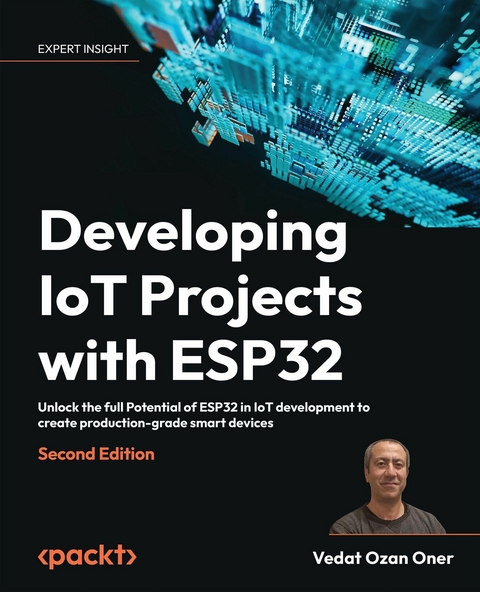
Developing IoT Projects with ESP32 (eBook)
578 Seiten
Packt Publishing Limited (Verlag)
978-1-80324-481-5 (ISBN)

ESP32, a low-cost and energy-efficient system-on-a-chip microcontroller, has become the backbone of numerous WiFi devices, fueling IoT innovation. This book offers a holistic approach to building an IoT system from the ground up, ensuring secure data communication from sensors to cloud platforms, empowering you to create production-grade IoT solutions using the ESP32 SoC.
Starting with IoT essentials supported by real-world use cases, this book takes you through the entire process of constructing an IoT device using ESP32. Each chapter introduces new dimensions to your IoT applications, covering sensor communication, the integration of prominent IoT libraries like LittleFS and LVGL, connectivity options via WiFi, security measures, cloud integration, and the visualization of real-time data using Grafana. Furthermore, a dedicated section explores AI/ML for embedded systems, guiding you through building and running ML applications with tinyML and ESP32-S3 to create state-of-the-art embedded products.
This book adopts a hands-on approach, ensuring you can start building IoT solutions right from the beginning. Towards the end of the book, you'll tackle a full-scale Smart Home project, applying all the techniques you've learned in real-time.
Embark on your journey to build secure, production-grade IoT systems with ESP32 today!
From smart sensors to cloud integration and the world of TinyML, this book is your comprehensive guide to the IoT ecosystem, using the ESP32 and industry-standard tools and technologiesKey FeaturesBuild IoT projects from scratch using ESP32Customize solutions, take them to cloud, visualize real-time data, implement security featuresPractice using a variety of hands-on projects such as an audio player, smart home, and moreBook DescriptionESP32, a low-cost and energy-efficient system-on-a-chip microcontroller, has become the backbone of numerous WiFi devices, fueling IoT innovation. This book offers a holistic approach to building an IoT system from the ground up, ensuring secure data communication from sensors to cloud platforms, empowering you to create production-grade IoT solutions using the ESP32 SoC. Starting with IoT essentials supported by real-world use cases, this book takes you through the entire process of constructing an IoT device using ESP32. Each chapter introduces new dimensions to your IoT applications, covering sensor communication, the integration of prominent IoT libraries like LittleFS and LVGL, connectivity options via WiFi, security measures, cloud integration, and the visualization of real-time data using Grafana. Furthermore, a dedicated section explores AI/ML for embedded systems, guiding you through building and running ML applications with tinyML and ESP32-S3 to create state-of-the-art embedded products. This book adopts a hands-on approach, ensuring you can start building IoT solutions right from the beginning. Towards the end of the book, you'll tackle a full-scale Smart Home project, applying all the techniques you've learned in real-time. Embark on your journey to build secure, production-grade IoT systems with ESP32 today!What you will learnExplore ESP32 with IDE and debugging tools for effective IoT creationDrive GPIO, I2C, multimedia, and storage for seamless integration of external devicesUtilize handy IoT libraries to enhance your ESP32 projectsManage WiFi like a pro with STA & AP modes, provisioning, and ESP Rainmaker framework featuresEnsure robust IoT security with secure boot and OTA firmware updatesHarness AWS IoT for data handling and achieve stunning visualization using GrafanaEnhance your projects with voice capabilities using ESP AFE and Speech RecognitionInnovate with tinyML on ESP32-S3 and the Edge Impulse platformWho this book is forIf you are an embedded software developer, an IoT software architect or developer, a technologist, or anyone who wants to learn how to use ESP32 and its applications, this book is for you. A basic understanding of embedded systems, programming, networking, and cloud computing concepts is necessary to get started with the book.]]>
Preface
It has been a long time since the first Internet of Things (IoT) devices entered our lives, and now they are helping us in many ways. We have smart TVs, voice assistants, connected appliances at home, or Industrial IoT (IIoT) devices being used in the transportation, healthcare, agriculture, and energy sectors – virtually everywhere. The new generation has been growing up with this technology and using IoT devices effectively (my 3-year-old daughter’s music box, for example, is an Echo device). Furthermore, new IoT products are introduced on the market every day with novel features or improved capabilities.
We all appreciate how fast technology is changing. It is hard for everybody to keep up with all those changes: technology manufacturers, technology consumers, and, in between them, people like us – IoT developers that make technology available to consumers. Since the 1st edition of this book, Espressif Systems has added many chips to their portfolio in response to market needs. For instance, we see the single-core ESP32-C family of System-on-Chip (SoC) devices with RISC-V architecture. They have a reduced set of capabilities and memory but are much cheaper compared to the first ESP32. There is also the ESP32-S family as a new branch of the original ESP32 SoCs with more capabilities and peripherals to support Artificial Intelligence-of-Things (AIoT) solutions. On top of hardware, we see state-of-the-art frameworks and libraries that enable us to use those SoCs in different types of applications. In this book, I’ve tried to cover them from a bit of a different perspective in addition to the basics of ESP32 development as a starting point.
There are several key differences between the first edition and this one. First of all, the examples of this edition are developed in C++ by employing ESP-IDF, compared to the C programming language and the PlatformIO environment in the first edition. We will also use different development kits from Espressif Systems in this edition, which makes hardware setup easier in some examples. In terms of content, we will discuss machine learning on ESP32 with hands-on projects, but the Bluetooth/BLE topics have been excluded from the book and some others have been condensed to make room for the machine learning examples. A noteworthy addition that I expect you would find interesting in this edition is the exploration of integration with third-party libraries. In the relevant chapter, various methods of incorporating third-party libraries into ESP32 projects will be discussed.
This doesn’t mean the 1st edition is now obsolete. On the contrary, it is still perfectly valid if you are new to IoT with ESP32. With this edition of the book, we have a chance to discuss the subjects where the 1st edition With this edition of the book, we have a chance to discuss in detail about the emerging new technology in terms of new technology. I really enjoyed preparing the examples for this book, and I hope you enjoy them, too. I want to share a wise quote from a distinguished historian and women’s rights activist, Mary Ritter Beard, before delving into the topics.
“Action without study is fatal. Study without action is futile.”
- Mary Ritter Beard
Who this book is for
This book is targeted at embedded software developers, IoT software architects/developers, and technologists who want to learn how to employ ESP32 effectively in their IoT projects.
What this book covers
Chapter 1, Introduction to IoT Development and the ESP32 Platform, discusses IoT technology in general and introduces the ESP32 platform in terms of both hardware and software.
Chapter 2, Understanding the Development Tools, talks about the popular development environments ESP-IDF and PlatformIO, and teaches you how to utilize the toolchain to develop and test ESP32 applications.
Chapter 3, Using ESP32 Peripherals, gives practical examples of integrating with sensors and actuators by interfacing with common ESP32 peripherals, including audio and graphics.
Chapter 4, Employing Third-Party Libraries in ESP32 Projects, talks about different methods of importing third-party libraries with examples. LVGL is one of the libraries discussed in this chapter.
Chapter 5, Project – Audio Player, is the first reference project in the book with audio, graphics, and button interactions to engage its users.
Chapter 6, Using Wi-Fi Communication for Connectivity, shows how to communicate over different application layer protocols, such as MQTT and REST, after connecting to a local Wi-Fi network.
Chapter 7, ESP32 Security Features for Production-Grade Devices, explores the security features of ESP32 by giving examples of secure firmware updates and secure communication techniques. ESP RainMaker is the IoT platform that provides the backend services in the examples.
Chapter 8, Connecting to Cloud Platforms and Using Services, explains how to pass data to AWS IoT Core and visualize it on Grafana. Amazon Alexa integration is also covered with a step-by-step project example.
Chapter 9, Project – Smart Home, builds a full-fledged smart home solution on the ESP RainMaker platform to show how different devices can operate together in the same product.
Chapter 10, Machine Learning with ESP32, introduces the basics of machine learning and tinyML on ESP32, and discusses Espressif’s machine learning frameworks with a speech recognition example.
Chapter 11, Developing on Edge Impulse, explains how to develop machine learning applications on ESP32 by utilizing the Edge Impulse platform.
Chapter 12, Project – Baby Monitor, is the last project of the book, which shows how to design and develop a connected machine learning product. Edge Impulse and ESP RainMaker are the platforms employed in the project.
To get the most out of this book
The examples are written in modern C++ by using ESP-IDF (the major development framework for ESP32, maintained by Espressif Systems). Therefore, a basic understanding of modem C++ concepts would be beneficial to get a better grasp of the subjects discussed in the book. Although not required, some familiarity with using command-line tools in a terminal window could also help to follow the examples.
I tried to explain all the subjects in the scope of the book in as much detail as possible. Nevertheless, IoT is a vast field to talk about in a single book, so I appended a Further reading section at the end of most of the chapters in case you need some background information. If you find it difficult to follow any of the underlying subjects in a chapter, reading the reference books listed in the Further reading sections will support you in understanding the examples of that specific chapter better.
Download the example code files
The code bundle for the book is hosted on GitHub at https://github.com/PacktPublishing/Developing-IoT-Projects-with-ESP32-2nd-edition. We also have other code bundles from our rich catalog of books and videos available at https://github.com/PacktPublishing/. Check them out!
Download the color images
We also provide a PDF file that has color images of the screenshots/diagrams used in this book. You can download it here: https://packt.link/gbp/9781803237688.
Conventions used
There are a number of text conventions used throughout this book.
CodeInText: Indicates code words in text, database table names, folder names, filenames, file extensions, pathnames, dummy URLs, user input, and Twitter handles. For example: “Mount the downloaded WebStorm-10*.dmg disk image file as another disk in your system.”
A block of code is set as follows:
[default] exten => s,1,Dial(Zap/1|30) exten => s,2,Voicemail(u100) exten => s,102,Voicemail(b100) exten => i,1,Voicemail(s0) When we wish to draw your attention to a particular part of a code block, the relevant lines or items are set in bold:
[default] exten => s,1,Dial(Zap/1|30) exten => s,2,Voicemail(u100) exten => s,102,Voicemail(b100) exten => i,1,Voicemail(s0) Any command-line input or output is written as follows:
# cp /usr/src/asterisk-addons/configs/cdr_mysql.conf.sample /etc/asterisk/cdr_mysql.conf Bold: Indicates a new term, an important word, or words that you see on the screen. For instance, words in menus or dialog boxes appear in the text like this. For example: “Select System info from the Administration panel.”
Warnings or important notes appear like this.
Tips and tricks appear like this.
Get in touch
Feedback from our readers is...
| Erscheint lt. Verlag | 30.11.2023 |
|---|---|
| Sprache | englisch |
| Themenwelt | Mathematik / Informatik ► Informatik ► Netzwerke |
| Informatik ► Weitere Themen ► Hardware | |
| Technik ► Elektrotechnik / Energietechnik | |
| ISBN-10 | 1-80324-481-X / 180324481X |
| ISBN-13 | 978-1-80324-481-5 / 9781803244815 |
| Informationen gemäß Produktsicherheitsverordnung (GPSR) | |
| Haben Sie eine Frage zum Produkt? |
 EPUB (Ohne DRM)
Digital Rights Management: ohne DRM
Dieses eBook enthält kein DRM oder Kopierschutz. Eine Weitergabe an Dritte ist jedoch rechtlich nicht zulässig, weil Sie beim Kauf nur die Rechte an der persönlichen Nutzung erwerben.
Dateiformat: EPUB (Electronic Publication)
EPUB ist ein offener Standard für eBooks und eignet sich besonders zur Darstellung von Belletristik und Sachbüchern. Der Fließtext wird dynamisch an die Display- und Schriftgröße angepasst. Auch für mobile Lesegeräte ist EPUB daher gut geeignet.
Systemvoraussetzungen:
PC/Mac: Mit einem PC oder Mac können Sie dieses eBook lesen. Sie benötigen dafür die kostenlose Software Adobe Digital Editions.
eReader: Dieses eBook kann mit (fast) allen eBook-Readern gelesen werden. Mit dem amazon-Kindle ist es aber nicht kompatibel.
Smartphone/Tablet: Egal ob Apple oder Android, dieses eBook können Sie lesen. Sie benötigen dafür eine kostenlose App.
Geräteliste und zusätzliche Hinweise
Buying eBooks from abroad
For tax law reasons we can sell eBooks just within Germany and Switzerland. Regrettably we cannot fulfill eBook-orders from other countries.
aus dem Bereich