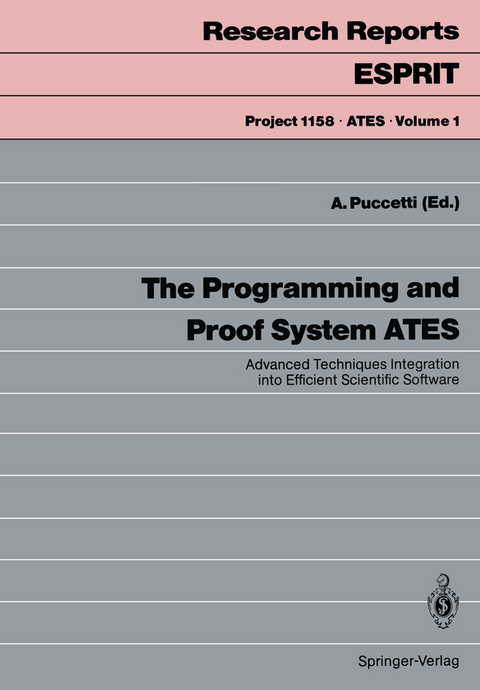
The Programming and Proof System ATES
Springer Berlin (Verlag)
978-3-540-54188-2 (ISBN)
1 Introduction.- 1.1 Abstract data types, Proof techniques.- 1.2 Motivation.- 1.3 Organization of the book.- 1.4 Acknowledgements.- 2 State of the Art.- 2.1 Abstract specification and programming languages.- 2.2 Proof systems.- 2.3 Conclusions.- 2.4 References.- 3 The Programming Language.- 3.1 General presentation.- 3.2 Types and operators.- 3.3 Constructions and algorithms.- 3.4 Structures and modules.- 3.5 Development with ATES.- 3.6 Advanced features.- 4 The Applications within the ATES Project.- 4.1 Introduction.- 4.2 The first application.- 4.3 The second application.- 4.4 Performance considerations.- 4.5 References.- 5 The Specification and Proof Language.- 5.1 Basic mathematical elements for proof.- 5.2 Axioms.- 5.3 Types and Operator specifications.- 5.4 Proof elements.- 6 Proving the Correctness of ATES Programs.- 6.1 Definition of the correctness.- 6.2 The interactive proof environment.- 6.3 Proving the verification conditions.- 6.4 Example: the 1D heat transfer problem.- 6.5 Conclusions.- 6.6 References.- 7 Extending the Techniques to Parallel Programs.- 7.1 Formal synthesis and verification of concurrent programs.- 7.2 Validation of the approach in the real-time area.- 7.3 References.- 8 Implementation Issues.- 8.1 Generalities.- 8.2 The ATES compiler.- 8.3 The ATES proof system.- 8.4 The ATES correctness proof system.- 8.5 References.- 9 Conclusion.- Appendix A. Formal Specification of the 1D Heat Transfer Problem.- Appendix B. Grammar of the ATES Specification Language.- Appendix C. Grammar of the ATES Source Language.
| Erscheint lt. Verlag | 24.7.1991 |
|---|---|
| Reihe/Serie | Project 1158. ATES | Research Reports Esprit |
| Co-Autor | D. Brocard, P. Gagert, P. Gribomont, O. Pirotte, A. Pucetti, J. Raguideau, A. Remouchamps, E. Ten Cate |
| Zusatzinfo | VIII, 341 p. 15 illus. |
| Verlagsort | Berlin |
| Sprache | englisch |
| Maße | 170 x 244 mm |
| Gewicht | 607 g |
| Themenwelt | Mathematik / Informatik ► Informatik ► Software Entwicklung |
| Schlagworte | Abstract Data Types • Abstrakte Datentypen • algorithms • Automatisches Beweisen • Datentyp • Design • Development • Finite Element Method • Formale Spezifikation • formal specification • Formal Specifications • language • Model • Modeling • programming • Programming language • Programmverifikation • Program verification • Semantics • Software • Software engineering • Software-Engineering • Software Engineering / Softwareentwicklung • Softwareentwicklung • theorem proving • verification |
| ISBN-10 | 3-540-54188-8 / 3540541888 |
| ISBN-13 | 978-3-540-54188-2 / 9783540541882 |
| Zustand | Neuware |
| Informationen gemäß Produktsicherheitsverordnung (GPSR) | |
| Haben Sie eine Frage zum Produkt? |
aus dem Bereich