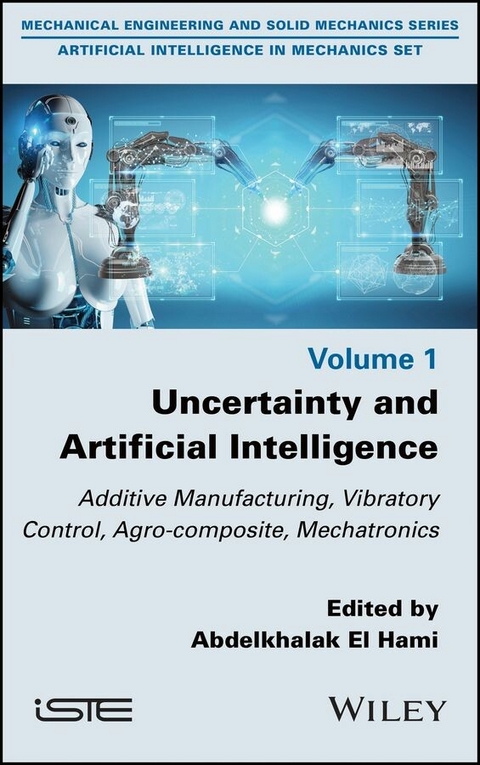
Uncertainty and Artificial Intelligence (eBook)
Today's information technology, along with Artificial Intelligence (AI), is moving towards total communication between all computerized systems. AI is a representation of human intelligence based on the creation and application of algorithms in specific computer environments. Its aim is to enable computers to act like human beings. For it to work, this type of technology requires computer systems, data with management systems and advanced algorithms, used by AI.
In mechanical engineering, AI can offer many possibilities: in mechanical construction, predictive maintenance, plant monitoring, robotics, additive manufacturing, materials, vibration control and agro composites, among many others.
This book is dedicated to Artificial Intelligence uncertainties in mechanical problems. Each chapter clearly sets out used and developed illustrative examples. Aimed at students, Uncertainty and Artificial Intelligence is also a valuable resource for practicing engineers and research lecturers.
Abdelkhalak El Hami is Full Professor at INSA-Rouen-Normandie, France. He is the author/co-author of over sixty books and is responsible for several European pedagogical projects. He is a specialist in the optimization, reliability and AI of multiphysical systems.
Today's information technology, along with Artificial Intelligence (AI), is moving towards total communication between all computerized systems. AI is a representation of human intelligence based on the creation and application of algorithms in specific computer environments. Its aim is to enable computers to act like human beings. For it to work, this type of technology requires computer systems, data with management systems and advanced algorithms, used by AI. In mechanical engineering, AI can offer many possibilities: in mechanical construction, predictive maintenance, plant monitoring, robotics, additive manufacturing, materials, vibration control and agro composites, among many others. This book is dedicated to Artificial Intelligence uncertainties in mechanical problems. Each chapter clearly sets out used and developed illustrative examples. Aimed at students, Uncertainty and Artificial Intelligence is also a valuable resource for practicing engineers and research lecturers.
Abdelkhalak El Hami is Full Professor at INSA-Rouen-Normandie, France. He is the author/co-author of over sixty books and is responsible for several European pedagogical projects. He is a specialist in the optimization, reliability and AI of multiphysical systems.
Preface ix
Abdelkhalak EL HAMI
Chapter 1 New Intelligence Method for Machine Tool Energy Consumption Estimation 1
Dorra BEN HASSEN, Anoire BEN JDIDIA, Mohamed TAOUFIK KHBOU, Mohamed Slim ABBES and Mohamed HADDAR
1.1 Introduction 1
1.2 Mathematical model for estimating power consumption by the spindle and table of a mill 3
1.3 ICA method 6
1.4 Results and discussion 11
1.5 Conclusion 15
1.6 References 15
Chapter 2 Uncertainty and Artificial Intelligence: Applications to Maintenance in Additive Manufacturing 19
Ghais KHARMANDA, Hicham BAAMMI and Abdelkhalak EL HAMI
2.1 Introduction 19
2.2 Integration of uncertainty 20
2.3 Uncertainty in artificial intelligence 21
2.4 Artificial intelligence in additive manufacturing 24
2.5 Predictive maintenance in additive manufacturing 27
2.6 Proposed strategy and applications 30
2.7 Conclusion 34
2.8 References 35
Chapter 3 Bio-Composite Structural Durability: Using Artificial Intelligence for Cluster Classification 39
Abel CHEROUAT
3.1 Introduction 40
3.2 The state of acoustic emission technology 43
3.3 The concept behind classification 54
3.4 Application to the classification of damage mechanisms in agro-composites 62
3.5 Artificial neural networks for classifying damage 76
3.6 Conclusion 89
3.7 References 90
Chapter 4 Intelligent Control for Attenuating Vertical Vibrations in Vehicles 97
Maroua HADDAR, Fakher CHAARI and Mohamed HADDAR
4.1 Introduction 97
4.2 Limits of passive and semi-active control strategies 99
4.3 Model-free control (MFC) 100
4.4 Application to the control of vertical vehicular vibrations 105
4.5 Conclusion 115
4.6 References 115
Chapter 5 Optimization of the Power Inductor of a DC/DC Converter 119
Abdelhamid AMAR, Bouchaïb RADI and Abdelkhalak EL HAMI
5.1 Introduction 119
5.2 Description of the power inductor 121
5.3 Thermomechanical modeling of the power inductor 121
5.4 Optimization methods 126
5.5 Optimization of the power inductor 131
5.6 Conclusion 134
5.7 References 135
Chapter 6 Study of the Influence of Noise and Speed on the Robustness of Independent Component Analysis in the Presence of Uncertainty 137
Dorra BEN HASSEN, Anoire BEN JDIDIA, Mohamed Slim ABBES, Fakher CHAARI and Mohamed HADDAR
6.1 Introduction 137
6.2 The model studied 139
6.3 Construction of the road surface profile 141
6.4 The principle of the ICA method 142
6.5 Monte Carlo technique 145
6.6 Results and discussion 145
6.7 Conclusion 154
6.8 References 154
Chapter 7 Multi-Objective Optimization Applied to a High Electron Mobility Transistor 157
Rabii EL MAANI, Abdelhamid AMAR, Bouchaïb RADI and Abdelkhalak EL HAMI
7.1 Introduction 157
7.2 Description of HEMT technology 159
7.3 Multi-physical modeling of the HEMT 160
7.4 The multi-objective optimization approach 165
7.5 Multi-objective optimization applied to HEMT technology 168
7.6 Conclusion 170
7.7 References 171
List of Authors 173
Index 175
1
New Intelligence Method for Machine Tool Energy Consumption Estimation
1.1. Introduction
Modern life has led us to consume high levels of electric energy, which is required for our needs. Research has demonstrated that the role of industry in worldwide energy consumption will rise from 3,000 Mtoe in 2010 to 5,000 Mtoe in 2050. This increase is associated with high emissions from the greenhouse effect, which has a negative impact on the environment. This is why eco-production has become increasingly necessary: to limit the high consumption of energy by industry. To do this, researchers have used tools for estimating energy consumed by machine tools. This chapter applies an artificial intelligence method, called independent component analysis (ICA), to evaluate the power consumed during a peripheral milling operation.
Our life is dominated by new technologies that have led to a heightened consumption of electrical energy. For example, in the United States, 31% of all energy is consumed by industry. 90% of this consumption goes to manufacturing, of which 70% is used by machine tools (Zhou et al. 2016). From there, atmospheric CO2 emissions are caused by the energy consumption of the manufacturing industry. According to Herzog (2009), 99% of environmental problems are caused by the consumption of energy in manufacturing processes. The harmful effects are enormous, and the research by Herzog (2009) has indeed shown that manufacturing operations are responsible for 19% of these emissions. This is why the optimization of energy consumption by machine tools is urgent for protecting the environment. In order to minimize this consumption, various studies have relied on modeling the energy consumed by machine tools, especially during cutting operations. Let us cite the model created by Rajemi et al. (2010) as an example, which allows for the quantification of the required energy by turning operations. This model accounts for the lifetime of a tool. We also note the model proposed by Avram and Xirouchakis (2011) for quantifying the power consumed by the spindle and the table of a mill while cutting. They calculate the energy of the spindle by multiplying the force of the cut by the speed of the cut. The energy of the table, meanwhile, is calculated using the product of the cutting torque and the angular speed. The Kara and Li (2011) model was based on the material removal rate (MRR). Another model was established by Calvanese et al. (2013), which presented the energy of an axis feed. It is equal to the product of the effort made in cutting and the cutting speed. To obtain this effort, the average value of the width of the shaving must be determined. Taking this model as a basis, an improvement was presented by Alberteli et al. (2016). They make use of the constant angular position of the cutting tool. Other recent work has been published in the literature by Ben Jdidia et al. (2019b). This work aims to estimate the dynamic cutting energy consumed by the spindle and the table of a mill for resurfacing operations. To estimate the effort involved in cutting, the authors apply the method of finite elements, which is a complex method.
Therefore, this chapter aims to estimate the energy consumed by a mill by applying a new method, namely ICA. This method is a major technique for blindly separating sources. It is based on inverse problems and is a simple method whose robustness has been demonstrated in numerous fields. For example, Ben Hassen et al. (2019) and Chaabane et al. (2019) use this method in estimating road surfaces, using knowledge related to vehicular vibration. Taktak et al. (2012) demonstrate the efficiency of this method in identifying the defects associated with a gear system. It only requires the knowledge of the dynamic response, such as accelerations, for estimating the responses. This is the inverse method.
1.2. Mathematical model for estimating power consumption by the spindle and table of a mill
Figure 1.1 describes the machine tool studied (a mill) during a peripheral cutting operation. Two principal efforts are studied, the tangential component of the cutting effort Ft(t) applied to the spindle and the effort made in advancing Fx(t), applied to the table. These two efforts are considered dynamic. Indeed, one tooth, denoted i, that removes material has a momentary angular position called Φi(t). A shaving whose width varies over time is generated. This width is formed by two components: one static, caused by the rigid body, and one dynamic, caused by the motion of the tool at time t and t-τ:
where Ω is the speed of the spindle rotation in–rpm, ϕp is the angle between two successive teeth and ψ is the cutting angle.
Figure 1.1. Cutting system of a machine tool: a mill
The power consumed by the spindle and the table during the machining operation is given by the following two equations:
where:
- – Vc represents the cutting speed in m/min;
- – Vf represents the feed speed in mm/min.
Figure 1.2 shows the distribution of cutting efforts during a circular machining operation (Romdhane 2017).
Figure 1.2. Distribution of the cutting effort for a circular machining operation
The projection of the differential cutting effort gives the following results:
where dFx,i, dFr,i and dFt,i are, respectively, the efforts of advancement, radial and tangential differentials, kr is the specific radial pressure of cutting, kt is the specific tangential pressure of cutting, ap is the depth of the cut in mm and h(t) designates the variable width of the shavings as a function of time, which is determined using the following equation:
We note that:
- – ux(t) and uy(t) represent the displacement of the tool at time t;
- – ux(t-τ) and uy(t-τ) represent the displacement at time t-τ.
The total cutting effort exerted by all of the teeth over the machined object can be written as follows:
where:
- – N represents the number of teeth;
- – Nf is the number of cutting elements.
It is very clear from the previous equations that the determination of the cutting effort is essential for quantifying the two types of power. To do this, the artificial intelligence method ICA is applied to estimate the variable tangential and cutting efforts.
1.3. ICA method
ICA is an important method for the blind separation of sources. It makes it possible to decompose a random signal X(t), in this case the motion of the nodes, into a combination of statistically independent components that are the estimated cutting efforts (Abbes et al. 2011). The vector of observed signals can be written as (Hassen et al. 2019):
where A is the mixing matrix and S represents the source signals.
The stages of application in ICA are provided in detail below.
1.3.1. Pretreatment of signals
The vector X(t) of observed signals undergoes pretreatments, namely centering and whitening, in order to make ICA evaluation easier.
1.3.1.1. Centering
Centering consists of subtracting from vector X its average vector m=E{X} so that its average becomes zero and then S can also have an average of zero.
1.3.1.2. Whitening
The second pretreatment in ICA is the whitening of observed variables. This technique makes it possible to eliminate the noise of a signal. This vector has a matrix with unit covariance. We then get:
So, to whiten a signal X, we calculate its covariance matrix as follows:
where:
- – U is the orthogonal matrix of the eigenvectors of matrix RX;
- – D is the diagonal matrix of its eigenvectors of matrix RX.
We thus get:
We then determine the whitening matrix as follows:
1.3.2. Separation
After undergoing the pretreatment, the vector for observed signals X(t) is used as a point of entry to ICA in order to separate the sources using the following steps.
1.3.2.1. Maximization of the kurtosis function
Kurtosis is a tool that finds non-Gaussian components and their place in the field of frequency. It is defined as the normalized marginal fourth-order cumulant (Achard 2003; Zarzoso and Comon 2008):
We can see that this criterion is indifferent to the scale factor, in other words: K(λw) = K( w) for λ ≠ 0.
Since the scale is generally unimportant, we can apply normalization. ∥W∥=1.
To maximize the kurtosis, we...
| Erscheint lt. Verlag | 28.11.2023 |
|---|---|
| Sprache | englisch |
| Themenwelt | Mathematik / Informatik ► Informatik ► Theorie / Studium |
| Schlagworte | Additive Manufacturing • Advanced Algorithms • agro composites • AI • Artificial Intelligence • Component Manufacturing • Computer Science • Data Management • Electrical & Electronics Engineering • Elektrotechnik u. Elektronik • Human Intelligence • Industrial Engineering • Industrial Engineering / Manufacturing • Industrielle Verfahrenstechnik • Informatik • Komponentenfertigung • Künstliche Intelligenz • mechanical construction • mechanical engineering • Plant monitoring • Predictive Maintenance • Produktion i. d. Industriellen Verfahrenstechnik • Robotics • Uncertainty • Vibration Control |
| ISBN-13 | 9781394255344 / 9781394255344 |
| Informationen gemäß Produktsicherheitsverordnung (GPSR) | |
| Haben Sie eine Frage zum Produkt? |
 EPUB (Adobe DRM)
Kopierschutz: Adobe-DRM
Adobe-DRM ist ein Kopierschutz, der das eBook vor Mißbrauch schützen soll. Dabei wird das eBook bereits beim Download auf Ihre persönliche Adobe-ID autorisiert. Lesen können Sie das eBook dann nur auf den Geräten, welche ebenfalls auf Ihre Adobe-ID registriert sind.
Details zum Adobe-DRM
Dateiformat: EPUB (Electronic Publication)
EPUB ist ein offener Standard für eBooks und eignet sich besonders zur Darstellung von Belletristik und Sachbüchern. Der Fließtext wird dynamisch an die Display- und Schriftgröße angepasst. Auch für mobile Lesegeräte ist EPUB daher gut geeignet.
Systemvoraussetzungen:
PC/Mac: Mit einem PC oder Mac können Sie dieses eBook lesen. Sie benötigen eine
eReader: Dieses eBook kann mit (fast) allen eBook-Readern gelesen werden. Mit dem amazon-Kindle ist es aber nicht kompatibel.
Smartphone/Tablet: Egal ob Apple oder Android, dieses eBook können Sie lesen. Sie benötigen eine
Geräteliste und zusätzliche Hinweise
Buying eBooks from abroad
For tax law reasons we can sell eBooks just within Germany and Switzerland. Regrettably we cannot fulfill eBook-orders from other countries.
aus dem Bereich