


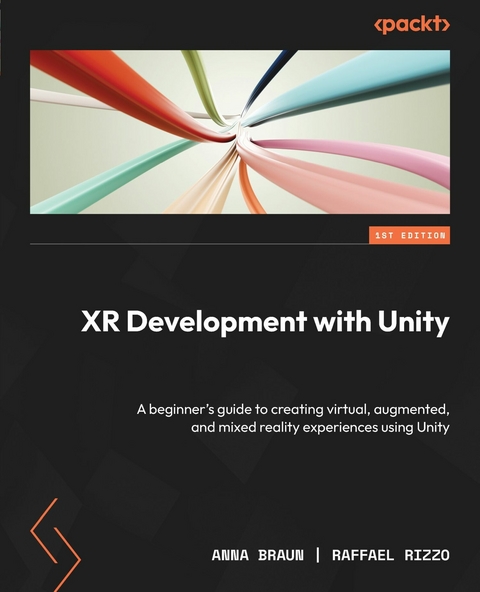
XR Development with Unity (eBook)
284 Seiten
Packt Publishing (Verlag)
9781805120049 (ISBN)
The drastic surge in the demand for XR development has led to an imminent need for comprehensive resources, learning material, and overall know-how in this area. This one-stop resource will ensure that professionals venturing into XR development can access all XR-related techniques to build appealing XR applications, without relying on Google every step of the way.
This book is your guide to developing XR applications with Unity 2021.3 or later versions, helping you to create VR, AR, and MR experiences of increasing complexity. The chapters cover the entire XR application development process from setting up an interactive XR scene using the XR Interaction Toolkit or AR Foundation, adding physics, animations, continuous movement, teleportation, sound effects, and visual effects, to testing and deploying to VR headsets, simulators, smartphones, and tablets. Additionally, this XR book takes you on a journey from the basics of Unity and C# to advanced techniques such as building multiplayer applications and incorporating hand- and gaze-tracking capabilities.
By the end of this book, you'll be fully equipped to create cutting-edge XR projects for engaging individual, academic, and industrial use cases that captivate your audience.
Create VR, AR, and MR experiences with the help of step-by-step tutorials on VR and AR simulators, interactivity, sound and visual effects, along with advanced XR techniques such as multiplayer integrationKey FeaturesCreate impressive XR projects without the need to own expensive VR headsetsExplore Unity XR features and techniques such as hand-tracking and plane detection using the XR Interaction Toolkit and AR FoundationBring your XR projects to life with step-by-step explanations along with practical examplesPurchase of the print or Kindle book includes a free PDF eBookBook DescriptionThe drastic surge in the demand for XR development has led to an imminent need for comprehensive resources, learning material, and overall know-how in this area. This one-stop resource will ensure that professionals venturing into XR development can access all XR-related techniques to build appealing XR applications, without relying on Google every step of the way. This book is your guide to developing XR applications with Unity 2021.3 or later versions, helping you to create VR, AR, and MR experiences of increasing complexity. The chapters cover the entire XR application development process from setting up an interactive XR scene using the XR Interaction Toolkit or AR Foundation, adding physics, animations, continuous movement, teleportation, sound effects, and visual effects, to testing and deploying to VR headsets, simulators, smartphones, and tablets. Additionally, this XR book takes you on a journey from the basics of Unity and C# to advanced techniques such as building multiplayer applications and incorporating hand- and gaze-tracking capabilities. By the end of this book, you'll be fully equipped to create cutting-edge XR projects for engaging individual, academic, and industrial use cases that captivate your audience.What you will learnGet started with Unity by building your own 3D projectExplore the XR Interaction Toolkit and AR Foundation, as well as test XR applications on your PCFind out how to deploy XR projects on different platformsBuild interactive XR apps with increasing degrees of complexity by leveraging C# scriptingCreate a fully immersive VR drum scene by using Unity's audio and particle systemsAdd advanced XR techniques such as hand-tracking, gaze-tracking, and multiplayer capabilities to your XR appsWho this book is forThis book is for students, developers, researchers, and professionals with a background in computer science. Business analysts, PMs, and other management professionals and executives will also benefit from this book. If you have basic knowledge of programming and are looking to gain expertise in creating virtual reality and augmented reality applications in Unity, then this book is for you. While having experience as a VR game player with basic programming knowledge can enhance your understanding of the content, it is not a prerequisite.]]>
Preface
Hi there, and welcome to the exciting and ever-evolving world of Extended Reality (XR) development! If you’re feeling a mix of excitement and nervousness about diving into XR development in Unity for the first time, you’re not alone.
But don’t worry – the primary goal of this book is to make XR development accessible to everyone, regardless of prior experience. We’ll use simple language, provide vivid examples, and guide you through every step, from making objects grabbable to writing scripts in C# and incorporating hand-tracking into your scenes. You won’t even need access to a VR headset or AR-compatible smartphone to follow along; you can test most of the projects using simulators on your laptop or PC, ensuring accessibility for all.
In our own XR development journey, we’ve faced the frustration of spending endless hours trying to make a basic XR experience work. Now that we’ve gained extensive experience at notable companies such as Deutsche Telekom and academic institutions such as Fraunhofer IGD, we want to share our knowledge with you.
This book is not only a complete guide that will take you from being a novice in XR development or Unity to reaching an intermediate level in creating interactive XR applications for any domain. Its structure is also designed to help you easily access XR-related techniques to build outstanding XR applications, so you won’t need to constantly search online for answers, as we once did. Our goal is not to narrow your XR development expertise to specific use cases but to equip you with a wide array of tools so that you can bring any XR project to life, without limitations.
We’re thrilled to start on this journey with you!
Who this book is for
If you’re a student, professional, or just curious about venturing into VR, MR, or AR, this book is tailored for you. Whether you’re familiar with interactive media or just beginning, we will guide you through building XR applications in Unity with ease. No Unity experience? No problem. We cover the essentials, equipping you to develop interactive VR, MR, and AR projects.
What this book covers
Chapter 1, Introduction to XR and Unity, serves as a general introduction to the topic of XR development in Unity. This chapter explains which approaches exist to bring VR, MR, and AR to life. Furthermore, Unity’s role in XR development is introduced. The main goal of this chapter is to provide a good baseline to start learning how to build XR applications.
Chapter 2, The Unity Editor and Scene Creation, is aimed at those unfamiliar with Unity. It explains how to install Unity Hub and the Unity Editor and provides a step-by-step guide on how to create a basic scene in Unity. This chapter introduces fundamental concepts, from lighting and rendering to importing assets from the Unity Asset Store, equipping you with everything you need to know about the Unity Engine before diving into XR development.
Chapter 3, VR Development in Unity, presents the capabilities and components of the XR Interaction Toolkit and how to add it to a VR scene. After exploring the different types of interactions, from grabbing to climbing, this chapter explains how to test and deploy VR scenes to VR headsets or simulators, such as the XR Device Simulator.
Chapter 4, AR Development in Unity, explains how to create AR experiences in Unity using AR Foundation, ARKit, and ARCore. After building your first, simple AR application, this chapter focuses on testing this application directly on a PC, using XR simulation, and deploying it to Android and iOS devices.
Chapter 5, Building Interactive VR Experiences, explains how to add interactivity to a scene via animations, buttons events, or the programming language C#. Although this chapter teaches intermediate-level concepts, it is beginner-friendly and doesn’t require any preexisting knowledge of C#.
Chapter 6, Building Interactive AR Experiences, details how to create an interactive AR application, via touch controls and UI elements. Using the programming language C#, this chapter showcases how to build an AR experience that aligns with state-of-the-art design patterns and the core components of commercial AR applications.
Chapter 7, Adding Sound and Visual Effects, covers how to make XR scenes more immersive and realistic by mimicking physical phenomena from real life. This chapter explains the foundation of sound theory and particle behavior and highlights how both of these physical phenomena can be simulated in an XR environment with Unity. Through a hands-on project, this chapter explains how to add audio sources, audio mixers, and a particle system to an XR scene and how to fine-tune their properties, making them as realistic as possible.
Chapter 8, Building Advanced XR Techniques, introduces advanced XR techniques, elevating the overall user experience and immersion of any XR application. Specifically, this chapter details how to add hand-tracking or gaze-tracking support to VR applications via the XR Interaction Toolkit and explains how to build multiplayer experiences, where users can see each other via simple avatars and hand animations.
Chapter 9, Best Practices and Future Trends in XR Development, explores the current and future trends in XR technology. It provides insights into XR research and XR companies of various industries and introduces best practices along the entire XR development life cycle. To conclude this book, this chapter introduces additional toolkits and plugins for XR development. These resources are ideal for further exploration in future XR projects beyond what was covered in this book.
To get the most out of this book
If you don’t yet have Unity installed on your PC or laptop, don’t worry – we will guide you through this process in Chapter 2.
| Software/hardware covered in the book | Operating system requirements |
| Unity version 2021.3.4 or later | Windows, macOS, or Linux |
As you venture into creating immersive virtual, augmented, and mixed reality experiences, it’s crucial to set the foundation right. This starts by cloning the project repository using Git LFS. Even if you plan to build all projects from the ground up, it’s highly recommended to clone the entire repository. There will undoubtedly be sections where cross-referencing your progress with the actual solution will prove beneficial.
Attention
Do not simply download the repository in a ZIP format. Doing so will most likely result in errors upon opening. The correct approach is to clone it using Git LFS.
When working on virtual, augmented, and mixed reality projects in Unity, it’s common to handle large files – think 3D models, textures, audio clips, and more. Simply downloading a project might seem like a straightforward approach, but you may run into issues. The reason is rooted in how GitHub (and many other platforms) handle large files.
Let’s illustrate this with a simple analogy. Imagine you have a vast library of books. Instead of storing all these books at your home, which would take up enormous space, you get a reference card for each book. Whenever you want to read a particular book, you present the card at the library, and they provide the book for you.
Git LFS, which stands for Git Large File Storage, operates on a similar principle. Instead of saving bulky files directly within the repository, Git LFS maintains a tiny reference or “pointer.” The actual hefty files are stored elsewhere. Consequently, when you directly download a project without employing LFS, you only obtain these pointers, not the genuine files. To secure the entire content, you must clone the project with Git LFS.
The installation process for Git LFS and cloning our repository is very straightforward. Here’s a step-by-step guide:
- Install Git: If you have Windows, download Git from the Git for Windows website (https://gitforwindows.org/), and follow the installation instructions. For macOS, you can either download Git from the official website (https://git-scm.com/download/mac) or simply use brew install git in your Terminal if you have Homebrew. For Linux, use your package manager, such as sudo apt-get install git for Debian-based distributions.
- Setting up Git: Open your Terminal or Command Prompt. Configure your username with git config --global user.name "Your Name". Configure your email with git config --global user.email...
| Erscheint lt. Verlag | 30.11.2023 |
|---|---|
| Sprache | englisch |
| Themenwelt | Mathematik / Informatik ► Informatik ► Grafik / Design |
| Mathematik / Informatik ► Informatik ► Programmiersprachen / -werkzeuge | |
| Informatik ► Software Entwicklung ► Mobile- / App-Entwicklung | |
| Informatik ► Software Entwicklung ► Spieleprogrammierung | |
| Mathematik / Informatik ► Informatik ► Theorie / Studium | |
| Informatik ► Weitere Themen ► Smartphones / Tablets | |
| ISBN-13 | 9781805120049 / 9781805120049 |
| Informationen gemäß Produktsicherheitsverordnung (GPSR) | |
| Haben Sie eine Frage zum Produkt? |
 EPUB (Ohne DRM)
Digital Rights Management: ohne DRM
Dieses eBook enthält kein DRM oder Kopierschutz. Eine Weitergabe an Dritte ist jedoch rechtlich nicht zulässig, weil Sie beim Kauf nur die Rechte an der persönlichen Nutzung erwerben.
Dateiformat: EPUB (Electronic Publication)
EPUB ist ein offener Standard für eBooks und eignet sich besonders zur Darstellung von Belletristik und Sachbüchern. Der Fließtext wird dynamisch an die Display- und Schriftgröße angepasst. Auch für mobile Lesegeräte ist EPUB daher gut geeignet.
Systemvoraussetzungen:
PC/Mac: Mit einem PC oder Mac können Sie dieses eBook lesen. Sie benötigen dafür die kostenlose Software Adobe Digital Editions.
eReader: Dieses eBook kann mit (fast) allen eBook-Readern gelesen werden. Mit dem amazon-Kindle ist es aber nicht kompatibel.
Smartphone/Tablet: Egal ob Apple oder Android, dieses eBook können Sie lesen. Sie benötigen dafür eine kostenlose App.
Geräteliste und zusätzliche Hinweise
Buying eBooks from abroad
For tax law reasons we can sell eBooks just within Germany and Switzerland. Regrettably we cannot fulfill eBook-orders from other countries.
aus dem Bereich


