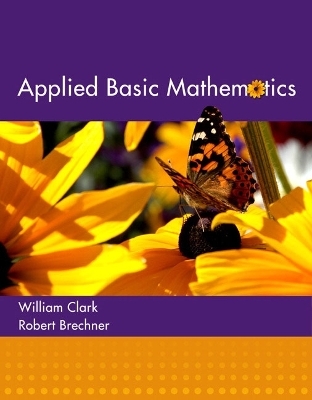
Applied Basic Mathematics
Pearson (Verlag)
978-0-321-19407-7 (ISBN)
- Titel erscheint in neuer Auflage
- Artikel merken
The Clark/Brechner structure encourages students to reinforce and review what they learn with Try-It Exercises that follow each Example and Solution Strategy, thorough exercise sets that include unique Guide Problems, and a comprehensive chapter summary called the Ten Minute Chapter Review. The structure of this book constantly relates the math to students' everyday lives by incorporating several application-driven features throughout the text and by including an Apply Your Knowledge learning objective in each section of the text.
Bill Clark presently teaches at Harper College in the Chicago area. Prior to his current position, he was a professor at Miami Dade College. An engaging and dynamic teacher, he has initiated a number of programs to serve diverse student populations. He was instrumental in the implementation of Miami Dade’s Title V Calculus program. He has also developed and implemented a multi-cultural infusion project and a number of learning communities. In his leisure time, Bill enjoys travel and long walks with his dog. Bob Brechner has taught at Miami Dade College for the past 41 years. He currently holds the position of Professor Emeritus. Over the years, he has been Adjunct Professor at Florida International University School, Florida Atlantic University, and the International Fine Arts College. Brechner holds a BS in Industrial Management from the Georgia Institute of Technology in Atlanta, Georgia and an MBA from Emory University in Atlanta. His other publications include Contemporary Mathematics for Business and Consumers, A Little Math with Your Business, and Guidelines for the New Manager. Bob lives in Coconut Grove, Florida, with his wife, Shari Joy. His passions include travel, photography, tennis, running and boating.
1. Whole Numbers
1.1 Understanding the Basics of Whole Numbers
1.2 Adding Whole Numbers
1.3 Subtracting Whole Numbers
1.4 Multiplying Whole Numbers
1.5 Dividing Whole Numbers
1.6 Evaluating Exponential Expressions and Applying Order of Operations
1.7 Solving Application Problems
2. Fractions
2.1 Factors, Prime Factorizations, and Least Common Multiples
2.2 Introduction to Fractions and Mixed Numbers
2.3 Equivalent Fractions
2.4 Multiplying Fractions and Mixed Numbers
2.5 Dividing Fractions and Mixed Numbers
2.6 Adding Fractions and Mixed Numbers
2.7 Subtracting Fractions and Mixed Numbers
3. Decimals
3.1 Understanding Decimals
3.2 Adding and Subtracting Decimals
3.3 Multiplying Decimals
3.4 Dividing Decimals
3.5 Working with Fractions and Decimals
4. Ratio and Proportion
4.1 Understanding Ratios
4.2 Working with Rates and Units
4.3 Understanding and Solving Proportions
5. Percents
5.1 Introduction to Percents
5.2 Solve Percent Problems Using Equations
5.3 Solve Percent Problems Using Proportions
5.4 Solve Percent Application Problems
6. Measurement
6.1 The U.S. Customary System
6.2 Denominate Numbers
6.3 The Metric System
6.4 Converting between the U.S. System and the Metric System
6.5 Time and Temperature
7. Geometry
7.1 Lines and Angles
7.2 Plane and Solid Geometric Figures
7.3 Perimeter and Circumference
7.4 Area
7.5 Square Roots and the Pythagorean Theorem
7.6 Volume
8. Statistics
8.1 Data Presentation — Tables and Graphs
8.2 Mean, Median, Mode, and Range
9. Signed Numbers
9.1 Introduction to Signed Numbers
9.2 Adding Signed Numbers
9.3 Subtracting Signed Numbers
9.4 Multiplying and Dividing Signed Numbers
9.5 Signed Numbers and Order of Operations
10. Introduction to Algebra
10.1 Algebraic Expressions
10.2 Solving and Equation Using the Addition Property of Equality
10.3 Solving an Equation Using the Multiplication Property of Equality
10.4 Solving an Equation Using the Addition and Multiplication Properties
10.5 Solving Application Problems
Glossary
Appendixes
A. Try-It Exercise Solutions
B. Answers to Selected Exercises
C. Math Study Skills
D. Table of Squares and Square Roots
Index
| Erscheint lt. Verlag | 13.2.2008 |
|---|---|
| Sprache | englisch |
| Maße | 276 x 216 mm |
| Gewicht | 1694 g |
| Themenwelt | Mathematik / Informatik ► Mathematik |
| ISBN-10 | 0-321-19407-1 / 0321194071 |
| ISBN-13 | 978-0-321-19407-7 / 9780321194077 |
| Zustand | Neuware |
| Informationen gemäß Produktsicherheitsverordnung (GPSR) | |
| Haben Sie eine Frage zum Produkt? |
aus dem Bereich