


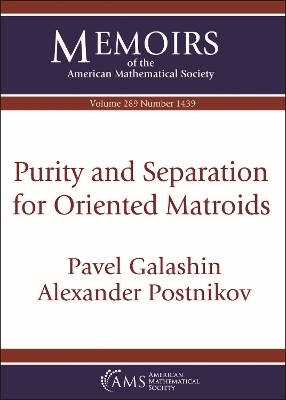
Purity and Separation for Oriented Matroids
Seiten
2023
American Mathematical Society (Verlag)
978-1-4704-6700-5 (ISBN)
American Mathematical Society (Verlag)
978-1-4704-6700-5 (ISBN)
- Titel z.Zt. nicht lieferbar
- Versandkostenfrei
- Auch auf Rechnung
- Artikel merken
We extend the notions of strongly separated and weakly separated collections introduced by Leclerc and Zelevinsky and define M-separated collections for any oriented matroid M. We show that maximal by size M-separated collections are in bijection with fine zonotopal tilings, or with one-element liftings of M in general position.
Leclerc and Zelevinsky, motivated by the study of quasi-commuting quantum flag minors, introduced the notions of strongly separated and weakly separated collections. These notions are closely related to the theory of cluster algebras, to the combinatorics of the double Bruhat cells, and to the totally positive Grassmannian.
A key feature, called the purity phenomenon, is that every maximal by inclusion strongly (resp., weakly) separated collection of subsets in [n] has the same cardinality.
In this paper, we extend these notions and define M-separated collections for any oriented matroid M.
We show that maximal by size M-separated collections are in bijection with fine zonotopal tilings (if M is a realizable oriented matroid), or with one-element liftings of M in general position (for an arbitrary oriented matroid).
We introduce the class of pure oriented matroids for which the purity phenomenon holds: an oriented matroid M is pure if M-separated collections form a pure simplicial complex, i.e., any maximal by inclusion M-separated collection is also maximal by size.
We pay closer attention to several special classes of oriented matroids: oriented matroids of rank 3, graphical oriented matroids, and uniform oriented matroids. We classify pure oriented matroids in these cases. An oriented matroid of rank 3 is pure if and only if it is a positroid (up to reorienting and relabeling its ground set). A graphical oriented matroid is pure if and only if its underlying graph is an outerplanar graph, that is, a subgraph of a triangulation of an n-gon.
We give a simple conjectural characterization of pure oriented matroids by forbidden minors and prove it for the above classes of matroids (rank 3, graphical, uniform).
Leclerc and Zelevinsky, motivated by the study of quasi-commuting quantum flag minors, introduced the notions of strongly separated and weakly separated collections. These notions are closely related to the theory of cluster algebras, to the combinatorics of the double Bruhat cells, and to the totally positive Grassmannian.
A key feature, called the purity phenomenon, is that every maximal by inclusion strongly (resp., weakly) separated collection of subsets in [n] has the same cardinality.
In this paper, we extend these notions and define M-separated collections for any oriented matroid M.
We show that maximal by size M-separated collections are in bijection with fine zonotopal tilings (if M is a realizable oriented matroid), or with one-element liftings of M in general position (for an arbitrary oriented matroid).
We introduce the class of pure oriented matroids for which the purity phenomenon holds: an oriented matroid M is pure if M-separated collections form a pure simplicial complex, i.e., any maximal by inclusion M-separated collection is also maximal by size.
We pay closer attention to several special classes of oriented matroids: oriented matroids of rank 3, graphical oriented matroids, and uniform oriented matroids. We classify pure oriented matroids in these cases. An oriented matroid of rank 3 is pure if and only if it is a positroid (up to reorienting and relabeling its ground set). A graphical oriented matroid is pure if and only if its underlying graph is an outerplanar graph, that is, a subgraph of a triangulation of an n-gon.
We give a simple conjectural characterization of pure oriented matroids by forbidden minors and prove it for the above classes of matroids (rank 3, graphical, uniform).
Pavel Galashin, University of California, Los Angeles, California, and Massachusetts Institute of Technology, Cambridge, Massachusetts. Alexander Postnikov, Massachusetts Institute of Technology, Cambridge, Massachusetts.
| Erscheinungsdatum | 14.11.2023 |
|---|---|
| Reihe/Serie | Memoirs of the American Mathematical Society |
| Verlagsort | Providence |
| Sprache | englisch |
| Maße | 178 x 254 mm |
| Themenwelt | Mathematik / Informatik ► Mathematik ► Geometrie / Topologie |
| ISBN-10 | 1-4704-6700-3 / 1470467003 |
| ISBN-13 | 978-1-4704-6700-5 / 9781470467005 |
| Zustand | Neuware |
| Informationen gemäß Produktsicherheitsverordnung (GPSR) | |
| Haben Sie eine Frage zum Produkt? |
Mehr entdecken
aus dem Bereich

aus dem Bereich
Gekrümmte Kurven und Flächen
Buch | Softcover (2024)
De Gruyter (Verlag)
CHF 76,90
a history of modern trigonometry
Buch | Softcover (2025)
Princeton University Press (Verlag)
CHF 34,90


