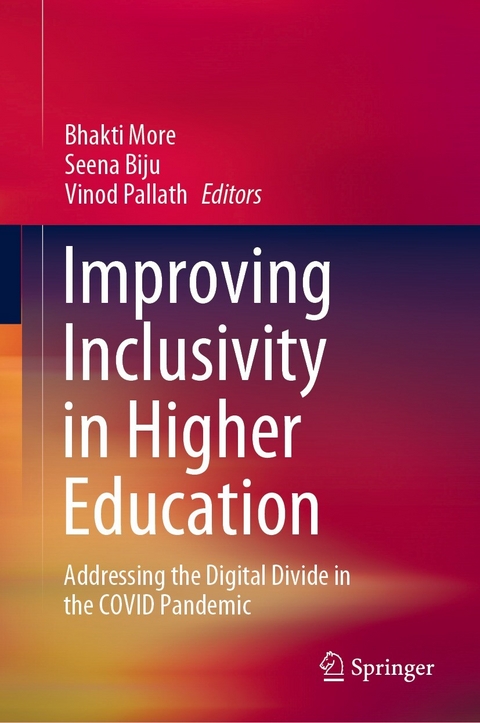
Improving Inclusivity in Higher Education (eBook)
223 Seiten
Springer Nature Singapore (Verlag)
978-981-99-5076-8 (ISBN)
?Bhakti More is a Chairperson and an Associate Professor at School of Design & Architecture, Manipal Academy of Higher Education Dubai Campus, United Arab Emirates. She has pursued Doctoral studies from School of Built Environment, University of Salford, Manchester, United Kingdom. She has over two decades of experience in teaching and as project architect in the design industry in India and United Arab Emirates. Her area of specialization is in Urban Sociology, Environmental Sustainability and Housing.
Seena Biju was Professor and Associate Director, Department of Humanities and Social Sciences at the Sikkim Manipal University, India. She had been Dean for School of Management and Business at the Manipal International University, Malaysia. She was a Professor from the domains of Statistics & Operations and has about 24 years of experience in teaching Data Analytics, Quality Management and Six Sigma, Probability & Statistics, Operations Research, Research Methodology, Quantitative Techniques, Decision Theory and related topics to students of the Post Graduate & Under-Graduate programs of various disciplines. A postgraduate in Applied Statistics (MSc) and Business Administration - Operations (MBA), she was a Lean Six Sigma Black Belt Certified and an alumnus of the Indian Statistical Institute India. Her key areas of research were Statistical modelling, Six sigma Theory and Academic Quality Measurement & Assurance.
Vinod Pallath is Associate Professor at Medical Education Research and Development Unit (MERDU), Faculty of Medicine, University of Malaya (UM), Kuala Lumpur, Malaysia. He leads faculty development at Faculty of Medicine, University of Malaya. His research currently focuses on Faculty Development, Professionalism, Leadership and management and Student support in medical education. As a trained Medical Microbiologist, he also teaches and does research in bacterial virulence and currently focuses his research on survival strategies in uropathogens.
This book addresses issues of access that COVID-19 brought forth in higher education, with a primary focus on Asian countries. In looking to address SDG4 to promote "e;inclusive and equitable quality education for all"e;, the volume explores the challenges relating to educational exclusion by considering how specially-abled students have been impacted by the digital divide in the context of the pandemic. It puts a spotlight on the approaches, experiences, and case analyses from various geographies in the region to study transitions in inclusivity. Universities and institutes of higher education have had to reconsider their digital offerings and services all the more since the onset of the pandemic, but have, in many instances, failed to fully account for how Internet access can be limited, unavailable, or unaffordable for many students. As a result, specially-abled learners - students without sufficient technological resources, such as those living in remote areas where there are little or no Internet facilities - have been, however unintentionally, neglected. While universities implemented their own practices, processes and policies to reach, and teach, disadvantaged learners, they had to further adapt these strategies, re-aligning them to meet the unprecedented circumstances, and concomitant needs, of specially-abled learners - and there is still much more to do. This book consolidates regional perspectives on how to work towards goals of inclusivity, and bridge the digital divide, looking into, and beyond, the conditions of the pandemic. Relevant to scholars and policymakers, this book is of interest to those focused on digitisation and the transition to the 'new normal' in higher education.
| Erscheint lt. Verlag | 6.11.2023 |
|---|---|
| Zusatzinfo | XXVII, 223 p. 67 illus., 59 illus. in color. |
| Sprache | englisch |
| Themenwelt | Mathematik / Informatik ► Informatik |
| Sozialwissenschaften ► Kommunikation / Medien ► Medienwissenschaft | |
| Sozialwissenschaften ► Pädagogik ► Didaktik | |
| Sozialwissenschaften ► Pädagogik ► Erwachsenenbildung | |
| Sozialwissenschaften ► Pädagogik ► Sonder-, Heil- und Förderpädagogik | |
| Sozialwissenschaften ► Politik / Verwaltung | |
| Schlagworte | assistive technologies • competency building • Digital Divide • higher education • Inclusive Education • Learning environment • remote learning • Specially abled Learners • universal design for learning |
| ISBN-10 | 981-99-5076-7 / 9819950767 |
| ISBN-13 | 978-981-99-5076-8 / 9789819950768 |
| Informationen gemäß Produktsicherheitsverordnung (GPSR) | |
| Haben Sie eine Frage zum Produkt? |
 PDF (Wasserzeichen)
DRM: Digitales Wasserzeichen
Dieses eBook enthält ein digitales Wasserzeichen und ist damit für Sie personalisiert. Bei einer missbräuchlichen Weitergabe des eBooks an Dritte ist eine Rückverfolgung an die Quelle möglich.
Dateiformat: PDF (Portable Document Format)
Mit einem festen Seitenlayout eignet sich die PDF besonders für Fachbücher mit Spalten, Tabellen und Abbildungen. Eine PDF kann auf fast allen Geräten angezeigt werden, ist aber für kleine Displays (Smartphone, eReader) nur eingeschränkt geeignet.
Systemvoraussetzungen:
PC/Mac: Mit einem PC oder Mac können Sie dieses eBook lesen. Sie benötigen dafür einen PDF-Viewer - z.B. den Adobe Reader oder Adobe Digital Editions.
eReader: Dieses eBook kann mit (fast) allen eBook-Readern gelesen werden. Mit dem amazon-Kindle ist es aber nicht kompatibel.
Smartphone/Tablet: Egal ob Apple oder Android, dieses eBook können Sie lesen. Sie benötigen dafür einen PDF-Viewer - z.B. die kostenlose Adobe Digital Editions-App.
Buying eBooks from abroad
For tax law reasons we can sell eBooks just within Germany and Switzerland. Regrettably we cannot fulfill eBook-orders from other countries.
aus dem Bereich