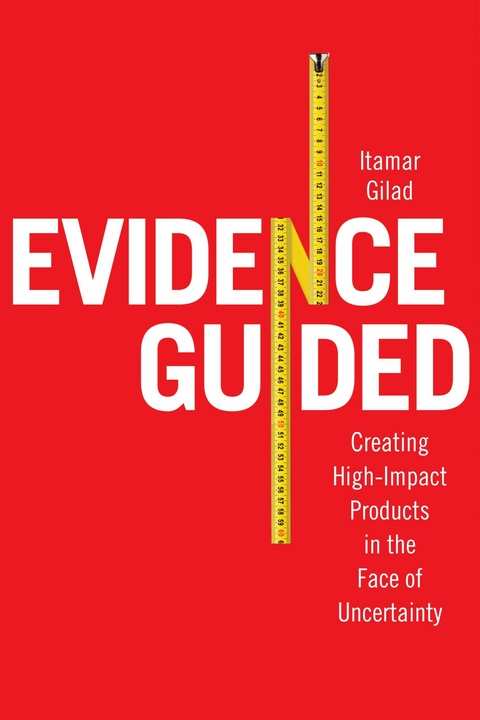
Evidence Guided (eBook)
208 Seiten
Publishdrive (Verlag)
9788409535644 (ISBN)
Research shows that most of what we build creates little or no value for our users and the business. To break away from this harsh reality, you need to adopt a different system, one that combines human judgment with evidence. Using evidence effectively flips the odds in our favor: it boosts outcomes and reduces waste; it improves decision-making, alignment, and empowerment, and reduces battles of opinion and politics. For these reasons, Evidence-guided Development is at the heart of every successful product company you know.
In this book, Itamar Gilad presents an actionable model to bring evidence-guided development into your organization. Combining tried-and-tested methods with tools created by the author, Evidence-Guided offers a systematic approach-the GIST model (Goals, Ideas, Steps, and Tasks)-to help you create high-impact products. You'll learn how to choose the right outcomes, prioritize ideas, build and learn at a fast pace, and collaborate more effectively with developers, managers, and stakeholders. The book provides principles, models, tools, and processes, all demonstrated through real-world examples and infused with nuance gained through years of practice.
The methods presented in this book can be used by individual contributors, team leads, and managers. They apply to companies of all sizes and life stages, developing for a variety of customer types. The first parts of the book will teach you the techniques, while the latter chapters will guide you through adapting the system for your particular type of company and through driving successful adoption.
Research shows that most of what we build creates little or no value for our users and the business. To break away from this harsh reality, you need to adopt a different system, one that combines human judgment with evidence. Using evidence effectively flips the odds in our favor: it boosts outcomes and reduces waste; it improves decision-making, alignment, and empowerment, and reduces battles of opinion and politics. For these reasons, Evidence-guided Development is at the heart of every successful product company you know.In this book, Itamar Gilad presents an actionable model to bring evidence-guided development into your organization. Combining tried-and-tested methods with tools created by the author, Evidence-Guided offers a systematic approach the GIST model (Goals, Ideas, Steps, and Tasks) to help you create high-impact products. You'll learn how to choose the right outcomes, prioritize ideas, build and learn at a fast pace, and collaborate more effectively with developers, managers, and stakeholders. The book provides principles, models, tools, and processes, all demonstrated through real-world examples and infused with nuance gained through years of practice.The methods presented in this book can be used by individual contributors, team leads, and managers. They apply to companies of all sizes and life stages, developing for a variety of customer types. The first parts of the book will teach you the techniques, while the latter chapters will guide you through adapting the system for your particular type of company and through driving successful adoption.
Introduction:
Why Evidence-Guided?
In my line of work, I regularly get to hear product people and managers explain what they plan to do with their products—strategies, roadmaps, new products, and features. I’m always impressed by the thought and creativity that goes into these. However, at the end of the presentation I’m often left wanting.
Then I ask the question that’s on my mind:
How do you know that these are the right things to do?
This may sound like a silly thing to ask, but I’m not trying to be cute. The answers are meaningful, and can be divided into two groups. There are those who don’t find the question surprising at all, and can readily share research, test results, and learnings in support of their ideas. The second, and more common reaction, is one of silent bewilderment. What do I mean “how do you know?” The plan was conceived, reviewed, and approved by smart and experienced people. Often it is derived from some bigger plan, and is backed by irrefutable logic or impressive-sounding data (“we pitched the feature to six customers and they all liked it”). These responses represent two drastically different schools of product development. The former is typical of companies making use of evidence to form decisions, while the latter, unbeknownst to them, are companies that heavily rely on opinions.
Having used both approaches myself for 20 years as a product manager and developer, and having consulted many product companies since, I can tell you there’s a world of difference between evidence-guided development, and opinion-based development; not just in the way you plan and execute, but in the results you see. Evidence-guided companies understand there’s a lot of uncertainty in the game and are tilting the odds in their favor. Opinion-based companies are effectively placing blind bets on a roulette table. You may get rich both ways, but one works much more consistently.
Evidence-guided development is not about ceding decisions to data; it’s about supercharging our judgment and helping us make better decisions. It’s also not slower—it’s much faster. Done right, evidence-guided approaches improve resource efficiency, reduce planning time, suppress politics, build trust, empower people and teams, and, most importantly, deliver value to the business and to the customers faster. It’s the way any truly successful product company you know is operating (or has operated in its best days).
Test Yourself
Are you working for an evidence-guided company? If you’re unsure, try filling out the scorecard below.
Go ahead, it will only take a minute.
GIST ScorecardFor each item below enter a score of 0%–100% showing how much you’re practicing this element of the system. Then you can average the scores in each category—goals, ideas, steps, tasks—and average again across categories to get your final score. |
| Goals |
|
| Goals average score ____% |
|
|
|
| Ideas average score ____% |
|
|
|
| Steps average ____% |
|
|
|
| Tasks average score ____% |
| Total score: ____% [average across Goals, Ideas, Steps, and Tasks] |
No one gets a perfect score in this test, but if filling the scorecard made you realize you have room to improve, this book may be right for you.
The scorecard is arranged according to the GIST model that breaks the adoption of evidence-guided development into four concrete areas: Goals, Ideas, Steps, and Tasks. I’ll teach you how to use GIST in depth in this book.
Who Is This Book For?
I wrote this book to help product people who wish to start working in an evidence-guided way—product managers, UX designers, and engineers at all levels up to CPO, CTO, and Head of Design.
If you’re involved in product development as a UX researcher, data analyst, product marketing manager, agile coach, or other role, you may find a lot of value in learning how evidence-guided development works. I warn you that things can get pretty technical and detailed.
The models and processes described in this book are widely applicable. You’ll find use for them whether you’re developing for businesses, consumers, developers, or internal customers, and whether your company is a startup, a scale-up, or an enterprise.
How to Use This Book
If you’re like me, you rarely read business management books from cover to cover. Here’s a map to help guide you:
- Chapter 1 explains the GIST model and the reason for using it as demonstrated by two stories from my time at Google. I recommend you don’t skip this chapter.
- Chapters 2–5 cover the four layers of the GIST model—Goals, Ideas, Steps, and Tasks—in detail. I explain the principles and models as well as a large number of practical techniques. If you’re working in a product team, or are managing people working in such teams, I highly recommend reading these chapters. If you’re a senior manager and are short on time, you may wish to jump directly to Chapter 6 to get an overview of the system, and then go back and read the parts you find most relevant.
- Chapters 6–8 deal with adapting the model to your type of company. Chapter 6, The Evidence-Guided Company, gives a full worked example of a midsize company using GIST, and explains the evidence-guided versions of product strategy, big projects, and roadmaps. Chapter 7, Scaling GIST, explains how GIST works in companies of various sizes—from startup to enterprise. Chapter 8, GIST Patterns, talks about GIST in B2B, B2C, Multi-sided marketplaces, Platforms and Services teams, and physical products. These chapters will be of most value for senior product people and for managers.
- Chapter 9, Adopting GIST, talks about the challenges and objections I commonly see when introducing evidence-guided development into companies, and ways to overcome them. This is an important chapter for anyone who’s attempting to drive the change in their own team, group, business unit, or organization.
Companion Page—For all the information I included in this book, there’s a lot more I couldn’t include for the sake of brevity and readability. For this reason I have set up a companion page at EvidenceGuided.com/BookResources where you’ll find eBooks, templates, links to articles, and further explanations. My aim is to keep this as an active, continually updated resource that reflects the latest learnings. As a reader of this book you get access to the page free of charge (signup may be required for some resources).
Courses—I also...
| Erscheint lt. Verlag | 1.11.2023 |
|---|---|
| Sprache | englisch |
| Themenwelt | Mathematik / Informatik ► Informatik ► Software Entwicklung |
| Schlagworte | Agile • Design • experimentation • Lean Startup • product discovery • Product Management • Software |
| ISBN-13 | 9788409535644 / 9788409535644 |
| Informationen gemäß Produktsicherheitsverordnung (GPSR) | |
| Haben Sie eine Frage zum Produkt? |
 EPUB (Ohne DRM)
Digital Rights Management: ohne DRM
Dieses eBook enthält kein DRM oder Kopierschutz. Eine Weitergabe an Dritte ist jedoch rechtlich nicht zulässig, weil Sie beim Kauf nur die Rechte an der persönlichen Nutzung erwerben.
Dateiformat: EPUB (Electronic Publication)
EPUB ist ein offener Standard für eBooks und eignet sich besonders zur Darstellung von Belletristik und Sachbüchern. Der Fließtext wird dynamisch an die Display- und Schriftgröße angepasst. Auch für mobile Lesegeräte ist EPUB daher gut geeignet.
Systemvoraussetzungen:
PC/Mac: Mit einem PC oder Mac können Sie dieses eBook lesen. Sie benötigen dafür die kostenlose Software Adobe Digital Editions.
eReader: Dieses eBook kann mit (fast) allen eBook-Readern gelesen werden. Mit dem amazon-Kindle ist es aber nicht kompatibel.
Smartphone/Tablet: Egal ob Apple oder Android, dieses eBook können Sie lesen. Sie benötigen dafür eine kostenlose App.
Geräteliste und zusätzliche Hinweise
Buying eBooks from abroad
For tax law reasons we can sell eBooks just within Germany and Switzerland. Regrettably we cannot fulfill eBook-orders from other countries.
aus dem Bereich