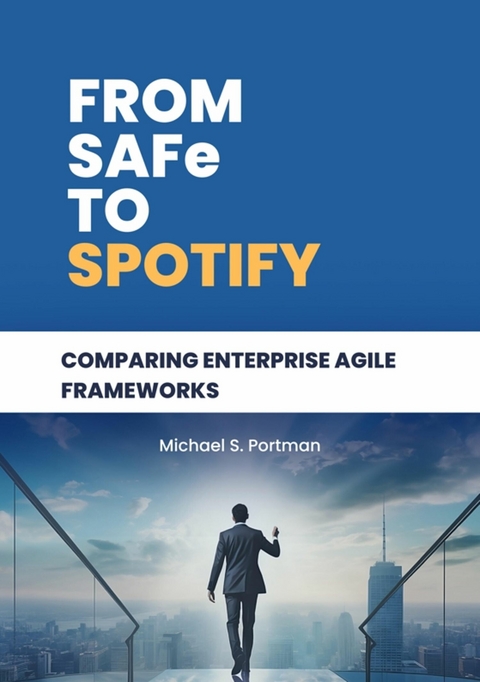
From SAFe to Spotify (eBook)
184 Seiten
tredition (Verlag)
978-3-384-03437-3 (ISBN)
Chapter 1: Scrum basics
History and development of Scrum
Scrum's origins date back further than one might initially believe. To comprehend the current understanding of Scrum, it is helpful to examine its history and the evolutions that lead to its current form.
From Rugby Fields to Development Teams: The Beginnings
The analogy for "scrum" originates in the world of rugby. For those unfamiliar with rugby, a scrum is a way to resume play after a minor infraction. In a compact formation, players from both teams collide and attempt to recover the object. The term has been used figuratively to characterize a group of individuals working on a problem in a focused and collaborative manner.
In 1986, Hirotaka Takeuchi and Ikujiro Nonaka published a paper in the Harvard Business Review containing the first concrete notions comparable to the modern Scrum methodology. In "The New New Product Development Game," the authors described a product development strategy that was quicker, more adaptable, and based on teamwork. They used the metaphor "Scrum" to characterize the process of collaboration within small, cross-functional teams working in phases or "sprints."
The 90s: Formulation and consolidation
In the 1990s, Jeff Sutherland and Ken Schwaber began independently developing concepts that were remarkably similar to modern Scrum. Sutherland implemented his concepts while working for the company "Easel" in 1993, adopting the term "Scrum" in allusion to the previously mentioned paper. On the other hand, Schwaber had created an analogous method for his company, "Advanced Development Methods."
In 1995, as fate would have it, the two met at a conference and merged their concepts. The outcome was the initial official definition of Scrum.
Scrum began to establish its permanent position in the software development and project management industries in the 1990s. The journey through this time, when the Internet revolutionized the business world and companies were continuously evolving, demonstrated the need for agile approaches.
The new millennium: A manifesto is born
In the highlands of Utah at the turn of the 21st century, 17 independent intellectuals gathered at the Snowbird ski resort. Their objective? To discuss and redefine software development's future. Jeff Sutherland and Ken Schwaber were among those present. The results of this meeting led to the 2001 publication of the "Agile Manifesto." Although not exclusive to Scrum, the Manifesto was a significant milestone that elucidated the principles underlying agile methods in a plain and concise manner.
The growing popularity and the Scrum Alliance
With the Agile Manifesto as a tailwind, Scrum's popularity grew rapidly. The method provided remedies to common software development issues, such as delivery delays and a lack of responsiveness to consumer feedback. The Scrum Alliance, an organization dedicated to disseminating and advancing Scrum, was founded in 2002. This Alliance introduced training and certifications that helped standardize the method while preserving its adaptability.
Case study: The fictitious company "WebSolutions
In the midst of the dotcom boom, the "WebSolutions" company faced enormous pressure to get to market quickly while delivering innovative solutions. Traditional waterfall methods were not enough. After some teething problems, the company decided to try Scrum. By adopting short sprints, regular reviews and close team collaboration, "WebSolutions" was not only able to deliver faster, but also produce higher quality products. It became a shining example of the transformation
The journey through the history of Scrum up to this point has taken us from its origins to its widespread adoption.
The 2010s: Scaling and diversification
New frameworks, such as the Scaled Agile Framework (SAFe) and Large Scale Scrum (LeSS), emerged to facilitate the use of Scrum in large organizations as an increasing number of large organizations adopted the methodology.
Simultaneously, industries ranging from finance to manufacturing came to recognize and embrace the benefits of agile development and Scrum.
The growing community and sharing of best practices
As with many other initiatives, the Scrum community has been essential to the framework's continued success. global conferences, seminars, and online platforms have enabled the sharing of best practices and the adaptation of the framework to new challenges and environments.
Case study: The fictitious healthcare provider "HealthTech Innovations
"HealthTech Innovations", a healthcare technology provider, faced the challenge of developing medical devices and software in a highly regulated industry. Traditional development approaches reached their limits here. By implementing Scrum and sharing with other industry players, the company was able to cut its product development times in half and significantly increase customer satisfaction.
Looking to the future: Where is the journey headed?
Although Scrum is now firmly rooted in the business world, it remains a dynamic framework. Scrum will be required to continue to adapt and improve as technologies and business practices evolve. Scrum's inherent characteristics of continuous learning and adaptation ensure that it will remain relevant regardless of the future's challenges.
Our journey through the intriguing history of Scrum has reached its conclusion. There will undoubtedly be many more chapters to this tale of inventiveness, adaptability, and unrelenting pursuit of excellence.
Core elements and principles of Scrum
Before we venture deeper into the application and incorporation of Scrum in various contexts, we should take a closer look at the fundamental elements and underlying principles. Not only are these the foundation of Scrum, but they also serve as the basis for all other methodologies and approaches.
1. The scrum values
One of the cornerstones of Scrum is its five core values:
• Commitment: Each team member commits to the goals of the sprint.
• Courage: It takes courage to tackle challenges and make changes.
• Focus: Concentration on what can be achieved during the current sprint.
• Openness: Communicate openly about progress, obstacles, and challenges.
• Respect: Each team member respects the skills and contributions of others.
These values are not just empty words on paper; they should be lived in every interaction and decision within a Scrum team.
2. The three pillars of Scrum
The work in Scrum is based on three supporting pillars:
• Transparency: All information is visible to everyone involved. This allows teams to make joint decisions and build trust.
• Inspection: At regular intervals, the current work results should be checked to ensure that they meet the desired requirements.
• Adjustment: If an inspection reveals that one or more elements of the process or product do not meet the requirements, an adjustment is made to correct the deviation.
Case study: The fictitious start-up "GreenTech Labs
The young team of "GreenTech Labs", an innovative start-up in the field of sustainable technologies, was looking for ways to speed up their development cycles. By introducing Scrum values and principles, they managed not only to increase their productivity, but also to foster a stronger team dynamic. Thanks to transparency, everyone always knew exactly what was being worked on. Regular inspections ensured they stayed on track, and if needed, they could quickly adjust the way they worked.
The crucial roles in Scrum
If Scrum were a play, the roles would be the principal actors; each role has its own responsibilities and strengths, and collectively they ensure that the Scrum process operates efficiently.
1. The Product Owner
The Product Owner (PO) is the visionary of the project. He or she ensures:
• That the product vision is clearly defined and understood by the entire team.
• That the product backlog, an ordered list of tasks and requirements, remains current and prioritized.
• That decisions regarding the final product are made expeditiously.
The PO acts as an interface between the development team and the stakeholders, ensuring that everyone is on the same page.
2. The Development Team
The development team is the heart of the product development process. It:
• Is self-organizing and autonomous in deciding how work is performed.
• Is composed of various professionals who have the required skills to deliver the product.
• Works closely together to achieve the goals set in the sprint.
3. The Scrum Master
The Scrum Master can be considered as the conductor of the Scrum stage show. His main tasks are:
• Ensure Scrum principles and practices are applied correctly and consistently.
• Remove obstacles that may prevent the team from achieving its goals.
• Coach and assist the team in continuous improvement.
A little insight: The CloudWave Solutions Experience
At "CloudWave...
| Erscheint lt. Verlag | 5.10.2023 |
|---|---|
| Verlagsort | Ahrensburg |
| Sprache | englisch |
| Themenwelt | Sachbuch/Ratgeber ► Beruf / Finanzen / Recht / Wirtschaft ► Bewerbung / Karriere |
| Mathematik / Informatik ► Mathematik | |
| Wirtschaft ► Betriebswirtschaft / Management ► Projektmanagement | |
| Wirtschaft ► Betriebswirtschaft / Management ► Unternehmensführung / Management | |
| Schlagworte | AgilePM • Agility • Dad • DSDM • Dynamic Systems Development Method • Enterprise Scrum • KANBAN • LESS • RUP • SAFE • Scaled Frameworks • Scaled Scrum • Scrum • Scrum of Scrums • Scurm@Scale • Spotify Model |
| ISBN-10 | 3-384-03437-6 / 3384034376 |
| ISBN-13 | 978-3-384-03437-3 / 9783384034373 |
| Informationen gemäß Produktsicherheitsverordnung (GPSR) | |
| Haben Sie eine Frage zum Produkt? |
 EPUB (Wasserzeichen)
DRM: Digitales Wasserzeichen
Dieses eBook enthält ein digitales Wasserzeichen und ist damit für Sie personalisiert. Bei einer missbräuchlichen Weitergabe des eBooks an Dritte ist eine Rückverfolgung an die Quelle möglich.
Dateiformat: EPUB (Electronic Publication)
EPUB ist ein offener Standard für eBooks und eignet sich besonders zur Darstellung von Belletristik und Sachbüchern. Der Fließtext wird dynamisch an die Display- und Schriftgröße angepasst. Auch für mobile Lesegeräte ist EPUB daher gut geeignet.
Systemvoraussetzungen:
PC/Mac: Mit einem PC oder Mac können Sie dieses eBook lesen. Sie benötigen dafür die kostenlose Software Adobe Digital Editions.
eReader: Dieses eBook kann mit (fast) allen eBook-Readern gelesen werden. Mit dem amazon-Kindle ist es aber nicht kompatibel.
Smartphone/Tablet: Egal ob Apple oder Android, dieses eBook können Sie lesen. Sie benötigen dafür eine kostenlose App.
Geräteliste und zusätzliche Hinweise
Buying eBooks from abroad
For tax law reasons we can sell eBooks just within Germany and Switzerland. Regrettably we cannot fulfill eBook-orders from other countries.
aus dem Bereich