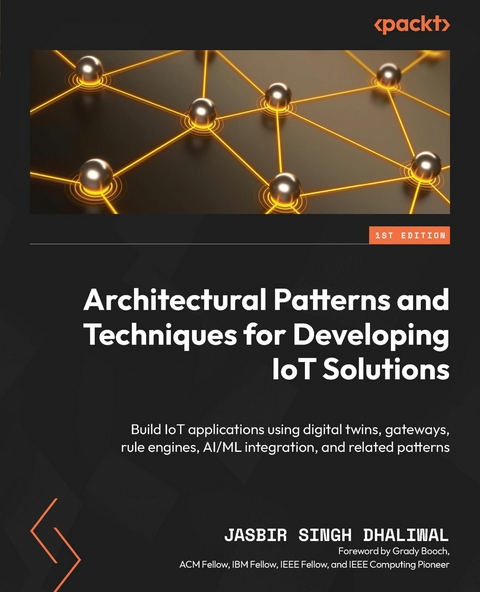
Architectural Patterns and Techniques for Developing IoT Solutions (eBook)
304 Seiten
Packt Publishing (Verlag)
978-1-80324-763-2 (ISBN)
As the Internet of Things (IoT) expands and moves to new domains, architectural patterns need to enable faster digital transformation and more uniform development. Through numerous use cases and examples, this book helps you conceptualize and implement IoT architectural patterns and use them in diverse contexts in real-world scenarios.
The book begins by introducing you to a variety of IoT architectural patterns and then helps you understand how they are used in domains such as retail, smart manufacturing, consumer, smart cities, and smart agriculture. You'll also find out how cross-cutting concerns such as security require special considerations in the IoT context. As you advance, you'll discover all the nuances that are inherent in each layer of IoT reference architecture, including considerations related to analytics for edge/constrained devices, data visualizations, and so on. In the concluding chapters, you'll explore emerging technologies such as blockchain, 3D printing, 5G, generative AI, quantum computing, and large language models (LLMs) that enhance IoT capabilities to realize broader applications.
By the end of this book, you'll have learned to architect scalable, secure, and unique IoT solutions in any domain using the power of IoT architectural patterns, and you will be able to avoid the pitfalls that typically derail IoT projects.
Apply modern architectural patterns and techniques to achieve scalable, resilient, and secure intelligent IoT solutions built for manufacturing, consumer, agriculture, smart cities, and other domainsKey FeaturesGet empowered to quickly develop IoT solutions using listed patterns and related guidanceLearn the applications of IoT architectural patterns in various domains through real-world case studiesExplore sensor and actuator selection, analytics, security, and emerging tools for architecting IoT systemsPurchase of the print or Kindle book includes a free PDF eBookBook DescriptionAs the Internet of Things (IoT) expands and moves to new domains, architectural patterns need to enable faster digital transformation and more uniform development. Through numerous use cases and examples, this book helps you conceptualize and implement IoT architectural patterns and use them in diverse contexts in real-world scenarios. The book begins by introducing you to a variety of IoT architectural patterns and then helps you understand how they are used in domains such as retail, smart manufacturing, consumer, smart cities, and smart agriculture. You ll also find out how cross-cutting concerns such as security require special considerations in the IoT context. As you advance, you ll discover all the nuances that are inherent in each layer of IoT reference architecture, including considerations related to analytics for edge/constrained devices, data visualizations, and so on. In the concluding chapters, you ll explore emerging technologies such as blockchain, 3D printing, 5G, generative AI, quantum computing, and large language models (LLMs) that enhance IoT capabilities to realize broader applications. By the end of this book, you ll have learned to architect scalable, secure, and unique IoT solutions in any domain using the power of IoT architectural patterns, and you will be able to avoid the pitfalls that typically derail IoT projects.What you will learnGet to grips with the essentials of different architectural patterns and anti-patternsDiscover the underlying commonalities in diverse IoT applicationsCombine patterns from physical and virtual realms to develop innovative applicationsChoose the right set of sensors and actuators for your solutionExplore analytics-related tools and techniques such as TinyML and sensor fusionOvercome the challenges faced in securing IoT systemsLeverage use cases based on edge computing and emerging technologies such as 3D printing, 5G, generative AI, and LLMsWho this book is forThis book is for IoT systems and solutions architects as well as other IoT practitioners, such as developers and both technical program and pre-sales managers who are interested in understanding how various IoT architectural patterns and techniques can be applied to developing unique and diverse IoT solutions. Prior knowledge of IoT fundamental concepts and its application areas is helpful but not mandatory.]]>
1
Introduction to IoT Patterns
The Internet of Things (IoT) has gained significant traction in the recent past and this field is poised for exponential growth in the coming years. This growth will span all the major domains/industry verticals, including consumer, home, manufacturing, health, travel, and transportation. This book will provide a novel perspective to those who want to understand the fundamental IoT patterns and how these patterns can be mixed and matched to implement unique and diverse IoT applications.
This introductory chapter details the architectural considerations that you must bear in mind while designing IoT solutions. Architecting IoT solutions is challenging as there are additional complexities due to the physical hardware selection, complex integrations, and connectivity requirements involved. This chapter also serves as a foundation for the patterns that will be introduced in the subsequent chapters.
In this chapter, we will cover the following topics:
- An overview of IoT
- IoT reference architecture
- Unique requirements of IoT use cases
- Recommended architecture principles and considerations
An overview of IoT
IoT has generated a lot of interest recently and has moved from a purely academic pursuit to the point where real use cases are being realized. IoT implementation is inherently complex due to multiple and diverse technologies (embedded, cloud, edge, big data, artificial intelligence (AI), machine learning (ML), and so on) being involved and due to the range of deployment options that are available (constraint devices in the field to the almost unlimited availablity of compute and other resources in the cloud). IoT enables diverse use cases and spans multiple domains (home automation, healthcare, track-and-trace, connected vehicles, autonomous driving, and more).
The relevance of IoT is only going to increase in the coming years because of the following reasons:
- IoT use cases encompass physical and virtual worlds and as a result, interesting and rich use cases can be developed (compared to purely virtual/software systems such as word processors, ERP systems, and more). It can be said that the scope and variety of IoT use cases is only limited by a person’s imagination.
- The immense potential of IoT has been validated by both academics and implementors. This can be attributed to the following reasons:
- The increased capability and efficiency of hardware components with a continous decrease in cost (and size) in line with Moore’s law. Efficient battery utilization by the current generation of hardware components has also reduced the hassles of frequent battery replacement.
- The rise of commercial cloud providers (hyperscalers), which enables unlimited scalability in terms of compute, storage, complex analytics, high-speed data ingestion, and more. These characteristics are very well suited to the needs of IoT applications. The following are some of the services that are provided by public cloud providers/hyperscalers and that can be leveraged while developing IoT use cases:
- Device management
- Firmware updates
- Edge management/analytics
- Device/data security
- Digital twins
- IoT analytics
- Data ingestion
- Data visualizations
- Data storage
- Video analytics
- Notifications
- Ubiquitous and low-cost connectivity in the form of traditional connectivity options (for example, Wi-Fi, 3G, and 4G) as well as connectivity options such as LoRaWAN and NB-IoT. Technologies such as NB-IoT are especially useful for IoT as they support long-range connectivity and provide long battery life. The advent of 5G has further enlarged the scope of IoT use cases by providing high bandwidth and minimal latency.
- The increased maturity of related technologies such as blockchain, robotics, AI/ML, energy harvesting, AR/VR, drones, social media, and more. These technologies enable IoT practitioners to augment IoT capabilities with the capabilities provided by these technologies to push the boundaries of innovation further and envisage non-conventional ideas.
- The increased adoption of mobile and wearable devices. These devices enable anytime access to IoT data and help control and monitor IoT devices in real time.
- Increased market competition, which forces enterprises to treat data as the fulcrum for decision-making as well as monetization opportunities. IoT also acts as the foundation for operationalizing additional revenue models such as service revenue over and above product sale revenue.
It is important to understand how IoT systems are different from non-IoT systems. A few of the key differentiators are as follows:
- Humans play a vital role in operating and managing most non-IoT (traditional IT/OT systems) systems, whereas IoT systems are designed to operate on their own or with minimal human intervention.
- IoT devices are constrained in terms of the compute, storage, or both, whereas most non-IoT applications are deployed on standard workstations where an ample amount of storage and compute is available.
- IoT applications, once deployed, are expected to last for years (10 to 15 years is the norm in the manufacturing industry) compared to non-IoT applications, where the shelf life is less (typical refresh cycles range between 3 to 5 years). Accordingly, IoT systems must be architected by balancing both current and long term needs.
- Considerable heterogeneity is observed in the selection of the hardware/software components as well as connectivity protocols. This is because there are different technologies to choose from, and for each technology choice, there are multiple implementations and offerings available from vendors. In comparison, there are fewer technology options possible in non-IoT systems.
- There are differences in the characteristics of the data that is generated in IoT and non-IoT systems. All the seven V’s of big data (velocity, variety, variability, volume, veracity, visualization, and value) are high in IoT systems compared to non-IoT systems.
- Very few IoT systems operate in isolation and are generally integrated with other enterprise systems. In IoT systems, there is a need to integrate Information Technology (IT) and Operational Technology (OT), as well as hardware devices. This presents an entirely new level of integration complexity that is rarely seen in traditional systems.
- Security is important in any connected system, but it becomes much more important in IoT as the attacks can result in physical harm (industrial robots gone rogue) in addition to reputation/financial loss. Additionally, most IoT field devices are installed in vulnerable environments where they can easily be tampered with. Therefore, the attack surface in an IoT use case is much larger than that of a non-IoT use case.
These unique characteristics of IoT systems can be visualized in the following diagram:
Figure 1.1 – Unique characteristics of an IoT system
This complexity can be quite daunting to anyone who has just ventured into the IoT domain. Although a rich variety of IoT use cases (or solution domains) is possible, there is also a certain degree of commonality that is present in most of the IoT use cases and related architectures. We have mentioned these similarities so that anyone who is new to this domain can understand the existing architectures and use cases.
IoT reference architecture
The IoT reference architecture follows a layered model, as shown in the following diagram:
Figure 1.2 – Layered IoT reference architecture
Let’s look at these layers in more detail:
- Perception/actuation layer: This layer indicates the physical layer where sensors (pressure, temperature, and so on) gather information about the environment. In turn, the environment is affected by the actuators (electric motor, thermostat control, and so on).
- Connectivity layer: This layer provides the connectivity required to send data (perception data from sensors and control commands to actuators, and so on) to/from the aggregation/processing layer. This layer is realized by leveraging connectivity options (5G, Wi-Fi, NB-IoT, LoRA, and so on). The decision to choose a specific connectivity option depends on various factors such as range and bandwidth.
- Processing layer: The processing layer ingests, analyzes, and stores data received from the connectivity layer. The processing can be performed either near the data source (edge computing) or in a...
| Erscheint lt. Verlag | 28.9.2023 |
|---|---|
| Vorwort | Grady Booch |
| Sprache | englisch |
| Themenwelt | Mathematik / Informatik ► Informatik ► Netzwerke |
| Mathematik / Informatik ► Informatik ► Theorie / Studium | |
| Informatik ► Weitere Themen ► Hardware | |
| ISBN-10 | 1-80324-763-0 / 1803247630 |
| ISBN-13 | 978-1-80324-763-2 / 9781803247632 |
| Informationen gemäß Produktsicherheitsverordnung (GPSR) | |
| Haben Sie eine Frage zum Produkt? |
 EPUB (Ohne DRM)
Digital Rights Management: ohne DRM
Dieses eBook enthält kein DRM oder Kopierschutz. Eine Weitergabe an Dritte ist jedoch rechtlich nicht zulässig, weil Sie beim Kauf nur die Rechte an der persönlichen Nutzung erwerben.
Dateiformat: EPUB (Electronic Publication)
EPUB ist ein offener Standard für eBooks und eignet sich besonders zur Darstellung von Belletristik und Sachbüchern. Der Fließtext wird dynamisch an die Display- und Schriftgröße angepasst. Auch für mobile Lesegeräte ist EPUB daher gut geeignet.
Systemvoraussetzungen:
PC/Mac: Mit einem PC oder Mac können Sie dieses eBook lesen. Sie benötigen dafür die kostenlose Software Adobe Digital Editions.
eReader: Dieses eBook kann mit (fast) allen eBook-Readern gelesen werden. Mit dem amazon-Kindle ist es aber nicht kompatibel.
Smartphone/Tablet: Egal ob Apple oder Android, dieses eBook können Sie lesen. Sie benötigen dafür eine kostenlose App.
Geräteliste und zusätzliche Hinweise
Buying eBooks from abroad
For tax law reasons we can sell eBooks just within Germany and Switzerland. Regrettably we cannot fulfill eBook-orders from other countries.
aus dem Bereich