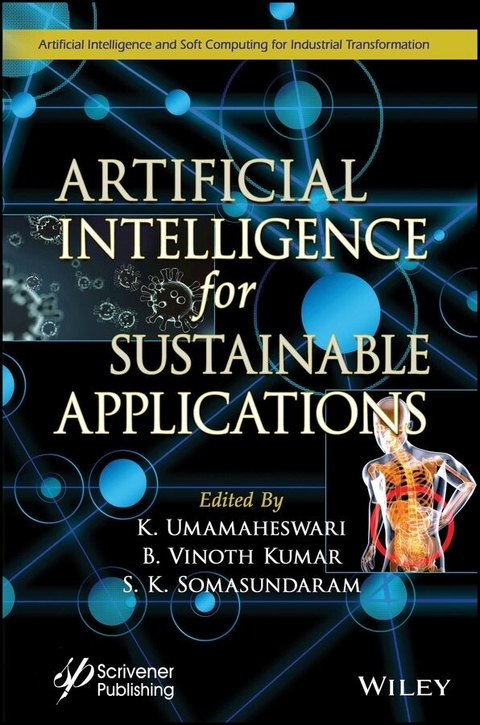
Artificial Intelligence for Sustainable Applications (eBook)
John Wiley & Sons (Verlag)
978-1-394-17523-9 (ISBN)
The objective of this book is to leverage the significance of artificial intelligence in achieving sustainable solutions using interdisciplinary research through innovative ideas.
With the advent of recent technologies, the demand for Information and Communication Technology (ICT)-based applications such as artificial intelligence (AI), machine learning (ML), Internet of Things (IoT), health care, data analytics, augmented reality/virtual reality, cyber-physical systems, and future generation networks, has increased drastically. In recent years, artificial intelligence has played a more significant role in everyday activities. While AI creates opportunities, it also presents greater challenges in the sustainable development of engineering applications. Therefore, the association between AI and sustainable applications is an essential field of research. Moreover, the applications of sustainable products have come a long way in the past few decades, driven by social and environmental awareness, and abundant modernization in the pertinent field. New research efforts are inevitable in the ongoing design of sustainable applications, which makes the study of communication between them a promising field to explore.
This book highlights the recent advances in AI and its allied technologies with a special focus on sustainable applications. It covers theoretical background, a hands-on approach, and real-time use cases with experimental and analytical results.
Audience
AI researchers as well as engineers in information technology and computer science.
K. Umamaheswari, PhD, is a professor and head with 27 years of experience in the Department of Information Technology at PSG College of Technology, Coimbatore, India.
B. Vinoth Kumar, PhD, is an associate professor with 19 years of experience in the Department of Information Technology at PSG College of Technology, Coimbatore, India.
S. K. Somasundaram, PhD, is an assistant professor in the Department of Information Technology, PSG College of Technology, Coimbatore, India.
ARTIFICAL INTELLIGENCE for SUSTAINABLE APPLICATIONS The objective of this book is to leverage the significance of artificial intelligence in achieving sustainable solutions using interdisciplinary research through innovative ideas. With the advent of recent technologies, the demand for Information and Communication Technology (ICT)-based applications such as artificial intelligence (AI), machine learning (ML), Internet of Things (IoT), health care, data analytics, augmented reality/virtual reality, cyber-physical systems, and future generation networks, has increased drastically. In recent years, artificial intelligence has played a more significant role in everyday activities. While AI creates opportunities, it also presents greater challenges in the sustainable development of engineering applications. Therefore, the association between AI and sustainable applications is an essential field of research. Moreover, the applications of sustainable products have come a long way in the past few decades, driven by social and environmental awareness, and abundant modernization in the pertinent field. New research efforts are inevitable in the ongoing design of sustainable applications, which makes the study of communication between them a promising field to explore. This book highlights the recent advances in AI and its allied technologies with a special focus on sustainable applications. It covers theoretical background, a hands-on approach, and real-time use cases with experimental and analytical results. Audience AI researchers as well as engineers in information technology and computer science.
K. Umamaheswari, PhD, is a professor and head with 27 years of experience in the Department of Information Technology at PSG College of Technology, Coimbatore, India. B. Vinoth Kumar, PhD, is an associate professor with 19 years of experience in the Department of Information Technology at PSG College of Technology, Coimbatore, India. S. K. Somasundaram, PhD, is an assistant professor in the Department of Information Technology, PSG College of Technology, Coimbatore, India.
1
Predictive Models of Alzheimer’s Disease Using Machine Learning Algorithms – An Analysis
Karpagam G. R.1*, Swathipriya M.1, Charanya A. G.1 and Murali Murugan2
1Department of Computer Science and Engineering, PSG College of Technology, Coimbatore, Tamil Nadu, India
2Director of Engineering, Macy’s, Georgia, USA
Abstract
Alzheimer’s is a neurodegenerative dementia that occurs in people aged above 65, and there is a rapid growth in the amount of people suffering from it. Almost three out of four AD cases are undiagnosed. This paper comes with the view of identifying a predictive machine learning model for Alzheimer’s disease with the help of a minimally invasive blood-based biomarker. By comparing models of different algorithms of machine learning, we conclude that the model following the Random Forest algorithm has the highest efficiency in terms of predicting the positive AD cases with the highest AUC of the ROC curve (0.927).
Keywords: Machine learning, automated machine learning, Alzheimer’s disease
1.1 Introduction
In the 1950s many researchers attempted to build models that could interpret the world better than humans do. Then came the term “Machine Learning”-the concept by which the machine can learn and behave in the same way as humans do. Machine learning (ML) saw rapid developments in the late 1990s and in early 2000s and have found its applications across several different domains including healthcare. The introduction of ML in healthcare has been a breakthrough in the industry and it is still improving through the advancements in ML. Applications of ML models are used in the healthcare industry in several areas such as diagnosis of diseases, Drug Discovery and Manufacturing, Medical Imaging Diagnosis and Outbreak Predictions etc. [8]. This paper focuses on analyzing the predictive ability of various ML algorithms and their models in the prediction of Alzheimer’s disease (AD) [4–6, 9].
AD is the most widely recognized type of neurodegenerative ailment leading to dementia that occurs mostly in individuals beyond the age of 65. A study says that only one out of three cases of AD are diagnosed across the world. As of now, the final diagnosis of Alzheimer’s is only done through autopsy. It is one of the diseases whose prediction is difficult at an early stage, because it is often considered as normal symptoms of aging [3]. This difficulty in diagnosis may be the reason for the high ratio of undiagnosed cases to that of the diagnosed cases. So the need for effective and minimally invasive diagnostic models (i.e. diagnosis which doesn’t involve severe break through the skin) is very much needed for early diagnosis by which we can avoid severe impairments. In the present study, we utilized the miRNA transcriptomic dataset from the GEO repository and built models using different algorithms in the WEKA platform and came up with the best predictive model by comparing the AUCs of the ROC curves of different models.
1.2 Prediction of Diseases Using Machine Learning
For a while now there have been several applications of artificial intelligence that are prosperous in various fields. AI assisted systems are utilized in healthcare, finance, education and is considered as a boon with enhancement. Being a part of AI machine learning innovations have been able to meet the needs of the people and its growth is unbounded. ML allows software applications to achieve a level of accuracy that can improve the current standards [2]. In the healthcare industry, ML has been utilized to produce accurate predictions of a particular disease. This not only makes the work of healthcare professionals easier but also increases patient outcomes. ML has also been helpful in handling the data and records of patients and in developing new medical procedures. In some ways these applications aim to make things a lot more efficient and easy for people to handle, including cost effectiveness.
However ML typically requires human intervention in various parts. This dependency on humans in order to achieve great performance sometimes becomes a hindrance. Thus to reduce human interventions, save time and increase accuracy in results an enhancement in machine learning technology is necessary. This programmed AI advancement is called Automated Machine Learning – AutoML. Besides the fact that AutoML is an emerging innovative technology, it has been utilized in prediction and analysis of heart diseases, cancer, diabetes, and electronic healthcare (EHR) analysis.
This chapter aims at exploring the ML algorithms and envisioning the best model that could help in predictions of Alzheimer’s disease. As of late researchers have been attempting to find biomarkers that indicate the presence of Alzheimer’s in patients at an early stage in order to diminish or decline the advancement of the disease. There are various strategies that involve early diagnosis of Alzheimer’s disease. Those include brain imaging/ neuroimaging , functional imaging, molecular imaging, blood and urine tests, analysis of protein levels (cerebrospinal fluid (CSF) levels of tau and beta-amyloid) and more. During this time with remarkable improvement in the innovative field, the analytic investigation of Alzheimer’s has also been improving. We now have reliable technologies in addition to the already existing clinical tests that can provide accurate diagnosis resulting in satisfying patient outcomes. AutoML has been used to successfully identify biomarkers that are minimally invasive [7]. This process promises combined computational efficiency and predictive performance.
1.3 Materials and Methods
Dataset
We used the openly accessible blood-based miRNA transcriptomic dataset from the Gene Expression Omnibus (GEO) repository in the process of building the predictive models. It comprises of data about the miRNA profiles in blood tests of 48 AD patients and 22 sound controls containing 506 features [1].
Tools
The comprehensive, open source ML software WEKA (3.8.5) which lets the users preprocess the dataset, apply diverse ML algorithms on data and analyze various outputs that was used throughout the process of building the models.
1.4 Methods
1. Data pre-processing: The data obtained from the GEO repository is converted into an arff file in the Experimenter application of WEKA and once the arff file is ready, the explorer application in the weka GUI chooser is utilized for the rest of the processes. In this environment we can explore our dataset by first going through the preprocessing process. Initially, the dataset is preprocessed by normalizing and then randomizing it. Since a raw dataset does not contain metrics that can be used for analysis, the values are kept within a scale that is applied for all numeric columns used in the model by normalizing it first. Normalization technique makes sure that our data produces smooth patterns where we can see a significant change in the model performance. It also helps in redundancy. Randomization is a technique that prevents a model from learning the sequence of training. Each point in the data implies independent change on the model without being biased by the same points before them. This is the first and most important step before sending the data to a model [11, 12, 15, 17].
2. Model development: Now that the dataset is preprocessed, it can be used to train a model. Here the method implemented is cross validation 10 folds. It is a most preferred method since the model can train on numerous train test splits offering clear and better signs of how the model will execute. This is done by training the full dataset. Then we use cross validation 10 folds to test the model’s ability of making predictions on new data.
3. Visualization: Once the models are ready, the test summary will manifest the performance measures of each model on the dataset. There are several metrics each with its own aim to depict the performance of each model. The area under the ROC curve metric gives the performance for classification models at various thresholds indicating how useful the test is. The higher the value of area under the ROC value, the better a model is at differentiating between patients affected by the disease and the patients without the disease. Similarly each metric has its own way of defining the performance of a model. In addition to these evaluation metrics the visualization tool can also be used to visualize the results [18, 19].
4. Best model prediction: Following the results predicting the best ML algorithm to distinguish between AD and healthy controls becomes easier. Comparing the area under the ROC curve the Random Forest (RF) algorithm produced better results [10, 13, 14, 16].
1.5 ML Algorithm and Their Results
1. J-48 Tree
J48 algorithm is the Java execution of C4.5 decision tree algorithm and C4.5 thusly is an augmentation of Id3 algorithm. In this algorithm, the decision tree is built by splitting the tree from top root to the bottom leaf until it reaches a stage where it cannot be split further. The attribute with which the splitting decision is taken is called the splitting attribute and it is chosen with the help of the information gain ratio. The attribute with the highest gain ratio at that level is chosen to split the tree further. To compute the data gain proportion, we utilize the idea of Information gain and...
| Erscheint lt. Verlag | 22.8.2023 |
|---|---|
| Reihe/Serie | Artificial Intelligence and Soft Computing for Industrial Transformation | Artificial Intelligence and Soft Computing for Industrial Transformation |
| Sprache | englisch |
| Themenwelt | Mathematik / Informatik ► Informatik ► Theorie / Studium |
| Schlagworte | AI • Artificial Intelligence • Artificial Neural Networks • bio-inspired algorithms • cognitive computing • Computer Science • Deep learning • Electrical & Electronics Engineering • Elektrotechnik u. Elektronik • evolutionary algorithms • Expert Systems • Fuzzy Systems • Informatik • Intelligente Systeme u. Agenten • Intelligent Systems & Agents • KI • Künstliche Intelligenz • machine learning • Meta-heuristics algorithms • Nachhaltigkeit • Natural Language Processing • probabilistic theory • Swarm intelligence |
| ISBN-10 | 1-394-17523-X / 139417523X |
| ISBN-13 | 978-1-394-17523-9 / 9781394175239 |
| Informationen gemäß Produktsicherheitsverordnung (GPSR) | |
| Haben Sie eine Frage zum Produkt? |
 EPUB (Adobe DRM)
Kopierschutz: Adobe-DRM
Adobe-DRM ist ein Kopierschutz, der das eBook vor Mißbrauch schützen soll. Dabei wird das eBook bereits beim Download auf Ihre persönliche Adobe-ID autorisiert. Lesen können Sie das eBook dann nur auf den Geräten, welche ebenfalls auf Ihre Adobe-ID registriert sind.
Details zum Adobe-DRM
Dateiformat: EPUB (Electronic Publication)
EPUB ist ein offener Standard für eBooks und eignet sich besonders zur Darstellung von Belletristik und Sachbüchern. Der Fließtext wird dynamisch an die Display- und Schriftgröße angepasst. Auch für mobile Lesegeräte ist EPUB daher gut geeignet.
Systemvoraussetzungen:
PC/Mac: Mit einem PC oder Mac können Sie dieses eBook lesen. Sie benötigen eine
eReader: Dieses eBook kann mit (fast) allen eBook-Readern gelesen werden. Mit dem amazon-Kindle ist es aber nicht kompatibel.
Smartphone/Tablet: Egal ob Apple oder Android, dieses eBook können Sie lesen. Sie benötigen eine
Geräteliste und zusätzliche Hinweise
Buying eBooks from abroad
For tax law reasons we can sell eBooks just within Germany and Switzerland. Regrettably we cannot fulfill eBook-orders from other countries.
aus dem Bereich