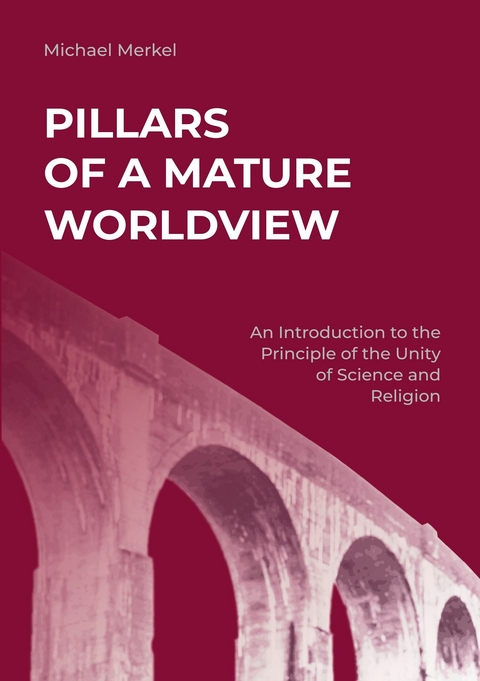
Pillars of a Mature Worldview (eBook)
592 Seiten
tredition (Verlag)
978-3-347-96409-9 (ISBN)
Michael Merkel wurde 1969 in München geboren. Er ist seit 1991 verheiratet, hat zwei erwachsene, inzwischen ebenfalls verheiratete Kinder sowie zwei Enkelkinder. Sein Wohnsitz ist südlich von München im oberbayerischen Holzkirchen. Nach dem Studium der theoretischen Physik entschied er sich gegen eine Forschungskarriere und wechselte stattdessen in die Wirtschaft. Seit über 25 Jahren arbeitet er in einem großen Versicherungskonzern, aktuell als Führungskraft im zentralen Risikomanagement. Neben Familie und Beruf liebt Michael Merkel die Natur, hat eine große Vorliebe für Sport (z.B. Ultralaufen) und interessiert sich besonders für die »großen Fragen des Lebens« im Spannungsfeld von Wissenschaft und Glauben. (Michael Merkel was born in Munich in 1969. He has been married since 1991, has two grown-up children, who are now also married, and two grandchildren. He lives south of Munich in Warngau, Upper Bavaria. After studying theoretical physics, he decided against a career in research and instead switched to business. He has been working for a large insurance company for over 25 years, currently as a manager in central risk management. In addition to family and career, Michael Merkel loves nature, has a great fondness for sports (e.g. ultra running) and is particularly interested in the »big questions of life« in the area of tension between science and faith.)
Michael Merkel wurde 1969 in München geboren. Er ist seit 1991 verheiratet, hat zwei erwachsene, inzwischen ebenfalls verheiratete Kinder sowie zwei Enkelkinder. Sein Wohnsitz ist südlich von München im oberbayerischen Holzkirchen. Nach dem Studium der theoretischen Physik entschied er sich gegen eine Forschungskarriere und wechselte stattdessen in die Wirtschaft. Seit über 25 Jahren arbeitet er in einem großen Versicherungskonzern, aktuell als Führungskraft im zentralen Risikomanagement. Neben Familie und Beruf liebt Michael Merkel die Natur, hat eine große Vorliebe für Sport (z.B. Ultralaufen) und interessiert sich besonders für die »großen Fragen des Lebens« im Spannungsfeld von Wissenschaft und Glauben. (Michael Merkel was born in Munich in 1969. He has been married since 1991, has two grown-up children, who are now also married, and two grandchildren. He lives south of Munich in Warngau, Upper Bavaria. After studying theoretical physics, he decided against a career in research and instead switched to business. He has been working for a large insurance company for over 25 years, currently as a manager in central risk management. In addition to family and career, Michael Merkel loves nature, has a great fondness for sports (e.g. ultra running) and is particularly interested in the »big questions of life« in the area of tension between science and faith.)
1 The Game of Life
People Need Orientation
Life is a game, as all games are: He who does not understand loses, and he who understands wins. JOHANN WILHELM LUDWIG GLEIM
Life is like drawing without an eraser. ECKART VON HIRSCHHAUSEN
A father is playing chess with his little daughter. Both sit opposite each other and gaze spellbound at the board with its white and black squares. Father and daughter seem very concentrated as they take turns moving their pieces. Suddenly, the daughter jumps up excitedly as she moves her knight into a promising position. This move seems to have been unexpected for the father as well. Annoyed, he mumbles something about »beginner’s mistake« and a »lost rook«. For minutes he visibly strains to look at the board, while his daughter can hardly sit still with tension. Finally, he moves his king one square to the right. Impatiently, the daughter captures the rook and thus takes her booty. The game continues. As time goes by, the daughter’s victorious expression disappears again. After a few small mistakes by the daughter, the father has won the game and breathes a sigh of relief. The daughter is also satisfied, having at least brought her supposedly overpowering father to the brink of defeat.
The quality of the individual moves can only be understood by those who are familiar with playing chess. In addition to understanding the aim of the game, this also includes knowing the rules of the game and the possible uses of all the game pieces. However, a solid basic knowledge alone does not make a good player. As we have seen from the above example, experience also plays a decisive role in a demanding game like chess. It is above all practical knowledge that enables the player to develop a promising game strategy and to select the best moves from a multitude of possible moves. Chess probably enjoys such great popularity because it offers numerous possibilities for influencing and shaping the game and is characterized by an open course of play. These characteristics make the game interesting, give it excitement and demand both thinking and creative players.
Human life resembles a game in many ways. Here, too, we have countless possibilities to shape and influence the course. However, unlike a game, which we can start all over again at any time, we only have one life at our disposal. Indeed, something is at stake in the »game of life«. If we want to be successful in this important game, we should thoroughly examine its nature and consider what this means for our way of life.
— The Game of Life
Basic Questions
Compared to a game, our life is not only much more meaningful and magnificent, but also much more multi-layered and complex. Moreover, life lacks an obvious »game manual« that offers orientation regarding the prevailing boundary conditions and design possibilities. If we want to get to the core of the game of life, we have to deal in depth with the great questions of life and in this way work out a mature worldview.
Let us now consider, analogously to the success factors of a game like chess, some fundamental questions about the art of living. As a counterpart to the game instructions these are to be answered as part of a realistic worldview. Figure 1 provides an overview of this, which is explained below.
Fig.1: Central Questions on the »Game of Life«
What is the goal and meaning of life?
Those who want to play successfully have the goal of the game firmly in mind with every move they make and consciously direct their moves towards it. But what is the goal and the meaning of our life? Is there an overriding meaning that is equally valid for all people, or are we called upon to define our life’s purpose and meaning ourselves? It is obvious that the goal and the meaning of life are not given like a game manual, but have to be consciously recognized and chosen. But where can we find valuable clues as to what we can base these choices on?
The exploration of the purpose of our existence is closely linked to the question of whether the »game of life« ends with physical death or whether it continues in some way afterwards. This question is of fundamental importance because depending on the answer, we will view and shape our lives under a completely different premise. Every person who wants to live a self-determined life will sooner or later stumble upon this and similar questions. As long as the goal and meaning of our lives are not sufficiently defined, we lack orientation and direction. Our »life moves« are then in a sense arbitrary.
In a game, the way other players play also has an influence on one’s own game strategy and tactics. It forces one to make adjustments despite one’s own plans and sometimes even to fundamentally rethink. In real life it is no different: Because we are integrated into the reality of a society, our personal room for maneuver depends very much on the nature of our social environment and its influence on us. The high significance of society for its constituent members requires us to reflect on whether and to what extent there may be an overarching, collective meaning and mission inherent in society itself. Consequently, it is not only the purpose of the human being, but also that of humanity that needs to be examined more closely. For this it is helpful to deal more closely with the properties of the world and in particular with the nature of human beings.
What is the world made of?
In the game of life, the world with its manifold phenomena forms the »playing field« on which we operate. The more thoroughly science explores our universe, the more clearly it becomes apparent how extraordinarily aesthetic, but also complex, our world is. Scientists have long since become accustomed to the fact that the explanation of investigated phenomena always raises new questions, the answers to which led to a constantly deepening understanding of the world. While the scientific view of the world was still largely mechanistic and materialistic at the beginning of the 20th century, research into various quantum phenomena in particular has forced a radical rethink. Today, modern science paints a picture of a world that is far more than its material surface would have us believe.
If the essence of the world is indeed not purely material, what about the human being who is part of this world? According to this knowledge, would it not be a must for modern people to consider that human beings could also possess a dimension that goes beyond matter? Should we indeed possess an immaterial identity independent of the body, usually called soul, then it would only be logical that we also deal with the nature of this special dimension. We would have to look at our lives from a much broader perspective and rethink what consequences this would have for our understanding of the human nature. Our conception of the human being would then possibly have to be supplemented by relevant attributes and aspects.
The question of the existence of a human soul immediately brings up the question of the existence of God. Those who strive for a mature and complete worldview cannot avoid examining which arguments speak for and which against such a hypothesis. For similar to the assumption of a soul, the assumption of a God also changes our worldview considerably and inevitably raises further questions, such as: Can God be recognized? Can statements be made about his attributes and characteristics of the relationship between Creator and creature be found? Does God have a purpose for the human being? And, to return to the game analogy: Could this source possibly yield central clues in the sense of a »game manual« for our lives?
What are the laws that govern the universe?
Our universe is characterized by numerous laws that result from the relationships between its various elements. We experience a multitude of these rules every day. As part of the physical creation, human beings are inevitably subject to the laws of nature that prevail there. We have to eat and drink regularly, protect ourselves from wind and weather, and observe other physical conditions if we want to survive. We also do not become younger in the course of time but are subject to a natural and inevitable ageing process that ultimately ends with physical death.
Interesting and at the same time enormously important is the question of whether law-like relationships also exist outside of physical reality. Since modern physics already provides clear indications of immaterial realms of existence, we should consider that these dimensions are also subject to laws. Our success in the »game of life« will depend crucially on understanding those laws that are of particu-lar importance for our human existence on an individual as well as on a social level.
Practical knowledge of the individual and collective art of living
In order to navigate successfully through life, it is not enough to deal with central philosophical questions. As in a game, we must also have relevant practical knowledge. The practical knowledge that is important for our actions arises when we ask ourselves what the understanding of the meaning of life and the nature of the world teaches us with regard to how we shape our lives. Analogous to the game strategy and tactics of a chess player, we need both an overarching life plan and an understanding of a purposeful organization of everyday life.
We can approach a meaningful life by defining essential life tasks that are in harmony with the...
| Erscheint lt. Verlag | 11.8.2023 |
|---|---|
| Verlagsort | Ahrensburg |
| Sprache | englisch |
| Themenwelt | Sachbuch/Ratgeber ► Gesundheit / Leben / Psychologie ► Partnerschaft / Sexualität |
| Geisteswissenschaften ► Philosophie ► Erkenntnistheorie / Wissenschaftstheorie | |
| Geisteswissenschaften ► Philosophie ► Logik | |
| Geisteswissenschaften ► Religion / Theologie ► Christentum | |
| Mathematik / Informatik ► Mathematik | |
| Medizin / Pharmazie ► Allgemeines / Lexika | |
| Naturwissenschaften ► Physik / Astronomie ► Astronomie / Astrophysik | |
| Recht / Steuern | |
| Schlagworte | answers to the big questions of life • Bahá'í perspective • era of unity • mature worldviev • paradigm shifts in science and religion • philosophy of life easy to understand |
| ISBN-10 | 3-347-96409-8 / 3347964098 |
| ISBN-13 | 978-3-347-96409-9 / 9783347964099 |
| Informationen gemäß Produktsicherheitsverordnung (GPSR) | |
| Haben Sie eine Frage zum Produkt? |
 EPUB (Wasserzeichen)
DRM: Digitales Wasserzeichen
Dieses eBook enthält ein digitales Wasserzeichen und ist damit für Sie personalisiert. Bei einer missbräuchlichen Weitergabe des eBooks an Dritte ist eine Rückverfolgung an die Quelle möglich.
Dateiformat: EPUB (Electronic Publication)
EPUB ist ein offener Standard für eBooks und eignet sich besonders zur Darstellung von Belletristik und Sachbüchern. Der Fließtext wird dynamisch an die Display- und Schriftgröße angepasst. Auch für mobile Lesegeräte ist EPUB daher gut geeignet.
Systemvoraussetzungen:
PC/Mac: Mit einem PC oder Mac können Sie dieses eBook lesen. Sie benötigen dafür die kostenlose Software Adobe Digital Editions.
eReader: Dieses eBook kann mit (fast) allen eBook-Readern gelesen werden. Mit dem amazon-Kindle ist es aber nicht kompatibel.
Smartphone/Tablet: Egal ob Apple oder Android, dieses eBook können Sie lesen. Sie benötigen dafür eine kostenlose App.
Geräteliste und zusätzliche Hinweise
Buying eBooks from abroad
For tax law reasons we can sell eBooks just within Germany and Switzerland. Regrettably we cannot fulfill eBook-orders from other countries.
aus dem Bereich