


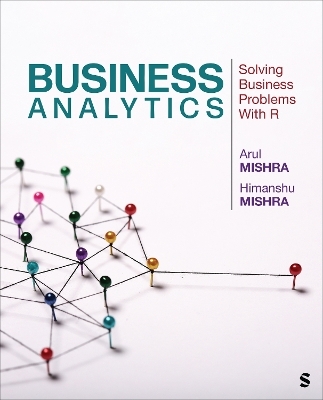
Business Analytics
SAGE Publications Inc (Verlag)
978-1-0718-1523-6 (ISBN)
Included with this title:
LMS Cartridge: Import this title’s instructor resources into your school’s learning management system (LMS) and save time. Don’t use an LMS? You can still access all of the same online resources for this title via the password-protected Instructor Resource Site.
Arul Mishra is the Emma Eccles Jones Presidential Chair Professor of Marketing and Adjunct Professor, School of Computing at the University of Utah. Her research, on a broader level, uses machine learning methods to understand customer decisions and guide firm strategies. Specifically, she derives theoretical and practical insights from data using computational algorithms to understand customer engagement in digital markets, customer preference and choice, financial decisions, online advertising, and creativity. Currently her research involves leveraging language and generative models for business applications. She also examines the ethical consequences of using algorithms. Can algorithms exacerbate or reduce the impact of social biases and inequities? How can algorithms help firms make better decisions? Methodologically, she uses Natural Language Processing, generative language models, image processing, and field studies to test social phenomena and theories. Arul’s research has been published in the Journal of Marketing Research, Journal of Consumer Research, Journal of Marketing, Marketing Science, Management Science, Journal of Personality and Social Psychology, Organizational Behavior and Human Decision Processes, Psychological Science, and American Psychologist®. Popular accounts of her work have appeared in Scientific American, Los Angeles Times, The Wall Street Journal, Chicago Tribune, MSN Money, The Financial Express, and Shape. Arul teaches or has taught several courses at the Eccles School of Business including Algorithms for Business Decisions for Master students, Consumer Analytics for undergraduate students, and doctoral courses on research theory and methods. Himanshu Mishra serves as the David Eccles Professor at the Eccles School of Business and as an Adjunct Professor in the Kahlert School of Computing at the University of Utah. He earned his Ph.D. in marketing from the University of Iowa. Himanshu uses machine learning methods to analyze human decisions in social and marketplace settings. He often collaborates with firms to apply the insights he gathers from research. The findings of his research inform consumer decision-making, AI′s role in fair decisions, risk assessment strategies, and overall human well-being. With over 20 years in academia, Himanshu has taught across undergraduate, graduate, and Ph.D. levels. His recent courses involve using machine learning applications to improve business decisions and the importance of algorithmic fairness. His extensive research contributions can be found in top journals and conferences spanning marketing, business, computer science, and psychology—including the Journal of Marketing Research, IEEE International Conference on Big Data, Psychological Science, and others. Moreover, media outlets like MSNBC, The Wall Street Journal, National Public Radio, and The New York Times have featured his work.
Part 1. Business Environment Analytics
Chapter 1: The external environment of a business
What Is a Business?
Internal and External Environment of a Business
Using Analytics to Understand the Business Environment
Chapter 2: Monitoring the Macroeconomic Environment
Defining the Macroeconomic Environment
Impact of Macroeconomic Factors on Business Outcomes
Regression for Prediction
Application of Linear Regression for Prediction
A Few Things to Remember
Implementation Using R: Predicting Units Ordered for MedDiagnostics
Understanding the Chapter
Chapter 3: Monitoring the Competitive Environment using Principal Component Analysis
The Competitive Environment of a Business
Visualization Using Principal Component Analysis
Application of PCA for Competitor Analysis
Other Uses of PCA
Implementation Using R: Competitor Analysis
Appendix: Technical Details of PCA
Understanding the Chapter
Chapter 4: Monitoring the Social Environment using Text Analysis
Understanding the Social Environment
Defining Text Data
Converting Qualitative Text Data to a Quantifiable Form
Analyzing Text Data
Choice of Meat Versus Meatless Options: A Reflection of the Social Environment
Other Text Analysis Methods
Implementation Using R: Choice of Meat Versus Meatless Options
Understanding the Chapter
Part 2. Marketing Analytics
Chapter 5: Market Segmentation using Clustering Algorithms
Segmenting Customers
Targeting Potential Customers
Positioning the Product in Customers’ Minds
Data-Driven Segmentation
Clustering Algorithms for Segmentation
Implementation Using R: Segmentation Using k-means and k-medoid
Understanding the Chapter
Chapter 6: Predicting Price with Neural Nets
Understanding Product Pricing
The Power of Pricing
Role of Analytics in Price Prediction
The Architecture of Neural Networks
A Deep Dive Into Neural Nets
Predicting House Prices Using Neural Nets
Implementation Using R: Predicting House Prices
Understanding the Chapter
Chapter 7: Advertising and Branding with A/B Testing
Advertising: Spreading the Message
Causal vs. Correlational
A/B Testing for Advertising Effectiveness
Steps in A/B Testing
Experimental Design to Test for Effective Advertisement
Machine-Learning-Based A/B Testing for Finding Effective Advertisements
Implementation Using R: A/B Testing for Advertising Effectiveness
Understanding the Chapter
Chapter 8: Customer Analytics using Neural Nets
Retaining Existing Customers
Rationale for a Defensive Strategy
Monitoring Satisfaction
Past Behavior as a Predictor of Churn
Predicting Customer Drop-Off Using Neural Nets
Implementation Using R: Predicting Customer Churn
Understanding the Chapter
Part 3. Financial and Accounting Analytics
Chapter 9: Loan Charge-off Prediction using an Explainable Model
Using Analytics for Financial Decisions
Risk Assessment: External Versus Internal Factors
Credit Underwriting: Protecting Against Risk
Logistic Regression
Using Logistic Regression for Charge-Off Prediction
Implementation Using R: Loan Approval
Understanding the Chapter
Chapter 10: Analyzing Financial Performance with LASSO
Financial Health of a Business
Importance of Forecasting Financial Health of the Business
Importance of Knowing Financial Health for Lenders
Importance of Knowing a Business’s Financial Health for Investors
Forecasting Financial Health
Multicollinearity
Using Penalized Regression for Evaluating Financial Health
Implementation Using R: Evaluating the Health of a Business
Appendix: Glossary of Financial Terms
Understanding the Chapter
Chapter 11: Forensic Accounting using Outlier Detection Algorithms
Machine Learning for Accounting
Forensic Accounting
Machine Learning for Forensic Accounting
Understanding Outliers
Detecting Fraudulent Transactions Using Loop
Business Insights and Conclusion
Implementation Using R: Outlier Detection for Identifying Fraudulent Transactions
Appendix: Glossary of Accounting Terms
Understanding the Chapter
Part 4. Operations and Supply Chain Analytics
Chapter 12: Predicting Decision Uncertainty using Random Forests
Decision-Making Under Uncertainty
Features of Decision Uncertainty
Backorder and Its Implications
Machine-Learning Options to Aid in Decision-Making Under Uncertainty
Random Forest
Backorder Prediction Using Random Forests
Business Insights and Summary
Implementation Using R: Backorder Prediction
Understanding the Chapter
Chapter 13: Predicting Employee Satisfaction using Boosted Decision Trees
Employee Satisfaction Drives Customer Satisfaction
Measuring Employee Satisfaction
Gradient-Boosted Trees
Using Boosted Decision Trees to Understand What Impacts Job Satisfaction
Business Insights and Summary
Implementation Using R: Employee Satisfaction
Understanding the Chapter
Chapter 14: New Product Development with A/B Testing
Innovations in the Marketplace
New Product Development Stages
The Importance of Testing and Market Research
The Intricacies of A/B Testing
Using A/B Testing to Test Gaming Prototypes
Using the A/B Test in New Product Development
Implementation Using R: The A/B Test
Understanding the Chapter
Part 5. Business Ethics and Analytics
Chapter 15: Fairness in Business Analytics
Introduction
What Are the Causes Behind Algorithmic Unfairness?
Mitigating Unfairness
Implementation Using Python: Debiasing an Algorithm
Understanding the Chapter
Part 6. Technical Appendix
| Erscheinungsdatum | 16.05.2024 |
|---|---|
| Verlagsort | Thousand Oaks |
| Sprache | englisch |
| Maße | 187 x 231 mm |
| Gewicht | 570 g |
| Themenwelt | Mathematik / Informatik ► Mathematik ► Finanz- / Wirtschaftsmathematik |
| Wirtschaft ► Betriebswirtschaft / Management ► Unternehmensführung / Management | |
| ISBN-10 | 1-0718-1523-7 / 1071815237 |
| ISBN-13 | 978-1-0718-1523-6 / 9781071815236 |
| Zustand | Neuware |
| Informationen gemäß Produktsicherheitsverordnung (GPSR) | |
| Haben Sie eine Frage zum Produkt? |
aus dem Bereich


