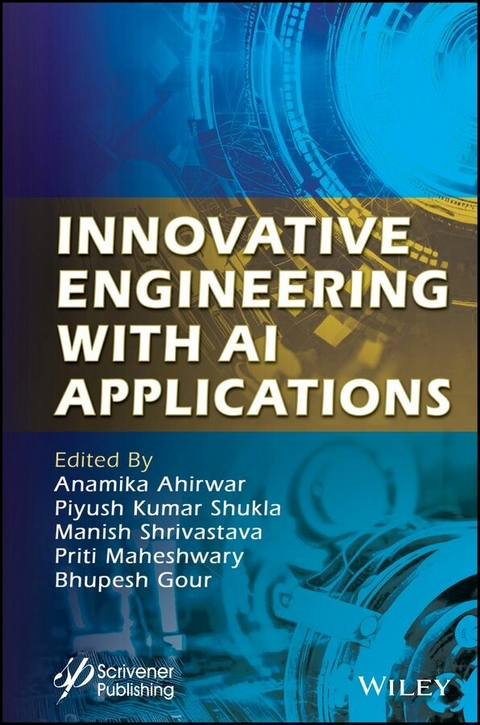
Innovative Engineering with AI Applications demonstrates how we can innovate in different engineering domains as well as how to make most business problems simpler by applying AI to them.
Engineering advancements combined with artificial intelligence (AI), have resulted in a hyper-connected society in which smart devices are not only used to exchange data but also have increased capabilities. These devices are becoming more context-aware and smarter by the day. This timely book shows how organizations, who want to innovate and adapt, can enter new markets using expertise in various emerging technologies (e.g. data, AI, system architecture, blockchain), and can build technology-based business models, a culture of innovation, and high-performing networks. The book specifies an approach that anyone can use to better architect, design, and more effectively build things that are technically novel, useful, and valuable, and to do so efficiently, on-time, and repeatable.
Audience
The book is essential to AI product developers, business leaders in all industries and organizational domains. Researchers, academicians, and students in the AI field will also benefit from reading this book.
Anamika Ahirwar, PhD, is an associate professor at the Compucom Institute of Information Technology & Management, Jaipur, India. She has about 20 years of experience in teaching and research and has published more than 45 research papers in reputed national/international journals and conferences, authored several books as well as five patents.
Piyush Kumar Shukla, PhD, is an associate professor in the Department of Computer Science & Engineering, University Institute of Technology, Bhopal, India. He has about 15 years of experience in teaching and research, is the author of 3 books, more than 50 articles and book chapters in international publications, as well as 15 Indian patents.
Manish Shrivastava, PhD, is the Principal of the Chameli Devi Institute of Technology & Management, Indore, India. He has published more than 100 articles in international journals and spent 7 years as a software engineer.
Priti Maheshwary, PhD, is a professor in the Department of CSE and Head of the Centre for Excellence in Internet of Things and Advance Computing Lab, Rabindranath Tagore University, Bhopal, India.
Bhupesh Gour, PhD, is a professor in the Department of Computer Science and Engineering at Lakshmi Narain College of Technology in Bhopal, India. He has 22 years of experience in academia as well as the software industry. He has published more than 50 articles in national and international journals, as well as four patents.
Innovative Engineering with AI Applications Innovative Engineering with AI Applications demonstrates how we can innovate in different engineering domains as well as how to make most business problems simpler by applying AI to them. Engineering advancements combined with artificial intelligence (AI), have resulted in a hyper-connected society in which smart devices are not only used to exchange data but also have increased capabilities. These devices are becoming more context-aware and smarter by the day. This timely book shows how organizations, who want to innovate and adapt, can enter new markets using expertise in various emerging technologies (e.g. data, AI, system architecture, blockchain), and can build technology-based business models, a culture of innovation, and high-performing networks. The book specifies an approach that anyone can use to better architect, design, and more effectively build things that are technically novel, useful, and valuable, and to do so efficiently, on-time, and repeatable. Audience The book is essential to AI product developers, business leaders in all industries and organizational domains. Researchers, academicians, and students in the AI field will also benefit from reading this book.
Anamika Ahirwar, PhD, is an associate professor at the Compucom Institute of Information Technology & Management, Jaipur, India. She has about 20 years of experience in teaching and research and has published more than 45 research papers in reputed national/international journals and conferences, authored several books as well as five patents. Piyush Kumar Shukla, PhD, is an associate professor in the Department of Computer Science & Engineering, University Institute of Technology, Bhopal, India. He has about 15 years of experience in teaching and research, is the author of 3 books, more than 50 articles and book chapters in international publications, as well as 15 Indian patents. Manish Shrivastava, PhD, is the Principal of the Chameli Devi Institute of Technology & Management, Indore, India. He has published more than 100 articles in international journals and spent 7 years as a software engineer. Priti Maheshwary, PhD, is a professor in the Department of CSE and Head of the Centre for Excellence in Internet of Things and Advance Computing Lab, Rabindranath Tagore University, Bhopal, India. Bhupesh Gour, PhD, is a professor in the Department of Computer Science and Engineering at Lakshmi Narain College of Technology in Bhopal, India. He has 22 years of experience in academia as well as the software industry. He has published more than 50 articles in national and international journals, as well as four patents.
1
Introduction of AI in Innovative Engineering
Anamika Ahirwar
Compucom Institute of Information Technology and Management, Jaipur, Rajasthan, India
Abstract
The widespread use of Artificial Intelligence [1] technology and its ongoing development have created new opportunities for creative engineering. Our daily lives have been completely taken over by the revolutionary realm of Artificial Intelligence (AI). It is the unique fusion of brains and therefore of machines. Artificial intelligence has been growing steadily over the last few years, establishing roots in most industries. There have been recent developments and technologies that support AI. The uses of AI don’t seem to be limited to physical space; they can be found in everything from a secondary aspect to a novel development. A new society is being created by many technologies, devices, and even some brand-new inventions that have yet to be realized. Therefore, it offers a seamless route that leads to a promising future. This chapter intends to focus on an overview of innovative engineering in artificial intelligence and introduces the concepts of innovative engineering and artificial engineering with the aid of many innovation engineering guiding principles. This chapter covers the background, need for, and applications of artificial intelligence and also explains the various subfields of artificial intelligence [8]. This chapter covers the background, need for, and applications of artificial intelligence.
Keywords: Innovation Engineering, Artificial Intelligence (AI), Artificial Narrow Intelligence (ANI), Artificial General Intelligence (AGI), Artificial Super Intelligence (ASI)
1.1 Introduction to Innovation Engineering
Innovation Engineering is defined as a method for solving technology and business problems for organizations who want to innovate, adapt, and/or enter new markets using expertise in emerging technologies (e.g. data, AI, system architecture, blockchain), technology business models, innovation culture, and high-performing networks.
When Dave Kelly specified the IDEO process for design in 1971, he changed the predictability of design projects around the world and made each design project more likely to serve its users well. In a similar way, this Innovation Engineering process is intended to make innovation projects in engineering more successful. The process builds upon many best practices in innovation, but it also brings them into a domain of more technically sophisticated areas.
The concept of Innovation Engineering also integrates many years of observing our students who have engineered novel technologies and companies. The goal is to specify an approach that anyone can use to better architect, design, and more effectively build things that are technically novel, useful, and valuable. And further, the goal is to be able to do this efficiently, on-time, and repeatable.
At its core, Innovation Engineering is the result of using the approaches, processes, behaviors, and mindsets of entrepreneurs/innovators with the context of engineering projects. This is illustrated in the Figure 1.1.
One thing that we have observed is that innovative technical leaders employ similar behavioral patterns as entrepreneurs even in areas of engineering architecture, design, and implementation. And further, these behaviors can be amplified within a process.
Figure 1.1 Innovation engineering.
1.2 Flow for Innovation Engineering
A high-level process example is shown in Figure 1.2. It simply illustrates the concept of brainstorming a problem/solution, converting the problem/ solution into a ‘story’ called a low-tech demo, and then using agile sprints to develop the project.
This simple process flow can be extended to include business and/or organizational context. Figure 1.2 shows a process flow for Innovation Engineering with greater detail and broader context. The flow illustrates that effective projects start always with a story or narrative. This narrative is generally based on background of the team and an observation of changes in the world (e.g. market, technical, societal, or regulatory changes). When a project does not start with a story narrative, it is typically too narrowly defined and generally goes off target in our experience. Note, the “Low Tech Demo” in the example maps to the Technical Story in the lower diagram which is used to kick-off an Agile project leading to an Implementation.
The story narrative is used to collect initial stakeholders, resources, and obtain initial validation for the project. In our experience, there is no better way to attract resources than by testing a story and/or initial prototype.
From here, the story narrative can be broken into two sub-narratives, one for the technical story and another for the broader context or business story. Each story is the starting point of a learning path, and specifically not an execution path. The technical path is an agile process that leads to an implementation starting first from the user’s viewpoint. For example, in Data-X, we use the following components as part of the technical story which we call a “low tech demo”.
Figure 1.2 A process flow for innovation engineering.
Low tech demo outline, an example of a technical story:
- What is it supposed to do – and ideally why
- User’s perspective, top three user expectations
- Key technical components with risk levels
- An architecture, and
- Short-term plan and assignments towards the simplest demonstration.
In contrast, the business learning path is intended to result in
- An industry ecosystem of customers, partners, suppliers, etc. and
- The discovery of a working business model or fulfillment of a mission in a government organization.
These learning paths converge when the business model/mission and the technology are all working and integrated. Only after this step can the innovation be scaled via execution and planning. Innovation Engineering tends to focus more on the technical path as required for successful implementation, but must include the broader process as described to be successful.
While all of this is a very quick overview of the process, it does set the context for a set of important principles that are required for the process to be successful. Like with any other organizational activity, Innovation Engineering requires a set of shared beliefs and behaviors to be successful. These ‘Guiding Principles’ for Innovation Engineering are outlined in the section below are intended to be synergistic with the process flow explained in the Figure 1.2.
1.3 Guiding Principles for Innovation Engineering
- Start with Story: Virtually all successful projects start with a story narrative. The story is the means of validation, consensus building, and collecting stakeholders. Any project that starts without a validated story likely jumps to an invalidated conclusion about the problem. Stories can vary in length and complexity, i.e. the problem of a user and its resolution, or the famous NABC story developed at SRI which stands for Needs, Approach, Benefit, and Competition. However, the key to a good story is that there is an insight that others have not seen and that there is substantial benefit of the solution to at least some segment or stakeholder.
- Scale or Invent: Determine if the project is about creating something new (i.e. a new product, new service, new technology, new customer, etc.) then it’s a learning process, and in that case it requires a team with corresponding behaviors. If the project is about scaling something that already works (i.e. serving more customers, increasing the capacity of a system, etc.) then it’s an execution process best accomplished by someone who has done it or something like it before. In this later case, the team can jump immediately to the scaling phase at the end of the process.
- User-first: The technical story must highlight a solution first from the user’s viewpoint. Note that entrepreneurial stories typically explain how a venture will both solve a problem and achieve a working business model, the technical story must explain the user’s viewpoint first and only then lead to the system architecture and the implementation.
- Effectuation: Great technical innovators and entrepreneurs all use “Effectuation Principals” in a natural manner. It roughly means to start with what you have, and sometimes it means you must take inventory of what you have first. To illustrate, if you were to make a dinner, do you first choose an intended dish and then gather the ingredients (not effectuation), or would you look at what you already have in the kitchen and then invent a new recipe from the ingredients you already have (effectuation). This principle can be applied to technical and business projects in the same manner.
- Break it down: Components, interfaces, and interconnections. Evaluate potential solutions by breaking the proposed system down into simple sub-systems with minimal inter-connections. Understand the interactions and causal relationships between subcomponents. And of course, if a sub-component already exists or can be easily obtained, then there is no need to build or redesign that subcomponent. For example, when Tesla created its battery, it created it from thousands of cells that were already being produced in mass scale,...
| Erscheint lt. Verlag | 18.7.2023 |
|---|---|
| Sprache | englisch |
| Themenwelt | Mathematik / Informatik ► Informatik ► Theorie / Studium |
| Schlagworte | AI • Artificial Intelligence • biodegradable • biolubricant • biomedical engineering • Biomedizintechnik • Computer Science • Depolymerization • Electrical & Electronics Engineering • Elektrotechnik u. Elektronik • Informatik • Intelligente Systeme u. Agenten • Intelligent Systems & Agents • KI • Künstliche Intelligenz • macroalgae • Marine environment • Medical Informatics & Biomedical Information Technology • Medizininformatik u. biomedizinische Informationstechnologie • microalgae • microbial species • microplastic detection • Microplastics • polysaccharides • Tribological Performance • Vegetable Oil |
| ISBN-13 | 9781119792147 / 9781119792147 |
| Informationen gemäß Produktsicherheitsverordnung (GPSR) | |
| Haben Sie eine Frage zum Produkt? |
 EPUB (Adobe DRM)
Kopierschutz: Adobe-DRM
Adobe-DRM ist ein Kopierschutz, der das eBook vor Mißbrauch schützen soll. Dabei wird das eBook bereits beim Download auf Ihre persönliche Adobe-ID autorisiert. Lesen können Sie das eBook dann nur auf den Geräten, welche ebenfalls auf Ihre Adobe-ID registriert sind.
Details zum Adobe-DRM
Dateiformat: EPUB (Electronic Publication)
EPUB ist ein offener Standard für eBooks und eignet sich besonders zur Darstellung von Belletristik und Sachbüchern. Der Fließtext wird dynamisch an die Display- und Schriftgröße angepasst. Auch für mobile Lesegeräte ist EPUB daher gut geeignet.
Systemvoraussetzungen:
PC/Mac: Mit einem PC oder Mac können Sie dieses eBook lesen. Sie benötigen eine
eReader: Dieses eBook kann mit (fast) allen eBook-Readern gelesen werden. Mit dem amazon-Kindle ist es aber nicht kompatibel.
Smartphone/Tablet: Egal ob Apple oder Android, dieses eBook können Sie lesen. Sie benötigen eine
Geräteliste und zusätzliche Hinweise
Buying eBooks from abroad
For tax law reasons we can sell eBooks just within Germany and Switzerland. Regrettably we cannot fulfill eBook-orders from other countries.
aus dem Bereich