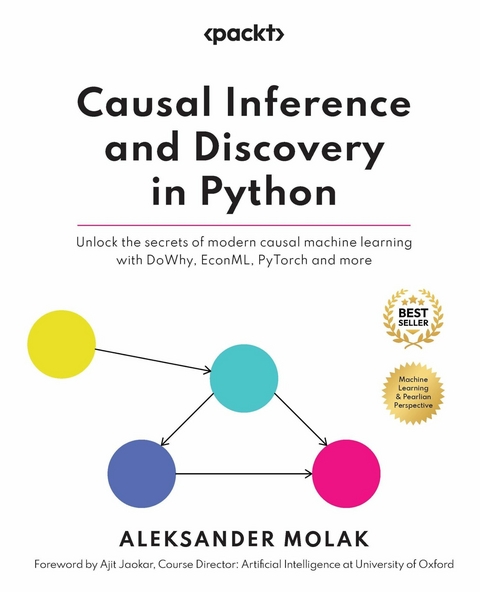
Causal Inference and Discovery in Python (eBook)
466 Seiten
Packt Publishing (Verlag)
978-1-80461-173-9 (ISBN)
Causal methods present unique challenges compared to traditional machine learning and statistics. Learning causality can be challenging, but it offers distinct advantages that elude a purely statistical mindset. Causal Inference and Discovery in Python helps you unlock the potential of causality.
You'll start with basic motivations behind causal thinking and a comprehensive introduction to Pearlian causal concepts, such as structural causal models, interventions, counterfactuals, and more. Each concept is accompanied by a theoretical explanation and a set of practical exercises with Python code. Next, you'll dive into the world of causal effect estimation, consistently progressing towards modern machine learning methods. Step-by-step, you'll discover Python causal ecosystem and harness the power of cutting-edge algorithms. You'll further explore the mechanics of how 'causes leave traces' and compare the main families of causal discovery algorithms. The final chapter gives you a broad outlook into the future of causal AI where we examine challenges and opportunities and provide you with a comprehensive list of resources to learn more.
By the end of this book, you will be able to build your own models for causal inference and discovery using statistical and machine learning techniques as well as perform basic project assessment.
Demystify causal inference and casual discovery by uncovering causal principles and merging them with powerful machine learning algorithms for observational and experimental dataPurchase of the print or Kindle book includes a free PDF eBookKey FeaturesExamine Pearlian causal concepts such as structural causal models, interventions, counterfactuals, and moreDiscover modern causal inference techniques for average and heterogenous treatment effect estimationExplore and leverage traditional and modern causal discovery methodsBook DescriptionCausal methods present unique challenges compared to traditional machine learning and statistics. Learning causality can be challenging, but it offers distinct advantages that elude a purely statistical mindset. Causal Inference and Discovery in Python helps you unlock the potential of causality. You ll start with basic motivations behind causal thinking and a comprehensive introduction to Pearlian causal concepts, such as structural causal models, interventions, counterfactuals, and more. Each concept is accompanied by a theoretical explanation and a set of practical exercises with Python code. Next, you ll dive into the world of causal effect estimation, consistently progressing towards modern machine learning methods. Step-by-step, you ll discover Python causal ecosystem and harness the power of cutting-edge algorithms. You ll further explore the mechanics of how causes leave traces and compare the main families of causal discovery algorithms. The final chapter gives you a broad outlook into the future of causal AI where we examine challenges and opportunities and provide you with a comprehensive list of resources to learn more. By the end of this book, you will be able to build your own models for causal inference and discovery using statistical and machine learning techniques as well as perform basic project assessment.What you will learnMaster the fundamental concepts of causal inferenceDecipher the mysteries of structural causal modelsUnleash the power of the 4-step causal inference process in PythonExplore advanced uplift modeling techniquesUnlock the secrets of modern causal discovery using PythonUse causal inference for social impact and community benefitWho this book is forThis book is for machine learning engineers, researchers, and data scientists looking to extend their toolkit and explore causal machine learning. It will also help people who ve worked with causality using other programming languages and now want to switch to Python, those who worked with traditional causal inference and want to learn about causal machine learning, and tech-savvy entrepreneurs who want to go beyond the limitations of traditional ML. You are expected to have basic knowledge of Python and Python scientific libraries along with knowledge of basic probability and statistics.]]>
Preface
I wrote this book with a purpose in mind.
My journey to practical causality was an exciting but also challenging road.
Going from great theoretical books to implementing models in practice, and from translating assumptions to verifying them in real-world scenarios, demanded significant work.
I could not find unified, comprehensive resources that could be my guide through this journey.
This book is intended to be that guide.
This book provides a map that allows you to break into the world of causality.
We start with basic motivations behind causal thinking and a comprehensive introduction to Pearlian causal concepts: structural causal model, interventions, counterfactuals, and more.
Each concept comes with a theoretical explanation and a set of practical exercises accompanied by Python code.
Next, we dive into the world of causal effect estimation. Starting simple, we consistently progress toward modern machine learning methods. Step by step, we introduce the Python causal ecosystem and harness the power of cutting-edge algorithms.
In the last part of the book, we sneak into the secret world of causal discovery. We explore the mechanics of how causes leave traces and compare the main families of causal discovery algorithms to unravel the potential of end-to-end causal discovery and human-in-the-loop learning.
We close the book with a broad outlook into the future of causal AI. We examine challenges and opportunities and provide you with a comprehensive list of resources to learn more.
Who this book is for
The main audience I wrote this book for consists of machine learning engineers, data scientists, and machine learning researchers with three or more years of experience, who want to extend their data science toolkit and explore the new unchartered territory of causal machine learning.
People familiar with causality who have worked with another technology (e.g., R) and want to switch to Python can also benefit from this book, as well as people who have worked with traditional causality and want to expand their knowledge and tap into the potential of causal machine learning.
Finally, this book can benefit tech-savvy entrepreneurs who want to build a competitive edge for their products and go beyond the limitations of traditional machine learning.
What this book covers
Chapter 1, Causality: Hey, We Have Machine Learning, So Why Even Bother?, briefly discusses the history of causality and a number of motivating examples. This chapter introduces the notion of spuriousness and demonstrates that some classic definitions of causality do not capture important aspects of causal learning (which human babies know about). This chapter provides the basic distinction between statistical and causal learning, which is a cornerstone for the rest of the book.
Chapter 2, Judea Pearl and the Ladder of Causation, provides us with a definition of the Ladder of Causation – a crucial concept introduced by Judea Pearl that emphasizes the differences between observational, interventional, and counterfactual queries and distributions. We build on top of these ideas and translate them into concrete code examples. Finally, we briefly discuss how different families of machine learning (supervised, reinforcement, semi-, and unsupervised) relate to causal modeling.
Chapter 3, Regression, Observations, and Interventions, prepares us to take a look at linear regression from a causal perspective. We analyze important properties of observational data and discuss the significance of these properties for causal reasoning. We re-evaluate the problem of statistical control through the causal lens and introduce structural causal models (SCMs). These topics help us build a strong foundation for the rest of the book.
Chapter 4, Graphical Models, starts with a refresher on graphs and basic graph theory. After refreshing the fundamental concepts, we use them to define directed acyclic graphs (DAGs) – one of the most crucial concepts in Pearlian causality. We briefly introduce the sources of causal graphs in the real world and touch upon causal models that are not easily describable using DAGs. This prepares us for Chapter 5.
Chapter 5, Forks, Chains, and Immoralities, focuses on three basic graphical structures: forks, chains, and immoralities (also known as colliders). We learn about the crucial properties of these structures and demonstrate how these graphical concepts manifest themselves in the statistical properties of the data. The knowledge we gain in this chapter will be one of the fundamental building blocks of the concepts and techniques that we introduced in Part 2 and Part 3 of this book.
Chapter 6, Nodes, Edges, and Statistical (In)Dependence, builds on top of the concepts introduced in Chapter 5 and takes them a step further. We introduce the concept of d-separation, which will allow us to systematically evaluate conditional independence queries in DAGs, and define the notion of estimand. Finally, we discuss three popular estimands and the conditions under which they can be applied.
Chapter 7, The Four-Step Process of Causal Inference, takes us to the practical side of causality. We introduce DoWhy – an open source causal inference library created by researchers from Microsoft – and show how to carry out a full causal inference process using its intuitive APIs. We demonstrate how to define a causal model, find a relevant estimand, estimate causal effects, and perform refutation tests.
Chapter 8, Causal Models – Assumptions and Challenges, brings our attention back to the topic of assumptions. Assumptions are a crucial and indispensable part of any causal project or analysis. In this chapter, we take a broader view and discuss the most important assumptions from the point of view of two causal formalisms: the Pearlian (graph-based) framework and the potential outcomes framework.
Chapter 9, Causal Inference and Machine Learning – from Matching to Meta-learners, opens the door to causal estimation beyond simple linear models. We start by introducing the ideas behind matching and propensity scores and discussing why propensity scores should not be used for matching. We introduce meta-learners – a class of models that can be used for the estimation of conditional average treatment effects (CATEs) and implement them using DoWhy and EconML packages.
Chapter 10, Causal Inference and Machine Learning – Advanced Estimators, Experiments, Evaluations, and More, introduces more advanced estimators: DR-Learner, double machine learning (DML), and causal forest. We show how to use CATE estimators with experimental data and introduce a number of useful evaluation metrics that can be applied in real-world scenarios. We conclude the chapter with a brief discussion of counterfactual explanations.
Chapter 11, Causal Inference and Machine Learning – Deep Learning, NLP, and Beyond, introduces deep learning models for CATE estimation and a PyTorch-based CATENets library. In the second part of the chapter, we take a look at the intersection of causal inference and NLP and introduce CausalBert – a Transformer-based model that can be used to remove spurious relationships present in textual data. We close the chapter with an introduction to the synthetic control estimator, which we use to estimate causal effects in real-world data.
Chapter 12, Can I Have a Causal Graph, Please?, provides us with a deeper look at the real-world sources of causal knowledge and introduces us to the concept of automated causal discovery. We discuss the idea of expert knowledge and its value in the process of causal analysis.
Chapter 13, Causal Discovery and Machine Learning – from Assumptions to Applications, starts with a review of assumptions required by some of the popular causal discovery algorithms. We introduce four main families of causal discovery methods and implement key algorithms using the gCastle library, addressing some of the important challenges on the way. Finally, we demonstrate how to encode expert knowledge when working with selected methods.
Chapter 14, Causal Discovery and Machine Learning – Advanced Deep Learning and Beyond, introduces an advanced causal discovery algorithm – DECI. We implement it using the modules coming from an...
| Erscheint lt. Verlag | 31.5.2023 |
|---|---|
| Vorwort | Ajit Jaokar |
| Sprache | englisch |
| Themenwelt | Informatik ► Theorie / Studium ► Künstliche Intelligenz / Robotik |
| ISBN-10 | 1-80461-173-5 / 1804611735 |
| ISBN-13 | 978-1-80461-173-9 / 9781804611739 |
| Informationen gemäß Produktsicherheitsverordnung (GPSR) | |
| Haben Sie eine Frage zum Produkt? |
 EPUB (Ohne DRM)
Digital Rights Management: ohne DRM
Dieses eBook enthält kein DRM oder Kopierschutz. Eine Weitergabe an Dritte ist jedoch rechtlich nicht zulässig, weil Sie beim Kauf nur die Rechte an der persönlichen Nutzung erwerben.
Dateiformat: EPUB (Electronic Publication)
EPUB ist ein offener Standard für eBooks und eignet sich besonders zur Darstellung von Belletristik und Sachbüchern. Der Fließtext wird dynamisch an die Display- und Schriftgröße angepasst. Auch für mobile Lesegeräte ist EPUB daher gut geeignet.
Systemvoraussetzungen:
PC/Mac: Mit einem PC oder Mac können Sie dieses eBook lesen. Sie benötigen dafür die kostenlose Software Adobe Digital Editions.
eReader: Dieses eBook kann mit (fast) allen eBook-Readern gelesen werden. Mit dem amazon-Kindle ist es aber nicht kompatibel.
Smartphone/Tablet: Egal ob Apple oder Android, dieses eBook können Sie lesen. Sie benötigen dafür eine kostenlose App.
Geräteliste und zusätzliche Hinweise
Buying eBooks from abroad
For tax law reasons we can sell eBooks just within Germany and Switzerland. Regrettably we cannot fulfill eBook-orders from other countries.
aus dem Bereich