Zum Hauptinhalt springen
Nicht aus der Schweiz? Besuchen Sie lehmanns.de

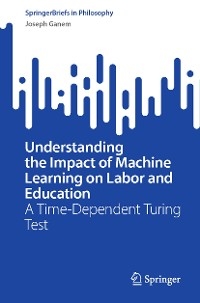
Understanding the Impact of Machine Learning on Labor and Education (eBook)

A Time-Dependent Turing Test

(Autor)

eBook Download: PDF
2023
74 Seiten
Springer Nature Switzerland (Verlag)
978-3-031-31004-1 (ISBN)
Lese- und Medienproben

Understanding the Impact of Machine Learning on Labor and Education - Joseph Ganem
Systemvoraussetzungen
53,49 inkl. MwSt
(CHF 52,25)
Der eBook-Verkauf erfolgt durch die Lehmanns Media GmbH (Berlin) zum Preis in Euro inkl. MwSt.
  • Download sofort lieferbar
  • Zahlungsarten anzeigen
This book provides a novel framework for understanding and revising labor markets and education policies in an era of machine learning. It posits that while learning and knowing both require thinking, learning is fundamentally different than knowing because it results in cognitive processes that change over time. Learning, in contrast to knowing, requires time and agency. Therefore, “learning algorithms”—that enable machines to modify their actions based on real-world experiences—are a fundamentally new form of artificial intelligence that have potential to be even more disruptive to labor markets than prior introductions of digital technology. To explore the difference between knowing and learning, Turing’s “Imitation Game,”—that he proposed as a test for machine thinking—is expanded to include time dependence.   The arguments presented in the book introduce three novel concepts:   (1) Comparative learning advantage: This is a concept analogous to comparative labor advantagebut arises from the disparate times required to learn new knowledge bases/skillsets. It is argued that in the future, comparative learning advantages between humans and machines will determine their division of labor.   (2) Two dimensions of job performance—expertise and interpersonal: Job tasks can be sorted into two broad categories. Tasks that require expertise have stable endpoints, which makes these tasks inherently repetitive and subject to automation. Tasks that are interpersonal are highly context-dependent and lack stable endpoints, which makes these tasks inherently non-routine. Humans compared to machines have a comparative learning advantage along the interpersonal dimension, which is increasing in value economically.   (3) The Learning Game is a time-dependent version of Turing’s “Imitation Game.” It is more than a thought experiment. The “Learning Game” provides a mathematical framework with quantitative criteria for training and assessing comparative learningadvantages.   The book is highly interdisciplinary—presenting philosophical arguments in economics, artificial intelligence, and education. It also provides data, mathematical analysis, and testable criteria that researchers in these fields will find of practical use. The book calls for a rethinking of how labor markets operate and how the education system should prepare students for future jobs. It concludes with a list of counterintuitive recommendations for future education and labor policies that all stakeholders—employers, employees, educators, students, and political leaders—should heed.

Erscheint lt. Verlag 1.6.2023
Reihe/Serie SpringerBriefs in Philosophy
SpringerBriefs in Philosophy
Zusatzinfo XVII, 74 p. 13 illus., 10 illus. in color.
Sprache englisch
Themenwelt Geisteswissenschaften Philosophie Erkenntnistheorie / Wissenschaftstheorie
Informatik Theorie / Studium Künstliche Intelligenz / Robotik
Mathematik / Informatik Mathematik Statistik
Schlagworte Advantages of a Liberal Arts Education • Artificial Intelligence in the Workplace • Comparative Advantage • Dependence of Lifetime Earnings on Education Levels • Determination of Wage Rates • Division of Labor between Humans and Machines • Economic Philosophy of Labor • Effect of Workplace Automation on Wages • Future Education Policies • imitation game • Job Training Programs • Labor Market Change Resulting from Artificial Intelligence • machine learning • Philosophy of Artificial Intelligence • turing test • Worker Displacement
ISBN-10 3-031-31004-7 / 3031310047
ISBN-13 978-3-031-31004-1 / 9783031310041
Informationen gemäß Produktsicherheitsverordnung (GPSR)
Haben Sie eine Frage zum Produkt?
PDFPDF (Wasserzeichen)

DRM: Digitales Wasserzeichen
Dieses eBook enthält ein digitales Wasser­zeichen und ist damit für Sie persona­lisiert. Bei einer missbräuch­lichen Weiter­gabe des eBooks an Dritte ist eine Rück­ver­folgung an die Quelle möglich.

Dateiformat: PDF (Portable Document Format)
Mit einem festen Seiten­layout eignet sich die PDF besonders für Fach­bücher mit Spalten, Tabellen und Abbild­ungen. Eine PDF kann auf fast allen Geräten ange­zeigt werden, ist aber für kleine Displays (Smart­phone, eReader) nur einge­schränkt geeignet.

Systemvoraussetzungen:
PC/Mac: Mit einem PC oder Mac können Sie dieses eBook lesen. Sie benötigen dafür einen PDF-Viewer - z.B. den Adobe Reader oder Adobe Digital Editions.
eReader: Dieses eBook kann mit (fast) allen eBook-Readern gelesen werden. Mit dem amazon-Kindle ist es aber nicht kompatibel.
Smartphone/Tablet: Egal ob Apple oder Android, dieses eBook können Sie lesen. Sie benötigen dafür einen PDF-Viewer - z.B. die kostenlose Adobe Digital Editions-App.

Buying eBooks from abroad
For tax law reasons we can sell eBooks just within Germany and Switzerland. Regrettably we cannot fulfill eBook-orders from other countries.

Mehr entdecken
aus dem Bereich
Die Grundlage der Digitalisierung

von Knut Hildebrand; Michael Mielke; Marcus Gebauer

eBook Download (2025)
Springer Fachmedien Wiesbaden (Verlag)
CHF 29,30
Die materielle Wahrheit hinter den neuen Datenimperien

von Kate Crawford

eBook Download (2024)
C.H.Beck (Verlag)
CHF 17,55