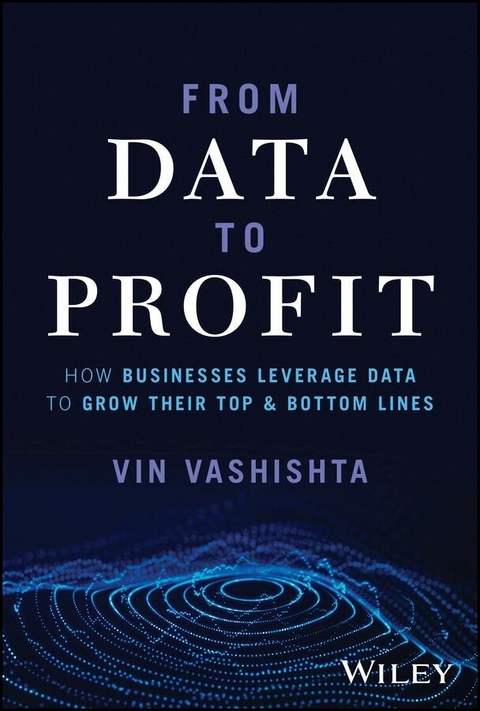
From Data To Profit (eBook)
John Wiley & Sons (Verlag)
978-1-394-19623-4 (ISBN)
Transform your company's AI and data frameworks to unlock the true power of disruptive new tech
In From Data to Profit: How Businesses Leverage Data to Grow Their Top and Bottom Lines, accomplished entrepreneur and AI strategist Vineet Vashishta delivers an engaging and insightful new take on making the most of data, artificial intelligence, and technology at your company. You'll learn to change the culture, strategy, structure, and operational framework of your company to take full advantage of disruptive advances in tech.
The author explores fascinating work being undertaken by firms in the real world, as well as high-value use cases and innovative projects and products made possible by realigning organizational frameworks using the capabilities of new technologies. He explains how to get everyone in your company on the same page, following a single framework, in a way that ensures individual departments get what they want and need.
You'll learn to outline a comprehensive technical vision and purpose that respects departmental autonomy over their core competencies while guaranteeing that they all get the tools they need to make technology their partner. You'll also discover why firms that have adopted a holistic strategy toward AI and data have enjoyed results far beyond those experienced by those that have taken a piecemeal approach.
From Data to Profit demonstrates the proper role of the CEO during an intensive transformation: one of maintaining culture during the change. It offers advice for organizational change, including the 3-Phase Data Organizational Development Framework, the Core <-> Rim 3 Main People Groups Framework, and the way to implement new roles for a Chief Digital Officer and Technical Strategist.
Perfect for data professionals, data organizational leaders, and data product and process owners, From Data to Profit will also benefit executives, managers, and other business leaders seeking hands-on advice for digital transformation at their firms.
VIN VASHISHTA is the Founder of V Squared and its Chief Revenue Officer and technical strategist. He builds data and AI strategies for SMEs and Fortune 500 clients. He has over 25 years' experience in technology with a background in science, strategy, leadership, applied machine learning research, and software engineering.
Transform your company s AI and data frameworks to unlock the true power of disruptive new tech In From Data to Profit: How Businesses Leverage Data to Grow Their Top and Bottom Lines, accomplished entrepreneur and AI strategist Vineet Vashishta delivers an engaging and insightful new take on making the most of data, artificial intelligence, and technology at your company. You ll learn to change the culture, strategy, structure, and operational framework of your company to take full advantage of disruptive advances in tech. The author explores fascinating work being undertaken by firms in the real world, as well as high-value use cases and innovative projects and products made possible by realigning organizational frameworks using the capabilities of new technologies. He explains how to get everyone in your company on the same page, following a single framework, in a way that ensures individual departments get what they want and need. You ll learn to outline a comprehensive technical vision and purpose that respects departmental autonomy over their core competencies while guaranteeing that they all get the tools they need to make technology their partner. You ll also discover why firms that have adopted a holistic strategy toward AI and data have enjoyed results far beyond those experienced by those that have taken a piecemeal approach. From Data to Profit demonstrates the proper role of the CEO during an intensive transformation: one of maintaining culture during the change. It offers advice for organizational change, including the 3-Phase Data Organizational Development Framework, the Core Rim 3 Main People Groups Framework, and the way to implement new roles for a Chief Digital Officer and Technical Strategist. Perfect for data professionals, data organizational leaders, and data product and process owners, From Data to Profit will also benefit executives, managers, and other business leaders seeking hands-on advice for digital transformation at their firms.
VIN VASHISHTA is the Founder of V Squared and its Chief Revenue Officer and technical strategist. He builds data and AI strategies for SMEs and Fortune 500 clients. He has over 25 years' experience in technology with a background in science, strategy, leadership, applied machine learning research, and software engineering.
Introduction vii
Chapter 1 Overview of the Frameworks 1
Chapter 2 There Is No Finish Line 15
Chapter 3 Why Is Transformation So Hard? 37
Chapter 4 Final vs. Evolutionary Decision Culture 59
Chapter 5 The Disruptor's Mindset 71
Chapter 6 A Data- Driven Definition of Strategy 89
Chapter 7 The Monolith--Technical Strategy 103
Chapter 8 Who Survives Disruption? 125
Chapter 9 Data--The Business's Hidden Giant 139
Chapter 10 The AI Maturity Model 155
Chapter 11 The Human-Machine Maturity Model 171
Chapter 12 A Vision for AI Opportunities 185
Chapter 13 Discovering AI Treasure 201
Chapter 14 Large Model Monetization Strategies--Quick Wins 215
Chapter 15 Large Model Monetization Strategies--The Bigger Picture 229
Chapter 16 Assessing the Business's AI Maturity 251
Chapter 17 Building the Data and AI Strategy 273
Chapter 18 Building the Center of Excellence 287
Chapter 19 Data and AI Product Strategy 301
Index 325
Introduction
Businesses are thinking about technology backward. Many business leaders think that 2020–2023 brought about the fastest digital transformation in history, but in fact those three years were the slowest technology will ever change again. Technology and therefore business will never move this slowly again in our lifetimes.
Businesses today are in adapt-or-die territory. Apple CEO Tim Cook said, “We don't believe you can save your way to prosperity. We think you invest your way to it.” As such, Apple is looking for new markets to expand into, using innovation to drive growth. Amazon is slimming down and reallocating its war chest with the same goal. Both used smart investments during the Great Recession to become the companies they are today.
The last time Amazon snapped its fingers, half of retail disappeared. Amazon combined digital and web technologies to disrupt the retail industry and become a titan. Even retail giant Walmart seemed invincible until Amazon leveraged technology to reveal the weakness in Walmart's operating model.
Amazon is looking for ways to be a disruptor again. But Amazon won't be alone this time, and the disruption will touch every competitive industry, not just retail. Microsoft and OpenAI's partnership was the major technical story of 2022 and revealed the potential scope of AI applications. Nothing in recent memory has captivated people's attention in the same way.
ChatGPT reached 1 million registered users in just 5 days and soon after became the fastest application to reach 100 million registered users. GPT-4 has propelled OpenAI and Microsoft further into the public spotlight. Microsoft is looking to duplicate ChatGPT's growth trajectory by building Copilot into its suite of enterprise applications and regain its dominance in the space.
The fast-follower applications from tech giants such as Google, SAP, and Salesforce have created even more interest. With multimodal models, video, images, audio, and text are generated together seamlessly. The rate of technology change isn't slowing down; it's accelerating.
The more people use and share their results, the more front of mind the technology becomes for CEOs. AI was once viewed as speculative and often attracted indifference. Now data and AI are leading a wave of new solutions. New business models have emerged in the first half of 2023, and investment continues to flow into AI startups. Even in an economic downturn, AI is experiencing growth, with some speculating that it will drive a turnaround.
A Novel Asset Class with a Greenfield of Opportunities
In late 2022, I talked with a reporter and said cautiously, “This feels like the real thing.” Past false starts with data and AI have jaded the entire data science field. I was hit by the first hype cycle, the one most have forgotten, in the early 1990s. The data science career that I imagined took almost 20 years to materialize.
I am a skeptic, but even I must acknowledge how capable AI models have become. The first half of 2023 has proven cautious optimism to be warranted. However, the grandiose predictions will fail to materialize because this wave is focused on practical applications. But the time between a new tool being released, practical applications being delivered, and revenue materializing is getting shorter every year.
Data and AI are driving this wave of tools and products. The World Economic Forum classifies data as a completely new asset class, unlike any we've seen before. It's not the new oil. It's more potent than that. The rapidly improving product landscape is filled with examples of the new monetization paradigm.
Use a gallon of oil or an ounce of gold once and they're gone. A gigabyte of data can be reused to generate value across the firm. The models it trains are never depleted. They can return value for years with minimal overhead. Partnering with large model platforms opens even more opportunities.
A 2021 Accenture study discovered that companies with a holistic data and AI strategy generated 50 percent more returns than their peers. Over the last 2 years, dozens of surveys have been published with similar findings. However, it took real-world applications to turn skeptics into promoters.
C-level leaders spent 5+ years investing in data teams and infrastructure. There's a mountain of evidence that the ROI hasn't materialized for everyone. Inconsistent results have revealed that the problem doesn't have a technical or tactical solution. Hiring talent and buying tools support technology delivery, but something is missing.
Talk to data scientists, and the same story plays out repeatedly. The business doesn't get it, and leadership doesn't buy in. Data teams are developing reports and simplistic models. Their capabilities and value are trapped just like the value in the company's data. How do we unlock it?
It begins with technical strategy. This book focuses on data and AI strategy, but I will reveal the bigger picture that businesses need to survive in the modern competitive marketplace.
The Road from Laggard to Industry Leadership
When Satya Nadella took over Microsoft, the company was at a crossroads. The business thought of itself as the industry leader. Customers had the opposite opinion. This is where Google finds itself at now. Microsoft executed a brilliant turnaround, and Google needs to take a page from its book to navigate the challenges to its search dominance.
Microsoft adopted a challenger's mindset and abandoned hopes of regaining dominance in its traditional core business lines. It took a completely different approach to its development tools. Microsoft restructured the business around the next technology wave and went all in on the Azure cloud platform and building a services ecosystem on it.
Its partnership with OpenAI marks a new transformation to AI. Azure is the core infrastructure supporting the collaboration, and Microsoft has launched its GPT 3.5 and GPT 4–enabled services there. OpenAI leverages Azure to train some of the most complex models in the world.
Microsoft's cloud services began a long journey back to technical dominance, but it has always looked ahead with AI firmly in its sights. At the same time, transformation doesn't come in giant leaps. Digital yielded to the cloud, then data, and now AI.
Microsoft has realized that opportunities for revenue growth come in waves. However, a business built to monetize software and services would fail to monetize the cloud. A company built without best-in-class cloud capabilities would fail to deliver best-in-class AI products. Microsoft needed to transform again to monetize the models in development with OpenAI.
It has proven to be a successful technical strategy, and Microsoft will leverage what it has learned to transform in the future as new technological waves roll in. Microsoft has become AI-first this time, but the next wave is already on the horizon.
Azure is at the center of its OpenAI partnership. All its attention is funneled to products and services customers can buy today. In fact, Microsoft is teaching a master class on monetizing advanced models. I'm not talking about multiyear time horizons. Products hit the marketplace months after new models are developed.
Technical Strategy as a New Top-Level Construct
What is the key to Microsoft's growing track record of success? Satya Nadella is a technical strategist. VCs are now looking for the next generation of technical strategists. Investors have realized the connection between the hybrid capability set and business success. In 2022, at the World Economic Forum in Davos, Jim Breyer, CEO of Breyer Capital, said, “We invest in technical strategists.” We are at the front of a sea change in strategy and technology. Businesses need a new partnership between C-level leaders, strategists, and technical experts to unlock the value trapped in their data and organizations.
Supporting that partnership is a new top-level strategic construct, the technology model. Everything in the business that creates and delivers value to customers needs a strategy. Firms are transferring an increasing amount of their business and operating models from people to technology.
The transfer began with digital transformation and cloud adoption. Data and AI are the next stages. The Internet of Things, virtual reality, augmented reality, and 5G are potential amplifiers. This is the nature of the technology-enabled marketplace. Disruption isn't coming. It's here, and the impacts are playing out in rapid cycles.
Transformation now comes in waves. In the mid-to-late 1900s, the spaces between technological advances were more than 10-year spans. Since 2000 we have seen new software, the Web, mobile, cloud, data, IoT, analytics, AI, platforms, and more on the horizon. Each wave supports greater technical capabilities, so more parts of the business and operating models can be transferred into the technology model.
Businesses' reliance on technology will never be this low again. In this book, I will explain the climb from where enterprises are now to where they must be to survive the next 5 years. It is a techno-strategic process that blurs the lines between data scientists and strategists.
I will explain how strategy planning and implementation follow the data science life cycle. The two domains have more in common than most realize.
Strategy is prescriptive and forward-looking. It informs decision-making across the...
| Erscheint lt. Verlag | 31.5.2023 |
|---|---|
| Sprache | englisch |
| Themenwelt | Mathematik / Informatik ► Informatik ► Theorie / Studium |
| Schlagworte | AI • ai frameworks • ai strategy • Artificial Intelligence • artificial intelligence frameworks • artificial intelligence strategy • Computer Science • data frameworks • Data strategy • implementing ai • implementing artificial intelligence • Informatik • KI • Künstliche Intelligenz • organizational ai • organizational artificial intelligence |
| ISBN-10 | 1-394-19623-7 / 1394196237 |
| ISBN-13 | 978-1-394-19623-4 / 9781394196234 |
| Informationen gemäß Produktsicherheitsverordnung (GPSR) | |
| Haben Sie eine Frage zum Produkt? |
 EPUB (Adobe DRM)
Kopierschutz: Adobe-DRM
Adobe-DRM ist ein Kopierschutz, der das eBook vor Mißbrauch schützen soll. Dabei wird das eBook bereits beim Download auf Ihre persönliche Adobe-ID autorisiert. Lesen können Sie das eBook dann nur auf den Geräten, welche ebenfalls auf Ihre Adobe-ID registriert sind.
Details zum Adobe-DRM
Dateiformat: EPUB (Electronic Publication)
EPUB ist ein offener Standard für eBooks und eignet sich besonders zur Darstellung von Belletristik und Sachbüchern. Der Fließtext wird dynamisch an die Display- und Schriftgröße angepasst. Auch für mobile Lesegeräte ist EPUB daher gut geeignet.
Systemvoraussetzungen:
PC/Mac: Mit einem PC oder Mac können Sie dieses eBook lesen. Sie benötigen eine
eReader: Dieses eBook kann mit (fast) allen eBook-Readern gelesen werden. Mit dem amazon-Kindle ist es aber nicht kompatibel.
Smartphone/Tablet: Egal ob Apple oder Android, dieses eBook können Sie lesen. Sie benötigen eine
Geräteliste und zusätzliche Hinweise
Buying eBooks from abroad
For tax law reasons we can sell eBooks just within Germany and Switzerland. Regrettably we cannot fulfill eBook-orders from other countries.
aus dem Bereich