


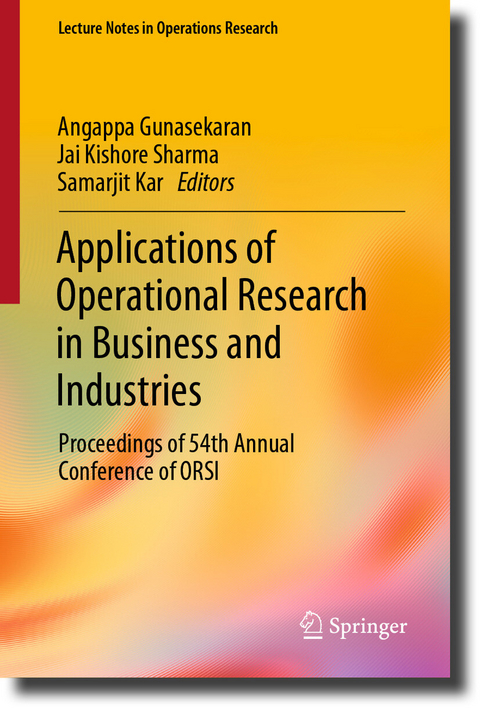
Applications of Operational Research in Business and Industries (eBook)
512 Seiten
Springer Nature Singapore (Verlag)
978-981-19-8012-1 (ISBN)
Effective decision-making while trading off the constraints and conflicting multiple objectives under rapid technological developments, massive generation of data, and extreme volatility is of paramount importance to organizations to win over the time-based competition today. While agility is a crucial issue, the firms have been increasingly relying on evidence-based decision-making through intelligent decision support systems driven by computational intelligence and automation to achieve a competitive advantage. The decisions are no longer confined to a specific functional area. Instead, business organizations today find actionable insight for formulating future courses of action by integrating multiple objectives and perspectives. Therefore, multi-objective decision-making plays a critical role in businesses and industries. In this regard, the importance of Operations Research (OR) models and their applications enables the firms to derive optimum solutions subject to various constraints and/or objectives while considering multiple functional areas of the organizations together. Hence, researchers and practitioners have extensively applied OR models to solve various organizational issues related to manufacturing, service, supply chain and logistics management, human resource management, finance, and market analysis, among others. Further, OR models driven by AI have been enabled to provide intelligent decision-support frameworks for achieving sustainable development goals.
The present issue provides a unique platform to showcase the contributions of the leading international experts on production systems and business from academia, industry, and government to discuss the issues in intelligent manufacturing, operations management, financial management, supply chain management, and Industry 4.0 in the Artificial Intelligence era. Some of the general (but not specific) scopes of this proceeding entail OR models such as Optimization and Control, Combinatorial Optimization, Queuing Theory, Resource Allocation Models, Linear and Nonlinear Programming Models, Multi-objective and multi-attribute Decision Models, Statistical Quality Control along with AI, Bayesian Data Analysis, Machine Learning and Econometrics and their applications vis-à-vis AI & Data-driven Production Management, Marketing and Retail Management, Financial Management, Human Resource Management, Operations Management, Smart Manufacturing & Industry 4.0, Supply Chain and Logistics Management, Digital Supply Network, Healthcare Administration, Inventory Management, consumer behavior, security analysis, and portfolio management and sustainability.
The present issue shall be of interest to the faculty members, students, and scholars of various engineering and social science institutions and universities, along with the practitioners and policymakers of different industries and organizations.Effective decision-making while trading off the constraints and conflicting multiple objectives under rapid technological developments, massive generation of data, and extreme volatility is of paramount importance to organizations to win over the time-based competition today. While agility is a crucial issue, the firms have been increasingly relying on evidence-based decision-making through intelligent decision support systems driven by computational intelligence and automation to achieve a competitive advantage. The decisions are no longer confined to a specific functional area. Instead, business organizations today find actionable insight for formulating future courses of action by integrating multiple objectives and perspectives. Therefore, multi-objective decision-making plays a critical role in businesses and industries. In this regard, the importance of Operations Research (OR) models and their applications enables the firms to derive optimum solutions subject to various constraints and/or objectives while considering multiple functional areas of the organizations together. Hence, researchers and practitioners have extensively applied OR models to solve various organizational issues related to manufacturing, service, supply chain and logistics management, human resource management, finance, and market analysis, among others. Further, OR models driven by AI have been enabled to provide intelligent decision-support frameworks for achieving sustainable development goals.The present issue provides a unique platform to showcase the contributions of the leading international experts on production systems and business from academia, industry, and government to discuss the issues in intelligent manufacturing, operations management, financial management, supply chain management, and Industry 4.0 in the Artificial Intelligence era. Some of the general (but not specific) scopes of this proceeding entail OR models such as Optimization and Control, Combinatorial Optimization, Queuing Theory, Resource Allocation Models, Linear and Nonlinear Programming Models, Multi-objective and multi-attribute Decision Models, Statistical Quality Control along with AI, Bayesian Data Analysis, Machine Learning and Econometrics and their applications vis-a-vis AI & Data-driven Production Management, Marketing and Retail Management, Financial Management, Human Resource Management, Operations Management, Smart Manufacturing & Industry 4.0, Supply Chain and Logistics Management, Digital Supply Network, Healthcare Administration, Inventory Management, consumer behavior, security analysis, and portfolio management and sustainability. The present issue shall be of interest to the faculty members, students, and scholars of various engineering and social science institutions and universities, along with the practitioners and policymakers of different industries and organizations.
| Erscheint lt. Verlag | 21.5.2023 |
|---|---|
| Reihe/Serie | Lecture Notes in Operations Research | Lecture Notes in Operations Research |
| Zusatzinfo | XVIII, 512 p. 123 illus., 98 illus. in color. |
| Sprache | englisch |
| Themenwelt | Mathematik / Informatik ► Informatik ► Datenbanken |
| Informatik ► Theorie / Studium ► Algorithmen | |
| Informatik ► Theorie / Studium ► Künstliche Intelligenz / Robotik | |
| Mathematik / Informatik ► Mathematik ► Angewandte Mathematik | |
| Mathematik / Informatik ► Mathematik ► Finanz- / Wirtschaftsmathematik | |
| Mathematik / Informatik ► Mathematik ► Statistik | |
| Wirtschaft ► Allgemeines / Lexika | |
| Wirtschaft ► Betriebswirtschaft / Management ► Planung / Organisation | |
| Wirtschaft ► Betriebswirtschaft / Management ► Unternehmensführung / Management | |
| Schlagworte | Decision-Making • Industry Oriented Computing Paradigms • Operations Research • Optimization • programming models • queuing theory • Random Process • Uncertain models |
| ISBN-10 | 981-19-8012-8 / 9811980128 |
| ISBN-13 | 978-981-19-8012-1 / 9789811980121 |
| Informationen gemäß Produktsicherheitsverordnung (GPSR) | |
| Haben Sie eine Frage zum Produkt? |
 PDF (Wasserzeichen)
DRM: Digitales Wasserzeichen
Dieses eBook enthält ein digitales Wasserzeichen und ist damit für Sie personalisiert. Bei einer missbräuchlichen Weitergabe des eBooks an Dritte ist eine Rückverfolgung an die Quelle möglich.
Dateiformat: PDF (Portable Document Format)
Mit einem festen Seitenlayout eignet sich die PDF besonders für Fachbücher mit Spalten, Tabellen und Abbildungen. Eine PDF kann auf fast allen Geräten angezeigt werden, ist aber für kleine Displays (Smartphone, eReader) nur eingeschränkt geeignet.
Systemvoraussetzungen:
PC/Mac: Mit einem PC oder Mac können Sie dieses eBook lesen. Sie benötigen dafür einen PDF-Viewer - z.B. den Adobe Reader oder Adobe Digital Editions.
eReader: Dieses eBook kann mit (fast) allen eBook-Readern gelesen werden. Mit dem amazon-Kindle ist es aber nicht kompatibel.
Smartphone/Tablet: Egal ob Apple oder Android, dieses eBook können Sie lesen. Sie benötigen dafür einen PDF-Viewer - z.B. die kostenlose Adobe Digital Editions-App.
Buying eBooks from abroad
For tax law reasons we can sell eBooks just within Germany and Switzerland. Regrettably we cannot fulfill eBook-orders from other countries.
aus dem Bereich


