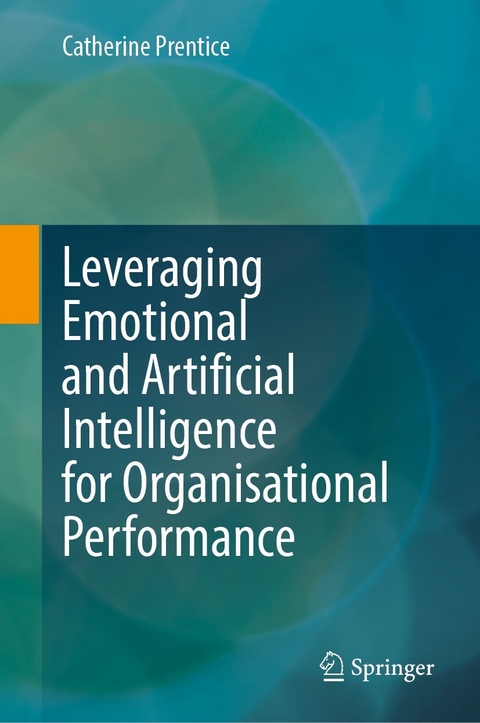
Leveraging Emotional and Artificial Intelligence for Organisational Performance (eBook)
176 Seiten
Springer Nature Singapore (Verlag)
978-981-99-1865-2 (ISBN)
Professor Catherine Prentice is a Professor of Marketing, Head of Marketing Discipline, University of Southern Queensland, Australia, the director of Asia Pacific Association for Gambling Studies and a founding committee of New Silk Road World Forum. Prior to her academic career, Catherine had worked in various industries for over a decade as a business owner of 12 medical clinics, travel agency, restaurants as well as a senior corporate executive at one of the largest corporations in Asia Pacific. She has published extensively in top-tier marketing and management journals. Her main research interests include artificial intelligence, emotional intelligence, service research, consumer psychology, consumer behaviours, branding, services and relationship marketing, and gambling studies. She currently serves as Associate Editor of several Q1 journals and an editorial member of over a dozen of Q1 journals.
This book takes a fresh stance and views EI and AI as services that are provided by service employees and machines as organisational offerings to customers. As emotional intelligence (EI) and artificial intelligence (AI) have been cited to have broad effects on individuals, businesses and beyond, this book is focused on the organisational context, specifically how they affect employees and customers from a marketing perspective. The stance in this book is consistent with the conceptualisation of a service. This book holds that intelligence in businesses must turn into organisational assets to manifest their values. Further, this book explores this service-dominant logic era, and compared to tangible products, service plays a key role in organisational performance and customer relationship with the organisation. Intelligence exhibited either by human or machine is not a tangible product, but can be utilised as a service to assist employees in performing tasks and delivering services as well as facilitating business transaction and customer experience.This book is structured as follows. Chapters 2 and 3 demystify emotional and artificial intelligence, from different perspectives, including conceptualisations, the history and evolution of the concepts, how they function and where they can apply to. These discussions help readers understand what exactly these two intelligences are. Chapters 4 and 5 analyse how emotional intelligence is related to employees and customers, respectively, with a focus on service organisations. Chapters 6-8 are dedicated to anatomising AI and how it is operationalised as a service to influence employees and customers. Specifically, viewing AI as a service, Chapter 6 examines the impact of AI service quality and how it is related to employee service quality. Chapter 7 analyses the influence of AI service quality on customers. Based on the discussion in Chapters 6 and 7, Chapter 8 is extended to develop a scale to measure such AI service, named AI service quality.The last three chapters of this book integrate EI and AI to analyse their respective impacts on employees and customers. Chapter 9 proposes EI as a moderator of AI, whereas Chapter 10 proposes AI as a moderator of EI. Chapter 11 employs service profit chain to integrate EI and AI in the chain relationship to understand their effects on both employees and customers. This chapter broadly covers the service industry with a focus on tourism and hospitality sector. The discussion on the impact of EI and AI is complemented with empirical studies conducted in tourism or hospitality context to address their effects in these sectors.
| Erscheint lt. Verlag | 11.5.2023 |
|---|---|
| Zusatzinfo | IX, 176 p. 15 illus., 8 illus. in color. |
| Sprache | englisch |
| Themenwelt | Informatik ► Theorie / Studium ► Künstliche Intelligenz / Robotik |
| Wirtschaft ► Betriebswirtschaft / Management ► Planung / Organisation | |
| Wirtschaft ► Betriebswirtschaft / Management ► Unternehmensführung / Management | |
| Wirtschaft ► Betriebswirtschaft / Management ► Wirtschaftsinformatik | |
| Schlagworte | Artificial Intelligence • Business profitability • Customer loyalty • Customer Satisfaction • Emotional Contagion • Emotional Intelligence • emotional labour • Employee Performance • Organizational Performance • robots • Service Employees • Service Encounter |
| ISBN-10 | 981-99-1865-0 / 9819918650 |
| ISBN-13 | 978-981-99-1865-2 / 9789819918652 |
| Informationen gemäß Produktsicherheitsverordnung (GPSR) | |
| Haben Sie eine Frage zum Produkt? |
 PDF (Wasserzeichen)
DRM: Digitales Wasserzeichen
Dieses eBook enthält ein digitales Wasserzeichen und ist damit für Sie personalisiert. Bei einer missbräuchlichen Weitergabe des eBooks an Dritte ist eine Rückverfolgung an die Quelle möglich.
Dateiformat: PDF (Portable Document Format)
Mit einem festen Seitenlayout eignet sich die PDF besonders für Fachbücher mit Spalten, Tabellen und Abbildungen. Eine PDF kann auf fast allen Geräten angezeigt werden, ist aber für kleine Displays (Smartphone, eReader) nur eingeschränkt geeignet.
Systemvoraussetzungen:
PC/Mac: Mit einem PC oder Mac können Sie dieses eBook lesen. Sie benötigen dafür einen PDF-Viewer - z.B. den Adobe Reader oder Adobe Digital Editions.
eReader: Dieses eBook kann mit (fast) allen eBook-Readern gelesen werden. Mit dem amazon-Kindle ist es aber nicht kompatibel.
Smartphone/Tablet: Egal ob Apple oder Android, dieses eBook können Sie lesen. Sie benötigen dafür einen PDF-Viewer - z.B. die kostenlose Adobe Digital Editions-App.
Buying eBooks from abroad
For tax law reasons we can sell eBooks just within Germany and Switzerland. Regrettably we cannot fulfill eBook-orders from other countries.
aus dem Bereich