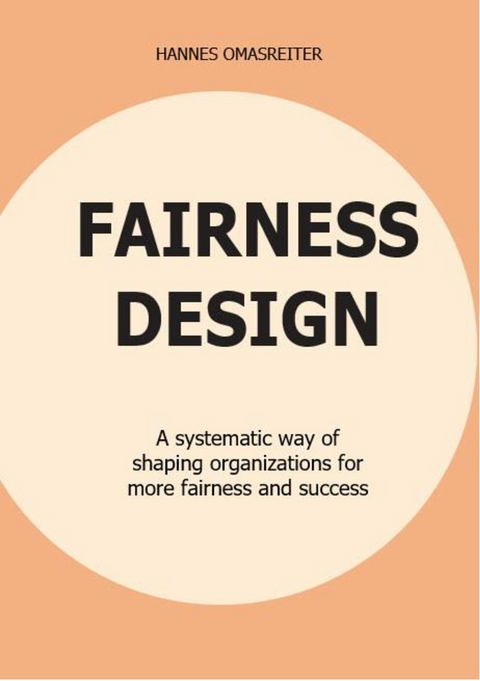
FAIRNESS DESIGN (eBook)
184 Seiten
tredition (Verlag)
9783347908208 (ISBN)
Dr. Hannes Omasreiter studied computer science with a minor in economics at the Technical University of Munich. He then completed his doctorate in engineering at the University of Stuttgart on an application of artificial intelligence in environmental and traffic engineering. For over 20 years, he has worked in research and development at Mercedes-Benz in the area of software process design.
Dr. Hannes Omasreiter studied computer science with a minor in economics at the Technical University of Munich. He then completed his doctorate in engineering at the University of Stuttgart on an application of artificial intelligence in environmental and traffic engineering. For over 20 years, he has worked in research and development at Mercedes-Benz in the area of software process design.
Fairness dimensions, fairness cross
If we consider a concrete decision-making situation in an organization, e.g. the question of which supplier should be selected for a particular order, then
Fairness Design has the goal of making the upcoming decision optimally in terms of the overall well-being of the organization. For the sake of simplicity, it should first be assumed that there is only one decision maker. In order for this decision maker to reach a decision that is as fair as possible, the following four prerequisites are necessary, which will be referred to below as the four fairness dimensions:
(1) Fairness (one wants to)
The decision-maker must want to arrive at a decision that is as fair as possible. The decision-maker must therefore act fairly in the sense that he or she does not allow himself or herself to be corrupted by possible personal advantages and thus be tempted to make a decision that is not optimal for the overall well-being of the organization.
If, for example, a decision-maker wants to select a supplier who would not be the best choice for the order in question, but whose managing director is a good acquaintance of the decision-maker, then – if he is not fair – he could evaluate this supplier’s offer unjustifiably positively and bring about a decision in favor of them. A fair decision maker, on the other hand, would try to evaluate the alternative offers of the different suppliers as disinterestedly and objectively as possible.
(2) Ability (one can)
The decision-maker must be able to arrive at a decision that is as fair as possible. In other words, he or she must have the professional competence, information and power of judgment to be able to decide which of the decision options is best for the organization. This dimension is therefore about the professional quality of a decision.
For example, a supplier might be sought in order to solve a specific, technically demanding task as well as possible. If the decision-maker is a purchaser who evaluates the supplier primarily from an economic point of view because he lacks the ability to evaluate the offer holistically and competently, then this could lead to a wrong decision. The reverse is also true, of course, if, for example, a decision-maker with technical expertise is unable to take sufficient account of the economic aspects. The decision-maker must therefore have the ability to assess the overall (short-term as well as long-term) impact of a decision on the well-being of the organization.
(3) Authority (one may)
The decision-maker must be allowed to arrive at a decision that is as fair as possible. He must therefore have the right to select the best decision option for the organization.
Suppose a decision-maker had identified the optimal supplier for an order based on his technical and business expertise and the overall well-being of the organization. But after deciding on this supplier, a more “powerful” manager vetoes the decision, so that in the end another – suboptimal – supplier is selected. Alternatively, the decision-maker might be denied important information from the outset that he needs to make an optimal decision. In this case, the probability of making the fairest possible decision is reduced accordingly. In these examples, then, curtailing decision-making authority would be detrimental to the overall well-being. In other situations, however, less authority for a decision-maker can promote the overall well-being, for example by replacing a single decision with a multi-person decision.
The fairness dimensions one to three presented so far influence the effectiveness of a decision. Effectiveness is about doing the right thing, i.e., hitting the desired target as well as possible. In this context, the fairer a decision is, the more effective it is.
The fourth and final dimension, on the other hand, concerns the efficiency of a decision. Efficiency is about doing things right, i.e., achieving the desired goal as quickly and easily as possible, i.e., with as little effort as possible.
(4) Efficiency (it pays off)
The decision maker’s effort to determine the fairest possible decision must be (economically) worthwhile. Thus, in assessing which decision option is best for an organization, the decision-maker must consider not only the actual decision goal, but also the path to get there. A decision option B may be fairer than a decision option A, even though the latter would actually be the better option (without effort consideration), if the effort to determine option A is significantly higher and thus its initial advantage is more than outweighed. In the interest of avoiding misunderstandings: This is not about the implementation effort that follows a decision. We are talking about the effort required to make the decision (i.e., up to the point at which the decision is made).
Example: A company discovers that a safety-critical component in some of the machines it produces and has already delivered to customers is defective and must therefore be replaced immediately. Due to capacity problems, a supplier must be contracted for the replacement. A number of suppliers come into question, and the decision-maker would need several weeks to carefully select them in order to make the best possible decision. Due to the time pressure, however, he decides on a supplier within a few hours, trying to select the optimal supplier within the given framework. In retrospect, an analysis shows that another supplier would have provided the same service for 20% less cost. Nevertheless, the decision was the right one, because the quick decision reduced risks for customers, the company’s image suffered far less, and possible claims for damages were avoided. In this case, the quick – actually suboptimal – decision was nevertheless the better, more efficient one.
The four fairness dimensions can be represented graphically as four vectors, collectively referred to as the “fairness intersection,” as follows:
Figure 8: Fairness cross
On the one hand, this fairness intersection serves to illustrate the basic factors influencing the fairness of decisions. On the other hand, it will be used later as the basis of fairness diagrams that can help in the selection of a fair decision-making process. In some cases, it will be possible in practice to exclude the authority dimension from the outset because there are no authority constraints. Then one can limit oneself to the remaining three dimensions. This graphical illustration can then be described as a “fairness star” (cf. Figure 1). The vector of the fairness intersection or star pointing “north,” i.e. the fairness vector, symbolizes the main dimension or goal that an organization would ideally like to achieve 100% in Fairness Design.
If this 100% fairness is achieved in a decision, it corresponds to “maximum or pure fairness” in Fairness Design (cf. Figure 2).
Figure 9: Fairness star
The remaining vectors of the fairness diagram symbolize the secondary dimensions or constraints that must be considered in order to achieve an optimal decision in terms of the overall well-being of the organization. If these secondary dimensions are considered as well and are in an optimal equilibrium for the (maximum) overall well-being of the organization, then the associated point on the fairness axis is said to be the “optimal fairness” (cf. Figure 11). Analogously, the points on the secondary dimensions shall then be referred to as “optimal capability,” “optimal efficiency,” and “optimal authority.” In order to achieve optimal fairness, it is usually sensible not to place any restrictions on the authority dimension, which is to say maximum authority is usually an important prerequisite for achieving optimal fairness.
Figure 10: Maximum/pure fairness
Figure 11: Optimal fairness
If, on the other hand, the powers to make a decision are limited, then optimal fairness under these circumstances should be referred to as “(maximum) realizable fairness” (cf. Figure 12). Realizable fairness is therefore the optimal fairness in terms of the overall well-being of the organization that is possible within the scope of the restricted powers.
Figure 12: Realizable fairness
Pure, optimal and realizable fairness do not necessarily have to be separate points on the fairness axis, but can coincide into two or even one point. For example, if there are no restrictions on powers, then realizable fairness corresponds to optimal fairness. If the other dimensions allow, optimal fairness may also correspond to pure fairness. However, in many cases it will be the case in practice that a trade-off between the dimensions is required, so that pure fairness is not optimal for the overall well-being. For example, if, on the one hand, all decision-makers who are considered completely independent and fair do not have the professional competence to decide a particular situation, and, on the other hand, all professionally suitable decision-makers would very likely give undue weight to their own interests in making the decision, then optimal fairness requires a trade-off in which a pure fair decision must be foregone – because this trade-off is likely to lead to a better overall well-being decision. When Fairness Design talks about a (preferably) fair decision, it typically does not mean a purely fair decision, but one that is (preferably) optimally fair, that is, one in which overall well-being is...
| Erscheint lt. Verlag | 24.3.2023 |
|---|---|
| Übersetzer | Katharine Oden |
| Verlagsort | Ahrensburg |
| Sprache | englisch |
| Themenwelt | Sachbuch/Ratgeber ► Beruf / Finanzen / Recht / Wirtschaft ► Bewerbung / Karriere |
| Sachbuch/Ratgeber ► Geschichte / Politik ► Politik / Gesellschaft | |
| Geisteswissenschaften ► Philosophie ► Ethik | |
| Mathematik / Informatik ► Mathematik | |
| Sozialwissenschaften ► Politik / Verwaltung | |
| Wirtschaft ► Betriebswirtschaft / Management ► Unternehmensführung / Management | |
| ISBN-13 | 9783347908208 / 9783347908208 |
| Informationen gemäß Produktsicherheitsverordnung (GPSR) | |
| Haben Sie eine Frage zum Produkt? |
 EPUB (Wasserzeichen)
DRM: Digitales Wasserzeichen
Dieses eBook enthält ein digitales Wasserzeichen und ist damit für Sie personalisiert. Bei einer missbräuchlichen Weitergabe des eBooks an Dritte ist eine Rückverfolgung an die Quelle möglich.
Dateiformat: EPUB (Electronic Publication)
EPUB ist ein offener Standard für eBooks und eignet sich besonders zur Darstellung von Belletristik und Sachbüchern. Der Fließtext wird dynamisch an die Display- und Schriftgröße angepasst. Auch für mobile Lesegeräte ist EPUB daher gut geeignet.
Systemvoraussetzungen:
PC/Mac: Mit einem PC oder Mac können Sie dieses eBook lesen. Sie benötigen dafür die kostenlose Software Adobe Digital Editions.
eReader: Dieses eBook kann mit (fast) allen eBook-Readern gelesen werden. Mit dem amazon-Kindle ist es aber nicht kompatibel.
Smartphone/Tablet: Egal ob Apple oder Android, dieses eBook können Sie lesen. Sie benötigen dafür eine kostenlose App.
Geräteliste und zusätzliche Hinweise
Buying eBooks from abroad
For tax law reasons we can sell eBooks just within Germany and Switzerland. Regrettably we cannot fulfill eBook-orders from other countries.
aus dem Bereich