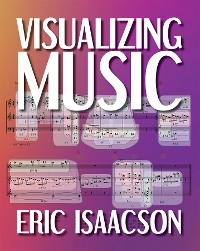
Visualizing Music (eBook)
386 Seiten
Indiana University Press (Verlag)
978-0-253-06475-2 (ISBN)

To feel the emotional force of music, we experience it aurally. But how can we convey musical understanding visually?
Visualizing Music explores the art of communicating about music through images. Drawing on principles from the fields of vision science and information visualization, Eric Isaacson describes how graphical images can help us understand music. By explaining the history of music visualizations through the lens of human perception and cognition, Isaacson offers a guide to understanding what makes musical images effective or ineffective and provides readers with extensive principles and strategies to create excellent images of their own. Illustrated with over 300 diagrams from both historical and modern sources, including examples and theories from Western art music, world music, and jazz, folk, and popular music, Visualizing Music explores the decisions made around image creation.
Together with an extensive online supplement and dozens of redrawings that show the impact of effective techniques, Visualizing Music is a captivating guide to thinking differently about design that will help music scholars better understand the power of musical images, thereby shifting the ephemeral to material.
Eric Isaacson is Associate Professor of Music Theory at the Indiana University Jacobs School of Music and a faculty member in the Indiana University Cognitive Science Program.
Preface
Acknowledgments
Accessing Audiovisual Materials
Introduction
Part 1: Preliminaries
1. Leveraging the Power of the Brain
2. The Role of Metaphor
3. Multivariate Images
4. Telling a Story
5. Facilitating Comparison
6. Information Layers
7. Information Integration
8. Making Every Part of an Image Count
9. Presenting Tabular Data
10. Small Multiples
11. Using Color
12. Additional General Principles
13. Case Study: Western Notation
Part 2: Musical Spaces
14. Pitch Spaces
15. Collections, Scales, and Modes
16. The Circle of Fifths
17. The Tonnetz
18. Atonal Spaces
19. Symmetrical Pitch Structures
20. Tonal Hierarchy, Tendency, Progression
21. The Overtone Series
Part 3: Musical Time
22. Basic Durations
23. Unmeasured Musical Time
24. Musically Measured Musical Time
25. Externally Measured Musical Time (Performance Timing)
26. Proportion
Part 4: Pitch, Texture, Timbre, Form
27. Textual Representations of Pitch
28. Piano Roll Notation
29. Alternate Notational Systems
30. Tuning and Temperament
31. Microtuning
32. Timbre
33. Texture
34. Voice Leading
35. Schematic and Procedural Representations
36. Formal Models
37. Pitch-Class Set Tables
38. Instrument Ranges
39. Translations
Part 5: Music Analysis
40. Lutosławksi's Jeux Venitiens
41. Annotating Musical Scores
42. Thematic Analysis
43. Contour Analysis
44. Tonal Plans
45. Symmetry in Music Analysis
46. Rhythmic Analysis
47. Formal Analysis
48. Hierarchy in Music
49. Serialism
50. Corpus Studies
51. Musical Chronologies, Influences, and Styles
52. Animation
Part 6: Visualization in the Professional Realm
53. Conference Handouts
54. Presentation Slide Shows
55. Conference Posters
56. Print Publication
57. The Essential Visualization Toolbox
Epilogue
Bibliography
Index
| Erscheint lt. Verlag | 2.5.2023 |
|---|---|
| Zusatzinfo | 14 color illus., 295 b&w illus., 1 b&w table |
| Verlagsort | Bloomington |
| Sprache | englisch |
| Maße | 200 x 200 mm |
| Themenwelt | Kunst / Musik / Theater ► Kunstgeschichte / Kunststile |
| Kunst / Musik / Theater ► Musik ► Musiktheorie / Musiklehre | |
| Mathematik / Informatik ► Informatik | |
| Mathematik / Informatik ► Mathematik ► Graphentheorie | |
| Schlagworte | Analysis • Communication • Ethnomusicology • Historical • Metaphor • Modern • Musical notation • musical time • Pitch • post-tonal • Representation • Structure • Style • Tabular Data • technical models • theory |
| ISBN-10 | 0-253-06475-9 / 0253064759 |
| ISBN-13 | 978-0-253-06475-2 / 9780253064752 |
| Informationen gemäß Produktsicherheitsverordnung (GPSR) | |
| Haben Sie eine Frage zum Produkt? |
 EPUB (Adobe DRM)
Kopierschutz: Adobe-DRM
Adobe-DRM ist ein Kopierschutz, der das eBook vor Mißbrauch schützen soll. Dabei wird das eBook bereits beim Download auf Ihre persönliche Adobe-ID autorisiert. Lesen können Sie das eBook dann nur auf den Geräten, welche ebenfalls auf Ihre Adobe-ID registriert sind.
Details zum Adobe-DRM
Dateiformat: EPUB (Electronic Publication)
EPUB ist ein offener Standard für eBooks und eignet sich besonders zur Darstellung von Belletristik und Sachbüchern. Der Fließtext wird dynamisch an die Display- und Schriftgröße angepasst. Auch für mobile Lesegeräte ist EPUB daher gut geeignet.
Systemvoraussetzungen:
PC/Mac: Mit einem PC oder Mac können Sie dieses eBook lesen. Sie benötigen eine
eReader: Dieses eBook kann mit (fast) allen eBook-Readern gelesen werden. Mit dem amazon-Kindle ist es aber nicht kompatibel.
Smartphone/Tablet: Egal ob Apple oder Android, dieses eBook können Sie lesen. Sie benötigen eine
Geräteliste und zusätzliche Hinweise
Buying eBooks from abroad
For tax law reasons we can sell eBooks just within Germany and Switzerland. Regrettably we cannot fulfill eBook-orders from other countries.
aus dem Bereich