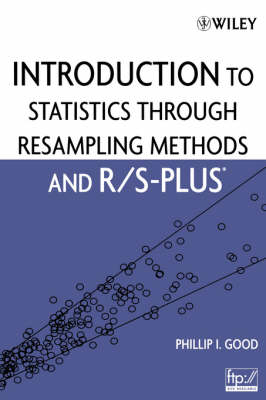
Introduction to Statistics Through Resampling Methods and R/S-PLUS
John Wiley & Sons Inc (Verlag)
9780471715757 (ISBN)
- Titel ist leider vergriffen;
keine Neuauflage - Artikel merken
Stimulate learning through discovery With its emphasis on the discovery method, this book allows readers to discover solutions on their own rather than simply copy answers or apply a formula by rote. Readers will quickly master and learn to apply statistical methods, such as bootstrap, decision trees, and permutations, to better characterize, report, test, and classify their research findings. In addition to traditional methods, specialized methods are covered, allowing readers to select and apply the most effective method for their research, including: * Tests and estimation procedures for one, two, and multiple samples * Model building * Multivariate analysis * Complex experimental design Throughout the text, the R programming language is used to illustrate new concepts and assist readers in completing exercises. Readers may download the freely available R programming language from the Internet or take advantage of the menu-driven S-PLUS(r) program. Written in an informal, highly accessible style, this text is an excellent guide to descriptive statistics, estimation, testing hypotheses, and model building.
All the pedagogical tools needed to facilitate quick learning are provided: * More than two hundred exercises scattered throughout the text stimulate readers' thinking and actively engage them in applying their newfound skills * Companion FTP site provides access to all data sets and programs discussed in the text * Dozens of thought-provoking questions in the final chapter, Problem Solving, assist readers in applying statistics to address real-life problems * Instructor's manual provides answers to exercises * Helpful appendices include an introduction to S-PLUS(r) features This text serves as an excellent introduction to statistics for students in all disciplines. The accessible style and focus on real-life problem solving are perfectly suited for both students and practitioners.
PHILLIP I. GOOD, PHD, is Operations Manager of Information Research, a consulting firm specializing in statistical solutions for private and public organizations. He has published more than thirty scholarly works, more than 600 articles, and fourteen books, including Common Errors in Statistics (and How to Avoid Them) and A Manager's Guide to the Design and Conduct of Clinical Trials, both from Wiley.
Preface. 1. Variation. 1.1 Variation. 1.2. Collecting Data. 1.3. Summarizing Your Data. 1.4. Types of Data. 1.5. Reporting Your Results. 1.6. Measures of Location. 1.7. Samples and Populations. 1.8. Variation- Within and Between. 1.9. Summary and Review. 2. Probability. 2.1. Probability. 2.2. Binomial. 2.3. Condition Probability. 2.4. Independence. 2.5. Applications to Genetics. 2.6. Summary and Review. 3. Distributions. 3.1. Distribution of Values. 3.2. Discrete Distributions. 3.3. Continuous Distributions. 3.4. Properties of Independence Observations. 3.5. Testing A Hypothesis. 3.6. Estimating Effect Size. 3.7 Summary and Review. 4. Testing Hypotheses. 4.1. One-Sample Problems. 4.2. Comparing Two Samples. 4.3. Which Test Should e Use? 4.4. Summary and Review. 5. Designing an Experiment or Survey. 5.1. The Hawthorne Effect. 5.2. Designing an Experiment or Survey. 5.3. How Large a Sample. 5.4. Meta-Analysis. 5.5. Summary and Review. 6. Analyzing Complex Experiments. 6.1. Changes Measured in Percentages. 6.2. Comparing More Than Two Samples. 6.3. Equalizing Variances. 6.4. Categorical Data. 6.5. Multivariate Analysis. 6.6. Summary and Review. 7. Developing Models. 7.1. Models. 7.2. Regression. 7.3. Fitting a Regression Equation. 7.4. Problems with Regression. 7.5 Quantile Regression. 7.6. Validation. 7.7 Classification and Regression Trees. 7.8 Summary and Review. 8. Reporting Your Findings. 8.1. What to Report. 8.2. Text, Tables, of Graph? 8.3. Summarizing Your Results. 8.4 Reporting Analysis Results. 8.5 Exceptions are the Real Story. 9. Problem Solving. 9.1. Real Life Problems. 9.2. Problem Sets. 9.3. Solutions. Appendix: S-PLUS. Answers to Selected Exercises. Subject Index. Index to R Functions.
| Zusatzinfo | Illustrations |
|---|---|
| Verlagsort | New York |
| Sprache | englisch |
| Maße | 153 x 232 mm |
| Gewicht | 370 g |
| Einbandart | Paperback |
| Themenwelt | Mathematik / Informatik ► Mathematik ► Statistik |
| Mathematik / Informatik ► Mathematik ► Wahrscheinlichkeit / Kombinatorik | |
| ISBN-13 | 9780471715757 / 9780471715757 |
| Zustand | Neuware |
| Informationen gemäß Produktsicherheitsverordnung (GPSR) | |
| Haben Sie eine Frage zum Produkt? |
aus dem Bereich