


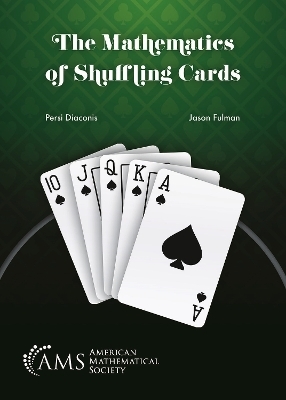
The Mathematics of Shuffling Cards
Seiten
2023
American Mathematical Society (Verlag)
978-1-4704-6303-8 (ISBN)
American Mathematical Society (Verlag)
978-1-4704-6303-8 (ISBN)
- Titel z.Zt. nicht lieferbar
- Versandkostenfrei
- Auch auf Rechnung
- Artikel merken
Provides a lively development of the mathematics needed to answer the question, ‘How many times should a deck of cards be shuffled to mix it up?’ The shuffles studied are the usual ones that real people use: riffle, overhand, and smooshing cards around on the table.
This book gives a lively development of the mathematics needed to answer the question, ""How many times should a deck of cards be shuffled to mix it up?"" The shuffles studied are the usual ones that real people use: riffle, overhand, and smooshing cards around on the table.
The mathematics ranges from probability (Markov chains) to combinatorics (symmetric function theory) to algebra (Hopf algebras). There are applications to magic tricks and gambling along with a careful comparison of the mathematics to the results of real people shuffling real cards. The book explores links between shuffling and higher mathematics--Lie theory, algebraic topology, the geometry of hyperplane arrangements, stochastic calculus, number theory, and more. It offers a useful springboard for seeing how probability theory is applied and leads to many corners of advanced mathematics.
The book can serve as a text for an upper division course in mathematics, statistics, or computer science departments and will be appreciated by graduate students and researchers in mathematics, statistics, and computer science, as well as magicians and people with a strong background in mathematics who are interested in games that use playing cards.
This book gives a lively development of the mathematics needed to answer the question, ""How many times should a deck of cards be shuffled to mix it up?"" The shuffles studied are the usual ones that real people use: riffle, overhand, and smooshing cards around on the table.
The mathematics ranges from probability (Markov chains) to combinatorics (symmetric function theory) to algebra (Hopf algebras). There are applications to magic tricks and gambling along with a careful comparison of the mathematics to the results of real people shuffling real cards. The book explores links between shuffling and higher mathematics--Lie theory, algebraic topology, the geometry of hyperplane arrangements, stochastic calculus, number theory, and more. It offers a useful springboard for seeing how probability theory is applied and leads to many corners of advanced mathematics.
The book can serve as a text for an upper division course in mathematics, statistics, or computer science departments and will be appreciated by graduate students and researchers in mathematics, statistics, and computer science, as well as magicians and people with a strong background in mathematics who are interested in games that use playing cards.
Persi Diaconis, Stanford University, CA. Jason Fulman, University of Southern California, Los Angeles, CA.
Shuffling cards: An introduction
Practice and history of shuffling cards
Convergence rates for riffle shuffles
Features
Eigenvectors and Hopf algebras
Shuffling and carries
Different models for riffle shuffling
Move to front shuffling and variations
Shuffling and geometry
Shuffling and algebraic topology
Type B shuffles and shelf shuffling machines
Descent algebras, $P$-partitions, and quasisymmetric functions
Overhand shuffling
``Smoosh'' shuffle
How to shuffle perfectly (randomly)
Applications to magic tricks, traffic merging, and statistics
Shuffling and multiple zeta values
Bibliography
Index
| Erscheinungsdatum | 10.07.2023 |
|---|---|
| Reihe/Serie | Miscellaneous Book Series |
| Verlagsort | Providence |
| Sprache | englisch |
| Maße | 178 x 254 mm |
| Gewicht | 226 g |
| Themenwelt | Mathematik / Informatik ► Mathematik ► Graphentheorie |
| ISBN-10 | 1-4704-6303-2 / 1470463032 |
| ISBN-13 | 978-1-4704-6303-8 / 9781470463038 |
| Zustand | Neuware |
| Informationen gemäß Produktsicherheitsverordnung (GPSR) | |
| Haben Sie eine Frage zum Produkt? |


