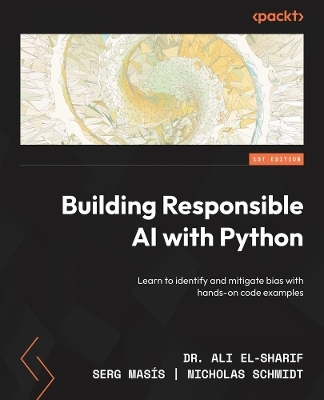
Building Responsible AI with Python
Packt Publishing Limited (Verlag)
978-1-80324-991-9 (ISBN)
Key Features
Measure group fairness, individual fairness and choose the right metric for different scenarios
Explain model’s logic using different explanation techniques
Mitigate bias at different stages of the machine learning pipeline
Book DescriptionAs we incorporate the next wave of AI-enabled products in high-stakes decisions, we need some level of assurance of the safety that we have come to expect from everyday products. Continuing the progress of using AI in high-stakes decisions requires trusting AI-enabled solutions to deliver their promised benefits while protecting the public from harm. Questions about the security, safety, privacy, and fairness of AI-enabled decisions need to be answered as a condition for deploying AI solutions at scale. This book is a guide that will introduce you to key concepts, use cases, tools, and techniques of the emerging field of Responsible AI. We will cover hands-on coding techniques to identify and measure bias. Measuring bias is not enough: we also need to explain and fix our models. This book outlines how to do this throughout the machine learning pipeline. By the end of this book, you will have mastered Python coding techniques of explaining machine learning models’ logic, measuring their fairness at the individual and group levels and monitor them in production environments to detect degradation in their accuracy or fairness.What you will learn
Explain the fundamental concepts of Responsible AI
Audit models machine learning models to ascertain their group and individual fairness outcomes
Apply explanatory techniques to gain insight into the inner logic of complex machine learning models
Alter the development of machine learning models using pre-processing, in-processing, and post-processing techniques to mitigate biased outcomes
Monitor machine learning models in production to identify drift and manage adverse impacts drift
Describe emerging trends in Responsible AI
Apply mitigation techniques to models, so that identified biases in models are remediated
Monitor models' post-production launch degradation to ensure accuracy and fairness objectives are maintained over time
Who this book is forData Scientists, Machine Learning Developers, and Data Science professionals who want to ensure that their machine learning model predictions are non- biased and accurate. Working knowledge of Python programming and basic concepts of machine learning model training and data validation is good to have.
Dr. Ali El-Sharif is a professor teaching Data Analytics and Cybersecurity. Dr. El-Sharif earned his Ph.D. in Information Systems at Nova Southeastern University, focusing on Explainable Artificial Intelligence. He also received Information Security from Nova Southeastern University, a Master of Business Administration (MBA), and a Bachelor of Computer Engineering from Wright State University. Dr. El-Sharif transitioned to academia after 20 years of being an industry practitioner, holding roles including software developer, solution architect, project manager, and management consultant. For the last two decades, Serg Masis has been at the confluence of the internet, application development, and analytics. Currently, he is a Climate and Agronomic Data Scientist at Syngenta, a leading agribusiness company with a mission to improve global food security. Before that role, he co founded a search engine startup incubated by Harvard Innovation Labs, combining the power of cloud computing and machine learning with principles in decision making science to expose users to new places and events efficiently. Whether it pertains to leisure activities, plant diseases, or customer lifetime value, Serg is passionate about providing the often missing link between data and decision making and machine learning interpretation helps bridge this gap more robustly. Nicholas Schmidt started working in the field of responsible AI through his twenty years of experience working at the intersection of statistics, law, and regulation. He is currently the CEO of SolasAI and the AI Practice Leader at BLDS, LLC. Before that, Nicholas studied at the University of Chicago. In his work at SolasAI, he leads a team of data scientists and engineers building software that assesses whether there is evidence of bias or discrimination in an algorithm, and then provides alternative models that are both fairer and highly predictive. Nicholas believes that algorithms can be used as a force for good, but that responsible governance is necessary for that to happen
Table of Contents
What is Responsible AI and Why Do We Need it?
Responsible AI Concepts
Bias and Fairness Concepts
Introducing our Datasets
Individual Fairness Assessment
Choosing the Right Metrics: A Summary
Choosing the Right Metrics: A Summary
Feature Importance Explanations
Visual Explanations
Decision Trees & Decision Rules Explanations
Contrastive and Counterfactual Explanations
Choosing the Right Explanation: A Summary
Pre-Processing Methods
In-Processing Methods
Choosing the Right Mitigation Approaches: A Summary
Choosing the Right Mitigation Approaches: A Summary
What is Model Drift and Why do We Care?
Managing the Adverse Impacts of Model Drift
| Erscheinungsdatum | 08.03.2024 |
|---|---|
| Verlagsort | Birmingham |
| Sprache | englisch |
| Maße | 191 x 235 mm |
| Themenwelt | Informatik ► Theorie / Studium ► Künstliche Intelligenz / Robotik |
| ISBN-10 | 1-80324-991-9 / 1803249919 |
| ISBN-13 | 978-1-80324-991-9 / 9781803249919 |
| Zustand | Neuware |
| Informationen gemäß Produktsicherheitsverordnung (GPSR) | |
| Haben Sie eine Frage zum Produkt? |
aus dem Bereich