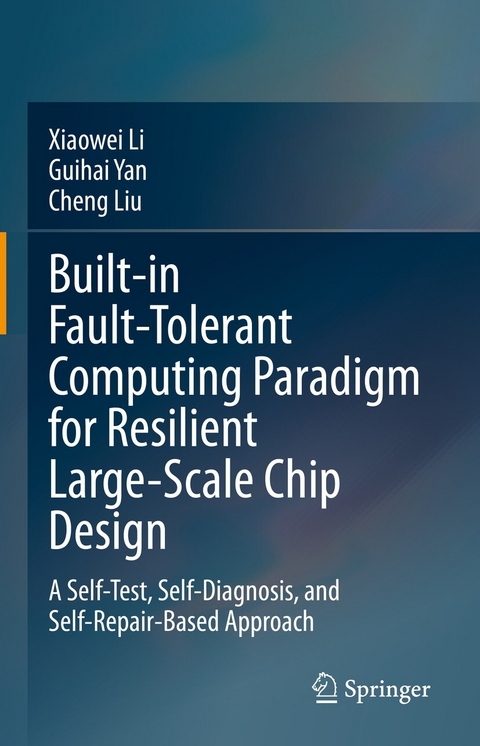
Built-in Fault-Tolerant Computing Paradigm for Resilient Large-Scale Chip Design (eBook)
304 Seiten
Springer Nature Singapore (Verlag)
978-981-19-8551-5 (ISBN)
This book is the outcome of extensive fault-tolerant computing research pursued at the State Key Lab of Processors, Institute of Computing Technology, Chinese Academy of Sciences over the past decade. The proposed built-in on-chip fault-tolerant computing paradigm has been verified in a broad range of scenarios, from small processors in satellite computers to large processors in HPCs. Hopefully, it will provide an alternative yet effective solution to the growing reliability challenges for large-scale VLSI designs.
With the end of Dennard scaling and Moore's law, IC chips, especially large-scale ones, now face more reliability challenges, and reliability has become one of the mainstay merits of VLSI designs. In this context, this book presents a built-in on-chip fault-tolerant computing paradigm that seeks to combine fault detection, fault diagnosis, and error recovery in large-scale VLSI design in a unified manner so as to minimize resource overhead and performance penalties. Following this computing paradigm, we propose a holistic solution based on three key components: self-test, self-diagnosis and self-repair, or "e;3S"e; for short. We then explore the use of 3S for general IC designs, general-purpose processors, network-on-chip (NoC) and deep learning accelerators, and present prototypes to demonstrate how 3S responds to in-field silicon degradation and recovery under various runtime faults caused by aging, process variations, or radical particles. Moreover, we demonstrate that 3S not onlyoffers a powerful backbone for various on-chip fault-tolerant designs and implementations, but also has farther-reaching implications such as maintaining graceful performance degradation, mitigating the impact of verification blind spots, and improving chip yield. This book is the outcome of extensive fault-tolerant computing research pursued at the State Key Lab of Processors, Institute of Computing Technology, Chinese Academy of Sciences over the past decade. The proposed built-in on-chip fault-tolerant computing paradigm has been verified in a broad range of scenarios, from small processors in satellite computers to large processors in HPCs. Hopefully, it will provide an alternative yet effective solution to the growing reliability challenges for large-scale VLSI designs.
| Erscheint lt. Verlag | 1.3.2023 |
|---|---|
| Zusatzinfo | XVIII, 304 p. 1 illus. |
| Sprache | englisch |
| Themenwelt | Mathematik / Informatik ► Informatik ► Theorie / Studium |
| Informatik ► Weitere Themen ► Hardware | |
| Schlagworte | Built-in Fault-tolerance • Fault-tolerant Computing Paradigm • Fault-tolerant Deep Learning Accelerators • Fault-tolerant Multi-core Processors • Fault-tolerant Network-on-Chip • On-chip Fault-tolerance • Self-test, Self-diagnosis, and Self-repair |
| ISBN-10 | 981-19-8551-0 / 9811985510 |
| ISBN-13 | 978-981-19-8551-5 / 9789811985515 |
| Informationen gemäß Produktsicherheitsverordnung (GPSR) | |
| Haben Sie eine Frage zum Produkt? |
 PDF (Wasserzeichen)
DRM: Digitales Wasserzeichen
Dieses eBook enthält ein digitales Wasserzeichen und ist damit für Sie personalisiert. Bei einer missbräuchlichen Weitergabe des eBooks an Dritte ist eine Rückverfolgung an die Quelle möglich.
Dateiformat: PDF (Portable Document Format)
Mit einem festen Seitenlayout eignet sich die PDF besonders für Fachbücher mit Spalten, Tabellen und Abbildungen. Eine PDF kann auf fast allen Geräten angezeigt werden, ist aber für kleine Displays (Smartphone, eReader) nur eingeschränkt geeignet.
Systemvoraussetzungen:
PC/Mac: Mit einem PC oder Mac können Sie dieses eBook lesen. Sie benötigen dafür einen PDF-Viewer - z.B. den Adobe Reader oder Adobe Digital Editions.
eReader: Dieses eBook kann mit (fast) allen eBook-Readern gelesen werden. Mit dem amazon-Kindle ist es aber nicht kompatibel.
Smartphone/Tablet: Egal ob Apple oder Android, dieses eBook können Sie lesen. Sie benötigen dafür einen PDF-Viewer - z.B. die kostenlose Adobe Digital Editions-App.
Buying eBooks from abroad
For tax law reasons we can sell eBooks just within Germany and Switzerland. Regrettably we cannot fulfill eBook-orders from other countries.
aus dem Bereich