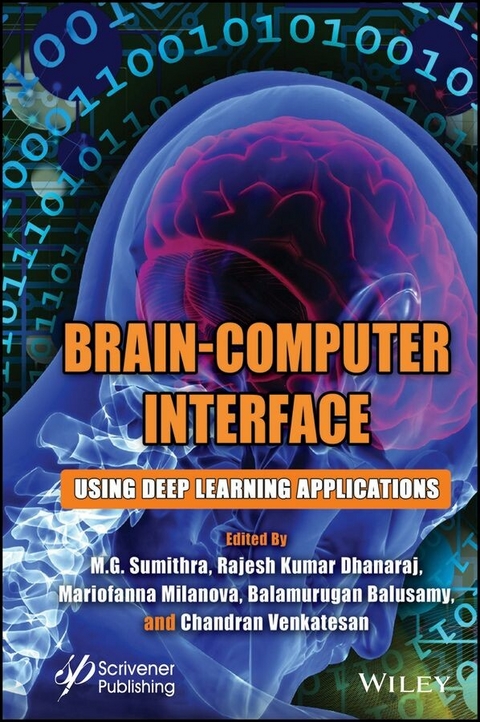
Brain-Computer Interface (eBook)
John Wiley & Sons (Verlag)
978-1-119-85775-4 (ISBN)
It covers all the research prospects and recent advancements in the brain-computer interface using deep learning.
The brain-computer interface (BCI) is an emerging technology that is developing to be more functional in practice. The aim is to establish, through experiences with electronic devices, a communication channel bridging the human neural networks within the brain to the external world. For example, creating communication or control applications for locked-in patients who have no control over their bodies will be one such use. Recently, from communication to marketing, recovery, care, mental state monitoring, and entertainment, the possible application areas have been expanding. Machine learning algorithms have advanced BCI technology in the last few decades, and in the sense of classification accuracy, performance standards have been greatly improved. For BCI to be effective in the real world, however, some problems remain to be solved.
Research focusing on deep learning is anticipated to bring solutions in this regard. Deep learning has been applied in various fields such as computer vision and natural language processing, along with BCI growth, outperforming conventional approaches to machine learning. As a result, a significant number of researchers have shown interest in deep learning in engineering, technology, and other industries; convolutional neural network (CNN), recurrent neural network (RNN), and generative adversarial network (GAN).
Audience
Researchers and industrialists working in brain-computer interface, deep learning, machine learning, medical image processing, data scientists and analysts, machine learning engineers, electrical engineering, and information technologists.
M. G. Sumithra, PhD, is a professor at Anna University Chennai, India. With 25 years of teaching experience, she has published more than 70 technical papers in refereed journals, 3 book chapters, and 130 research papers in national and international conferences. She is a Nvidia Deep Learning Institute Certified Instructor for 'Computer Vision'.
Rajesh Kumar Dhanaraj, PhD, is a professor in the School of Computing Science and Engineering at Galgotias University, Greater Noida, India. He has contributed around 25 authored and edited books on various technologies, 17 patents, and more than 40 articles and papers in various refereed journals and international conferences. He is a Senior Member of the Institute of Electrical and Electronics Engineers (IEEE).
Mariofanna Milanova, PhD, is a professor in the Department of Computer Science at the University of Arkansas, Little Rock, USA. She is an IEEE Senior Member and Nvidia's Deep Learning Institute University Ambassador. She has published more than 120 publications, more than 53 journal papers, 35 book chapters, and numerous conference papers. She also has two patents.
Balamurugan Balusamy, PhD, is a professor in the School of Computing Science and Engineering, Galgotias University, Greater Noida, India. He is a Pioneer Researcher in the areas of big data and IoT and has published more than 70 articles in various top international journals.
V. Chandran holds an M.E degree in VLSI Design from Government College of Technology, Coimbatore, and is a Nvidia Certified Instructor for Deep learning for Computer Vision.
BRAIN-COMPUTER INTERFACE It covers all the research prospects and recent advancements in the brain-computer interface using deep learning. The brain-computer interface (BCI) is an emerging technology that is developing to be more functional in practice. The aim is to establish, through experiences with electronic devices, a communication channel bridging the human neural networks within the brain to the external world. For example, creating communication or control applications for locked-in patients who have no control over their bodies will be one such use. Recently, from communication to marketing, recovery, care, mental state monitoring, and entertainment, the possible application areas have been expanding. Machine learning algorithms have advanced BCI technology in the last few decades, and in the sense of classification accuracy, performance standards have been greatly improved. For BCI to be effective in the real world, however, some problems remain to be solved. Research focusing on deep learning is anticipated to bring solutions in this regard. Deep learning has been applied in various fields such as computer vision and natural language processing, along with BCI growth, outperforming conventional approaches to machine learning. As a result, a significant number of researchers have shown interest in deep learning in engineering, technology, and other industries; convolutional neural network (CNN), recurrent neural network (RNN), and generative adversarial network (GAN). Audience Researchers and industrialists working in brain-computer interface, deep learning, machine learning, medical image processing, data scientists and analysts, machine learning engineers, electrical engineering, and information technologists.
M. G. Sumithra, PhD, is a professor at Anna University Chennai, India. With 25 years of teaching experience, she has published more than 70 technical papers in refereed journals, 3 book chapters, and 130 research papers in national and international conferences. She is a Nvidia Deep Learning Institute Certified Instructor for "Computer Vision". Rajesh Kumar Dhanaraj, PhD, is a professor in the School of Computing Science and Engineering at Galgotias University, Greater Noida, India. He has contributed around 25 authored and edited books on various technologies, 17 patents, and more than 40 articles and papers in various refereed journals and international conferences. He is a Senior Member of the Institute of Electrical and Electronics Engineers (IEEE). Mariofanna Milanova, PhD, is a professor in the Department of Computer Science at the University of Arkansas, Little Rock, USA. She is an IEEE Senior Member and Nvidia's Deep Learning Institute University Ambassador. She has published more than 120 publications, more than 53 journal papers, 35 book chapters, and numerous conference papers. She also has two patents. Balamurugan Balusamy, PhD, is a professor in the School of Computing Science and Engineering, Galgotias University, Greater Noida, India. He is a Pioneer Researcher in the areas of big data and IoT and has published more than 70 articles in various top international journals. V. Chandran holds an M.E degree in VLSI Design from Government College of Technology, Coimbatore, and is a Nvidia Certified Instructor for Deep learning for Computer Vision.
1
Introduction to Brain–Computer Interface: Applications and Challenges
Jyoti R. Munavalli1*, Priya R. Sankpal1, Sumathi A.1 and Jayashree M. Oli2
1ECE, BNM Institute of Technology, Bangalore, India
2Amrita School of Engineering, ECE, Bengaluru, Amrita Vishwa Vidyapeetham, India
Abstract
Brain–Computer Interface (BCI) is a technology that facilitates the communication between the brain and the machine. It is a promising field that has lot of potential to be tapped for various applications. To begin with, this chapter explains the basics of the brain and its function. It describes the BCI technology and the steps: from signal acquisition to applications. The signal capturing is done through invasive and non-invasive methods. The features from the brain signals are extracted and classified using various advanced machine learning classification algorithms. BCI is extensively helpful for health-related problems but it also has applications in education, smart homes, security and many more. BCI has its own share of challenges that it has to overcome so that it could be beneficial in the future use. We discuss about all the issues like ethical, technical and legal. This chapter provides an overview on BCI through basics, applications, and challenges.
Keywords: Brain-Computer Interface, BCI technology, BCI applications, BCI challenges
1.1 Introduction
“A man sitting in a garden enjoying his regular walk. There are three devices that are in use in the garden; a drone, a wheelchair, and a laptop. Each of them is controlled by the man without using any remote controller. Yes, he is controlling them with his mind. This is one of the examples of brain-machine interface and we will be having numerous of them in the near future.”
In the past 20 years, the world has seen tremendous changes in the technology. Many technologies were invented that really affected the society for/in their well-being. We are witnessing new arenas like Artificial Intelligence, Virtual Reality, electronic health records, robotics, Data Science, and many more. All these have revolutionized the healthcare delivery system. Artificial Intelligence has paved its way in diagnosis, prediction of diseases through its advanced algorithms like machine learning and deep learning [1]. Virtual reality assists in treatment plans like phobias and neurological disorders [2]. EMR-based real time optimization has improved the efficiency of hospital systems and aid in decision making, again through technological intervention [3–7]. It has been observed that robotic assisted surgeries and the extent to which data science was utilized during pandemic are the big marking of technology in healthcare (Healthcare 4.0). With these technological interventions, Brain Computing Interface (BCI) is one among them.
In 1920, the first record to measure brain activity of human was by means of EEG but the device was very elementary. Later in 1970, research on BCI that was particularly for neuro-prosthetic, began at the University of California, Los Angeles, but it was in 1990s that these devices were actually implemented in humans.
A Brain–Computer Interface is also referred as Brain Machine Interface or Mind-Machine Interface. BCI is a computer-based system that acquires the signals based on the activities in the brain and analyzes and translates the neuronal information into commands that can control external environment (either hardware or software). It is an Artificial Intelligence system that identifies the patterns from the collected brain signals. The electrical signals that are generated during brain activities are used in interaction or change with the surroundings. It allows individuals that are not capable to talk and/or make use of their limbs for operating the assistive devices that help them in walking and handling and controlling the objects [8]. BCI is extensively used in Medicine and Healthcare [9].
This chapter presents the overview of BCI: its history and basics, the process details with hardware components, its applications and then finally the challenges faced while dealing with BCI. We begin with the description of functional areas of brain.
Figure 1.1 Brain parts.
1.2 The Brain – Its Functions
The brain is a soft mass made up of the nerves and tissues that are connected to the spinal cord. The main parts of the brain are Cerebrum, Cerebellum and Brain stem (see Figure 1.1). Frontal lobe, temporal lobe, parietal lobe and occipital lobe, are the four lobes of cerebrum. They are responsible for reading, learning, thinking, emotions, walking, vision, and hearing (regarding senses). Cerebellum is responsible for balancing and coordination. Brain stem is responsible for heartbeat, breathing, blood pressure, swallowing, and eye movements [10, 11].
Brain generates many signals and the electrical signals generated are used in BCI system. These signals are measured using invasive or non-invasive techniques.
1.3 BCI Technology
BCI as mentioned earlier is a communication channel between the brain and the external processing device. The goal of BCI technology is to give a communication model to those people who are severely paralyzed and do not have control over their muscles [12]. It takes the bio-signals measured from a person and predicts some abstract facet of cognitive state.
Most commonly, the BCI focuses on patients that have problems with motor state and cognitive state. In normal humans, there is an intersection of brain activity, eye movement, and body movements. If any one of them is missed, it results in constrained state. Figure 1.2 shows this intersection. It is observed that BCI is applicable to the areas where patients have normal to major cognition levels working along with no motor state response to minor motor state response. So under this umbrella, we get patients that experience completely locked-in syndrome (CLIS) or Locked-in Syndrome (LiS) [13].
Figure 1.2 BCI domain.
Figure 1.3 Block diagram of BCI.
Locked-in syndrome is a neurological disorder also known as pseudo coma where patient is completely paralyzed that is losing control of voluntary muscles, except the eye movements. Therefore, such people can think and analyze but not speak and move. In recent past, it is seen that chronic LIS can be unlocked with the aid of BCI [14].
The block diagram of BCI is as in Figure 1.3. It begins with recording of signals from brain, then processing of these recorded signals. Here various features from the signals are extracted and classified as per their properties or characteristics. Based on these signals’ commands are generated and the BCI device works accordingly.
1.3.1 Signal Acquisition
In BCI, signal acquisitor plays an important role. There are different recording techniques in BCI and are broadly classified as invasive and non-invasive methods as shown in the Figure 1.4. These methods aid to bring out/pull out electric and magnetic signals of brain activity.
Figure 1.4 Types of BCI signal acquisitor.
1.3.1.1 Invasive Methods
Electrodes are implanted in the scalp to extract the required parameters and in non-invasive method, external sensors are used to measure the parameters.
a. Intra-Cortical Recording:
A single electrode or sometimes array of electrodes are in the cortex of the brain. These interfaces are been used for the past 70 years and some of the popular kinds of hardware for intracortical recording are as follows:
- Wire-based arrays
- Micro-machined micro-electrodes
- Polymer microelectrodes
i. Wire-Based Arrays
They are also called Microwire arrays, Wire arrays are made up of insulated metal wires with an uninsulated tip that is used to observe the bipotential form of neurons in a bipolar environment [15]. The diameter of those wires is in the range of 10–200 micrometers the limitations of microwire-based arrays are as follows:
- They are limited because of recording failures and FBR effects.
- Microwire arrays are highly prone to variation, disappearance, or disappearance of recorded signal in the timeframe spanning from weeks to months post-implantation [16].
- The wires are tedious to place and route to microelectronic packages.
- Isolation cracks, corrosion – analysis of tungsten microwaves extracted from rats after 9 months of use, revealed material deterioration in the form of isolation fractures and defamation.
- Extensive use of electrodes leads to electric leakages which result in errors when recording.
ii. Micro-Machined Micro-Electrodes
The introduction of photolithography and subsequent advancements in micromachining technology prompted the development of a new generation of silicon-based brain probes. (micromachined microelectrodes) [17]. Ex: Michigan Planar electrode arrays, Utah Electrode arrays [18].
The limitations are as follows:
- They degrade with time.
- Recording loss due to vascular mutilation.
- Failures in interconnection.
- Size and rigidity of the probes.
- Expensive (GoldPlatinum, Iridium are widely used in planar recording areas).
- They are prone to fracture.
- Failure in...
| Erscheint lt. Verlag | 10.2.2023 |
|---|---|
| Sprache | englisch |
| Themenwelt | Mathematik / Informatik ► Informatik ► Theorie / Studium |
| Schlagworte | AI • Artificial Intelligence • Computer Science • Deep learning • Electrical & Electronics Engineering • Elektrotechnik u. Elektronik • Gehirn-Computer-Schnittstelle • Informatik • Intelligente Systeme u. Agenten • Intelligent Systems & Agents • KI • Künstliche Intelligenz • Medical Science • Medizin |
| ISBN-10 | 1-119-85775-9 / 1119857759 |
| ISBN-13 | 978-1-119-85775-4 / 9781119857754 |
| Informationen gemäß Produktsicherheitsverordnung (GPSR) | |
| Haben Sie eine Frage zum Produkt? |
 EPUB (Adobe DRM)
Kopierschutz: Adobe-DRM
Adobe-DRM ist ein Kopierschutz, der das eBook vor Mißbrauch schützen soll. Dabei wird das eBook bereits beim Download auf Ihre persönliche Adobe-ID autorisiert. Lesen können Sie das eBook dann nur auf den Geräten, welche ebenfalls auf Ihre Adobe-ID registriert sind.
Details zum Adobe-DRM
Dateiformat: EPUB (Electronic Publication)
EPUB ist ein offener Standard für eBooks und eignet sich besonders zur Darstellung von Belletristik und Sachbüchern. Der Fließtext wird dynamisch an die Display- und Schriftgröße angepasst. Auch für mobile Lesegeräte ist EPUB daher gut geeignet.
Systemvoraussetzungen:
PC/Mac: Mit einem PC oder Mac können Sie dieses eBook lesen. Sie benötigen eine
eReader: Dieses eBook kann mit (fast) allen eBook-Readern gelesen werden. Mit dem amazon-Kindle ist es aber nicht kompatibel.
Smartphone/Tablet: Egal ob Apple oder Android, dieses eBook können Sie lesen. Sie benötigen eine
Geräteliste und zusätzliche Hinweise
Buying eBooks from abroad
For tax law reasons we can sell eBooks just within Germany and Switzerland. Regrettably we cannot fulfill eBook-orders from other countries.
aus dem Bereich