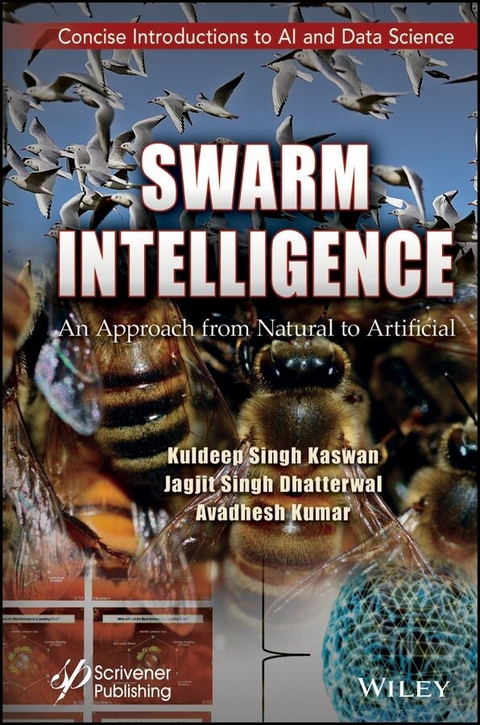
Swarm Intelligence (eBook)
John Wiley & Sons (Verlag)
978-1-119-86555-1 (ISBN)
This important authored book presents valuable new insights by exploring the boundaries shared by cognitive science, social psychology, artificial life, artificial intelligence, and evolutionary computation by applying these insights to solving complex engineering problems.
Motivated by the capability of the biologically inspired algorithms, 'Swarm Intelligence: An Approach from Natural to Artificial' focuses on ant, cat, crow, elephant, grasshopper, water wave and whale optimization, swarm cyborg and particle swarm optimization, and presents recent developments and applications concerning optimization with swarm intelligence techniques. The goal of the book is to offer a wide spectrum of sample works developed in leading research throughout the world about innovative methodologies of swarm intelligence and foundations of engineering swarm intelligent systems; as well as applications and interesting experiences using particle swarm optimization, which is at the heart of computational intelligence.
Discussed in the book are applications of various swarm intelligence models to operational planning of energy plants, modeling, and control of robots, organic computing, techniques of cloud services, bioinspired optimization, routing protocols for next-generation networks inspired by collective behaviors of insect societies and cybernetic organisms.
Audience
The book is directed to researchers, practicing engineers, and students in computational intelligence who are interested in enhancing their knowledge of techniques and swarm intelligence.
Kuldeep Singh Kaswan, PhD, is working in the School of Computing Science & Engineering, Galgotias University, Uttar Pradesh, India. He received his PhD in computer science from Banasthali Vidyapith, Rajasthan, and D. Engg. from Dana Brain Health Institute, Iran. His research interests are in brain-computer interface, cyborg, and data sciences.
Jagjit Singh Dhatterwal, PhD, is an associate professor in the Department of Artificial Intelligence & Data Science, Koneru Lakshmaiah Education Foundation, Vaddeswaram, AP, India. He completed his doctorate in computer science from Mewar University, Rajasthan, India. He has numerous publications in international/national journals and conferences.
Avadhesh Kumar, PhD, is Pro Vice-Chancellor at Galgotias University, India. He obtained his doctorate in computer science with a specialization in software engineering from Thapar University, Patiala, Punjab. He has more than 22 years of teaching and research experience and has published more than 40 research papers in SCI international journals/conferences. His research areas are aspect-oriented programming (AOP), software metrics, software quality, component-based software development (CBSD), artificial intelligence, and autonomic computing.
SWARM INTELLIGENCE This important authored book presents valuable new insights by exploring the boundaries shared by cognitive science, social psychology, artificial life, artificial intelligence, and evolutionary computation by applying these insights to solving complex engineering problems. Motivated by the capability of the biologically inspired algorithms, Swarm Intelligence: An Approach from Natural to Artificial focuses on ant, cat, crow, elephant, grasshopper, water wave and whale optimization, swarm cyborg and particle swarm optimization, and presents recent developments and applications concerning optimization with swarm intelligence techniques. The goal of the book is to offer a wide spectrum of sample works developed in leading research throughout the world about innovative methodologies of swarm intelligence and foundations of engineering swarm intelligent systems; as well as applications and interesting experiences using particle swarm optimization, which is at the heart of computational intelligence. Discussed in the book are applications of various swarm intelligence models to operational planning of energy plants, modeling, and control of robots, organic computing, techniques of cloud services, bioinspired optimization, routing protocols for next-generation networks inspired by collective behaviors of insect societies and cybernetic organisms. Audience The book is directed to researchers, practicing engineers, and students in computational intelligence who are interested in enhancing their knowledge of techniques and swarm intelligence.
Kuldeep Singh Kaswan, PhD, is working in the School of Computing Science & Engineering, Galgotias University, Uttar Pradesh, India. He received his PhD in computer science from Banasthali Vidyapith, Rajasthan, and D. Engg. from Dana Brain Health Institute, Iran. His research interests are in brain-computer interface, cyborg, and data sciences. Jagjit Singh Dhatterwal, PhD, is an associate professor in the Department of Artificial Intelligence & Data Science, Koneru Lakshmaiah Education Foundation, Vaddeswaram, AP, India. He completed his doctorate in computer science from Mewar University, Rajasthan, India. He has numerous publications in international/national journals and conferences. Avadhesh Kumar, PhD, is Pro Vice-Chancellor at Galgotias University, India. He obtained his doctorate in computer science with a specialization in software engineering from Thapar University, Patiala, Punjab. He has more than 22 years of teaching and research experience and has published more than 40 research papers in SCI international journals/conferences. His research areas are aspect-oriented programming (AOP), software metrics, software quality, component-based software development (CBSD), artificial intelligence, and autonomic computing.
1
Introduction of Swarm Intelligence
Abstract
Because biology is swarming intelligence, for millions of years, many biological processes have addressed complex issues through information exchange with groups. By thoroughly examining the behavioral factors aspects of individuals and integrating compartmental observations with mathematical or simulated modeling, the processes of the collective conduct in biological systems are now understood. We use insect-world examples to demonstrate how structures are developed, collective choices are taken, and how enormous groups of insects may move as one. This first chapter encourages computer programmers to look more carefully at the biomedical domain.
Keywords: Swarm behavior, collective behavior, particle swarm optimization (PSO), swarm agents, optimization method, global behavior, fish schooling
1.1 Introduction to Swarm Behavior
- A swarm may be described as an organized grouping of organizations that interact (or agents).
- In a swarm, individuals cooperate to achieve a global goal more efficiently than a single person could.
- Although an individual’s conduct is straightforward, group activities can become very difficult.
- Computer scientists use birds (for flocks), ants, poultry (for schools), bees, and wasps in swarm intellectual ability studies [1].
1.1.1 Individual vs. Collective Behaviors
- Swarming and individual behaviors are closely interconnected.
- Individuals form and determine the behaviors of the swarm. On the other hand, the swarm’s behavior affects the environment under which a person acts. Individuals specialize in one specific duty in a colony of ants. Taken together, activities and behaviors of ants guarantee the construction of optimum nesting systems, the protection of the queen and larva, the purification of nests, the search for the optimum sources of food, the improvement of assault methods, etc. Global behavior arises non-linearly from the activity and interconnections of members in the swarm [2].
The connection between refining aid interactions between people boosts experienced environmental knowledge and optimizes swarm development.
- The collaboration between people is determined genetically or through social interaction.
- Social relationships may be direct or indirect.
- Visual, auditory, or chemical contacts are immediate interactions [3].
- Indirect relationships happen when some people alter the environment, and others react to a different world.
- Social networking provides lines of communication to communicate knowledge.
1.2 Concepts of Swarm Intelligence
Swarm intelligence (SI) is a system that produces globally integrated functioning patterns due to the combined conduct of (unsupported) agents communicating locally with their environments [4].
- On the basis of SI, communal (or spread) issue solving may be explored without central authority or global modeling for function improvement, optimization of paths, timings, optimization of structures, design, and processing, and video analysis, productive implementations; and
- PSO (particle swarm optimization) and ACO (ant colony optimization).
1.3 Particle Swarm Optimization (PSO)
- The intent of the design is to visually recreate the beautiful and unexpected dance of a flock of birds.
- The objective of identifying patterns governs birds’ capacity to fly simultaneously and alter their course quickly, with an ideal grouping.
This PSO technique has become a convenient and straightforward optimization method [5].
1.3.1 Main Concept of PSO
- PSO is a population-based search technique where people are sorted into a pool, called particles. The possible answer to the optimization problem is every particle in the swarm.
- In the PSO system, each particle is “flown” in a multifunctional search area, adapting its search space to its own and adjacent particles’ experience or knowledge.
Therefore, a particle uses its best position and its neighbors’ most vital position to the situation itself towards the optimal solution.
- The consequence is that, while still exploring a region surrounding the perfect option, nanoparticles are flying towards the global minimum.
- Every particle’s effectiveness is measured based on a specified fitness function linked to the challenge.
1.4 Meaning of Swarm Intelligence
Pattern recognition is the systematic gathering of naturally occurring dispersed, self-organized systems. The idea is used in machine intelligence development. In 1989, it was presented in the methods used in cellular cyborgs by Gerardo Beni and Jing Wang.
Swarm intelligence (SI) systems generally consist of a community of essential agents or boots that interact independently and with each other. Nature, in particular living organisms, frequently inspires. The agents obey elementary principles. While no command and control structure determines how the agents behave, local exchanges lead to the formation of “intelligent” universal behaviors, which are unknown to the agents. Examples of natural SI include organisms, flocking of birds, hawk chasing, herding of animals, and growth of bacteria, fish schooling, and microbiological information.
Swarming concepts are called swarm cyborgs, but swarm intelligence refers to a broader range of algorithms. In the framework of forecasting issues, swarm prediction has been utilized. Similar techniques in synthetic intellectual capacity for genetic engineering to those suggested for swarm cyborgs must be studied [6].
1.5 What Is Swarm Intelligence?
The study of decentralized, self-organized networks is cognitive swarming that can rush in a coordinated way. Swarms exist naturally, and evolutionary habitats, such as ant colonies, flocks of birds, and animal husbandry, have been studied by scientists to discover how distinct bioproducts cooperate with their environments to achieve a shared objective.
In cyborgs, swarm knowledge involves the observation of nature and the use of concepts by scientists in machines. A cyborg swarm, for instance, may consist of small, identical appliances, each with sense. If data is exchanged with the other gadgets in the group acquired by one cyborg agent, it allows the users to act as a unified group. A cyborg swarm is typically straightforward, and agents frequently use sonar, radar, or camera to acquire additional data [7].
1.5.1 Types of Communication Between Swarm Agents
Isolated bots or swarming agents can interact in several ways, including:
- Point to point: Information is transmitted immediately from the agent to warn the swarm of places, impediments, or objectives.
- Broadcasting: One agent in the swarm immediately broadcasts information to the rest of the swarming via sound, light, or wireless media.
- Contextual information exchange: An agent leaves a message inside the swarm that can transmit information to affect the behavior of other members. The way insects leave behind a trail of pheromones to take their equivalents to a particular area is comparable.
1.5.2 Examples of Swarm Intelligence
Pattern recognition has a lot of uses. Small, drone-like cameras for risky search and recovery operations can show optimization techniques. The cyborgs may execute an extremely light duty in destructed regions, such as looking for survivors if scheduled for working together as a single unit. Pattern recognition is also used to mimic crowds, such as augmented reality games in films and the importance of technology.
“Smart dust” is a term used to characterize a microelectromechan-ical system (MEMS) that is tiny enough to remain hanging in the air. Researcher think that smart dust should analyze environmental details in distant worlds.
1.6 History of Swarm Intelligence
Independent creatures in naturalistic cloud computing usually have no idea of a high-level purpose but may mimic complicated real-world systems. When satisfied, numerous low-level objectives make this feasible. This enables significant collective activity resulting from these stupid and non-influent single individuals. A reintroduction to the modeling of natural things such as fire, wind, and liquid in computer-based animation tracks back to the early efforts of William “Bill” Reeves in 1983, culminating in the Pixar film Luca in 2021. During the development process, agents or “droplets” were created. In the virtual simulation, they undertook modifications, wandered around, and were finally rejected or “died.” Reeves found that such a pattern could represent the dynamism and shape of natural surroundings, which had been unfeasible with conventional surface depictions. The Boid model (1986) created basic principles that enhance the independence of particle behaviors and set simple low-level norms that may lead to emerging behavior by boids (bird-oid objects) and particles. Therefore, the sophistication of the Boid model is a direct result of the fundamental interconnections between each component. Craig Reynolds established three different swarming regulations for the following particles: segregation, alignment, and cohesion. While the concept of separating enables molecules to move away from one another to prevent crossover, the harmonization and cohesive ideas need directional upgrades to...
| Erscheint lt. Verlag | 8.2.2023 |
|---|---|
| Reihe/Serie | Concise Introductions to AI and Data Science | Concise Introductions to AI and Data Science |
| Sprache | englisch |
| Themenwelt | Mathematik / Informatik ► Informatik ► Theorie / Studium |
| Schlagworte | AI • ant behavior • Artificial Intelligence • Artificial Life • bee summing • behavior model • binary decision • brain storm • Chip • Cognitive • collective behavior • collective intelligence • Communication & Media Studies • Communication Studies • Computer Science • cultural algorithm • Economic Load Dispatch • Electrical & Electronics Engineering • Elektrotechnik u. Elektronik • Fish Schooling • Genetic Algorithm • Global Behavior • Informatik • Intelligente Systeme u. Agenten • Intelligent Systems & Agents • IQ scale • IQ Test • KI • Kommunikationswissenschaft • Kommunikation u. Medienforschung • Künstliche Intelligenz • machine intelligence • model-based search • optimal solution • Optimization • Optimization Method • oscillations • parameter selection • particle swarm optimization (PSO) • Pheromone • power constraint • propagating • refraction • Schwarmintelligenz • shortest path • simulation ant • Social behavior • socio-cognitive • Swarm Agents • Swarm Behavior • water wave |
| ISBN-10 | 1-119-86555-7 / 1119865557 |
| ISBN-13 | 978-1-119-86555-1 / 9781119865551 |
| Informationen gemäß Produktsicherheitsverordnung (GPSR) | |
| Haben Sie eine Frage zum Produkt? |
 EPUB (Adobe DRM)
Kopierschutz: Adobe-DRM
Adobe-DRM ist ein Kopierschutz, der das eBook vor Mißbrauch schützen soll. Dabei wird das eBook bereits beim Download auf Ihre persönliche Adobe-ID autorisiert. Lesen können Sie das eBook dann nur auf den Geräten, welche ebenfalls auf Ihre Adobe-ID registriert sind.
Details zum Adobe-DRM
Dateiformat: EPUB (Electronic Publication)
EPUB ist ein offener Standard für eBooks und eignet sich besonders zur Darstellung von Belletristik und Sachbüchern. Der Fließtext wird dynamisch an die Display- und Schriftgröße angepasst. Auch für mobile Lesegeräte ist EPUB daher gut geeignet.
Systemvoraussetzungen:
PC/Mac: Mit einem PC oder Mac können Sie dieses eBook lesen. Sie benötigen eine
eReader: Dieses eBook kann mit (fast) allen eBook-Readern gelesen werden. Mit dem amazon-Kindle ist es aber nicht kompatibel.
Smartphone/Tablet: Egal ob Apple oder Android, dieses eBook können Sie lesen. Sie benötigen eine
Geräteliste und zusätzliche Hinweise
Buying eBooks from abroad
For tax law reasons we can sell eBooks just within Germany and Switzerland. Regrettably we cannot fulfill eBook-orders from other countries.
aus dem Bereich