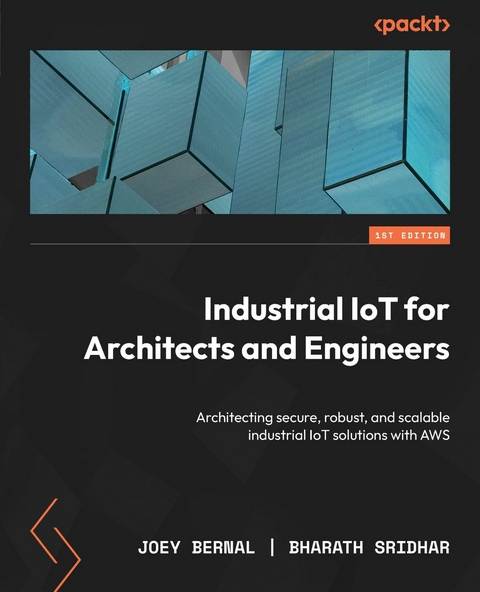
Industrial IoT for Architects and Engineers (eBook)
344 Seiten
Packt Publishing (Verlag)
978-1-80324-619-2 (ISBN)
When it comes to using the core and managed services available on AWS for making decisions about architectural environments for an enterprise, there are as many challenges as there are advantages. This Industrial IoT book follows the journey of data from the shop floor to the boardroom, identifying goals and aiding in strong architectural decision-making.
You'll begin from the ground up, analyzing environment needs and understanding what is required from the captured data, applying industry standards and conventions throughout the process. This will help you realize why digital integration is crucial and how to approach an Industrial IoT project from a holistic perspective. As you advance, you'll delve into the operational technology realm and consider integration patterns with common industrial protocols for data gathering and analysis with direct connectivity to data through sensors or systems. The book will equip you with the essentials for designing industrial IoT architectures while also covering intelligence at the edge and creating a greater awareness of the role of machine learning and artificial intelligence in overcoming architectural challenges.
By the end of this book, you'll be ready to apply IoT directly to the industry while adapting the concepts covered to implement AWS IoT technologies.
Go beyond connecting services to understand the unique challenges encountered in industrial environments by building Industrial IoT architectures using AWSPurchase of the print or kindle book includes a free eBook in the PDF formatKey FeaturesUnderstand the key components of IoT Architecture and how it applies to Industry 4.0Walk through extensive examples and solutions across multiple IndustriesLearn how to collect, process, store, and analyse Industrial IoT dataBook DescriptionWhen it comes to using the core and managed services available on AWS for making decisions about architectural environments for an enterprise, there are as many challenges as there are advantages. This Industrial IoT book follows the journey of data from the shop floor to the boardroom, identifying goals and aiding in strong architectural decision-making.You'll begin from the ground up, analyzing environment needs and understanding what is required from the captured data, applying industry standards and conventions throughout the process. This will help you realize why digital integration is crucial and how to approach an Industrial IoT project from a holistic perspective. As you advance, you'll delve into the operational technology realm and consider integration patterns with common industrial protocols for data gathering and analysis with direct connectivity to data through sensors or systems. The book will equip you with the essentials for designing industrial IoT architectures while also covering intelligence at the edge and creating a greater awareness of the role of machine learning and artificial intelligence in overcoming architectural challenges.By the end of this book, you'll be ready to apply IoT directly to the industry while adapting the concepts covered to implement AWS IoT technologies.What you will learnDiscover Industrial IoT best practices and conventionsUnderstand how to get started with edge computingDefine and build IoT solution architectures from scratchUse AWS as the core of your solution platformApply advanced analytics and machine learning to your dataDeploy edge processing to react in near real time to events within your environmentWho this book is forThis book is for architects, engineers, developers, and technical professionals interested in building an edge and cloud-based Internet of Things ecosystem with a focus on industry solutions. Since the focus of this book is specifically on IoT, a solid understanding of core IoT technologies and how they work is necessary to get started. If you are someone with no hands-on experience, but are familiar with the subject, you'll find the use cases useful to learn how architectural decisions are made.
1
Welcome to the IoT Revolution
This book is designed for architects and industrial engineers looking for guidance in moving into IoT or the Industry 4.0 space, offering some ideas, approaches, goals, and advice to help make your way forward a little easier and more successful. For readers new to IT architecture or the IoT space, we aim to help answer many of those initial questions or at least guide you in asking the right questions. We want to set the stage in these initial chapters before we get too deep into the technical details. Anyone new to these topics should benefit from these initial chapters, especially non-technical stakeholders who want to understand the why and how of Industrial IoT. With this in mind, please consider that we are providing historical and architectural background, guidance, and some best practices, from an IT and system development approach. If things get too technical, you have been warned.
In this chapter, we want to set the stage for understanding Industry 4.0 and help you to understand where it is headed and why it is important. We are going to review why the current Industrial Revolution and Industry 4.0 are so important, know where we are in the current state of technology, and learn how you can build your vision and value statement for driving technologies such as IoT into your organization.
We are going to cover the following main topics:
- Industry 4.0 and the digitalization of industry
- How IoT can support Industry 4.0 at scale
- The convergence – IT, OT, and management working together
- Leveraging good architecture to drive progress
In future chapters, we will delve much deeper into the how of Industrial IoT and learn how to implement and use some of this exciting technology, but stay with us. We need to understand some of the history better and discover where it all started. We have also chosen Amazon Web Services (AWS) as the hyperscaler of choice to base our practical examples. AWS is a formidable player in this space and has a great product roadmap and vision associated with Industrial IoT. There will be more about this as we progress across chapters.
Technical requirements
There are no specific technical requirements for this chapter. Readers at every level should clearly understand it. Our focus is setting the groundwork for why Industrial IoT is poised as one of the next major turns of the technology crank and how you can move forward with adoption within your industry.
Industry 4.0 and the digitalization of industry
Many software architects are sometimes wary of the hype around new technology. Great ideas and visions are pivots that lead us into the future and guide us in taking advantage of new technology in both our business and personal lives. However, the road to the current state of technology is paved with great ideas that never made it out of the concept phase, and overly aggressive marketing and sales around new (good and bad) technologies have made everyone just a little more cautious.
Usually, at the early stages of some technologies, marketing and sales teams jump in and take over, looking for any opportunity to push an idea or build a prototype with any potential customer, attempting to work together with customers to build a vision of what the future could be. But then comes the hard work of architecture, design, prototyping, rollout, testing, production, and support. Sometimes, the state of the technology isn’t quite ready, and reality intervenes. If you have been burned enough times, it gets harder to reach back in.
Fortunately for us, Industry 4.0 has made it well past the starting gate and into the reality of many organizations. Even though it has been making progress for most of the last decade, there is still a fair amount of work to be done before it can be considered mainstream technology in many organizations. The evolution and improvements in hardware, such as sensors and processors, software protocols, and integration tools, make retrieving real-time or near real-time data from almost any device or area more accessible and safer. The why of data capture and Industrial IoT is what we will be discussing in this chapter, while the how will be discussed in the rest of this book.
Industry 4.0, or the fourth Industrial Revolution, is commonly thought of as the automation and digitalization of industry and manufacturing systems. IoT and cloud technologies have become critical enablers of this effort and provide the ability to integrate and automate machinery to become more intelligent and adaptive. Ideally, this includes adopting artificial intelligence and machine learning to enable systems to self-monitor and diagnose or predict problems that may occur.
This description does provide a bit of futuristic vision, connotating a kind of rise of the machines approach, but it gives us a good starting point on which to base our discussion.
A very brief history lesson
History books and most university classes on this topic will agree that the world has undergone three previous industrial revolutions. For us, how we got to where we are is maybe not as important as where we are going, so we won’t belabor the history here, but we’ll provide some background to aid in your organizational discussions and help us pinpoint the reason for and the focus of this book.
The first Industrial Revolution
The first Industrial Revolution occurred in the late 1700s when mechanization based on water or steam power began. Traditional thought placed this beginning in the 1780s when the first mechanical loom was designed and built. While (relatively) easy to make, replicate, and ship, this allowed for the first major transition from production using hands to allowing machine-based tools to do the work.
Early industrial progress
There are, of course, precursors to the first Industrial Revolution. Recently, on a trip to the Netherlands, I was able to tour some windmills that advanced industry in the region as early as the 1600s, providing improvements to industries such as milling, weaving, and lumber production. Although windmill technology had been in service moving water in the region for centuries before this, this small evolution in leveraging the technology for other types of work allowed the Netherlands to advance into a new era, most notably in shipbuilding. Unfortunately, the technology could not be as easily exported since wind-driven machines were primarily a defining factor of the region. However, the inventiveness of the Dutch and the innovative use of gears, levers, and screws helped build the groundwork for future industry advances, evolving from, for example, farm animals for drawing water or agriculture.
The fact that much of the work was driven by steam was also important. The steam engine’s efficiency had greatly improved by this time, and it was now lighter and more transportable. Coal, and the ability to mine coal in significant quantities, was essential for powering these steam engines. Adapting these same engines moving in one direction or performing one motion to a different degree of movement allowed for more flexibility and complexity in industrial use. The loom was prominent in this phase because the textile industry was labor-intensive, and it became one of the first industries to adopt and see the benefit of new technology.
The second Industrial Revolution
The second Industrial Revolution often referred to as the technological revolution, started in the late 1800s and was a strong driver for the modern world we live in today. The expansion of almost everything we know and use in today’s world started during this period. Beginning with the growth of railroads and telegraphs, industry expanded further, bringing gas, water, sewer, and electricity and increasing globalization toward the end of the colonial age.
The expansion of electricity and assembly/production lines happened within this period. History credits Henry Ford for inventing the assembly line in 1913, paving the way for advanced mass production. Ford is also credited for advancements with the combustion engine, steel, and new fuels and materials that drove this exciting period of change and once again transformed many industries.
The third Industrial Revolution
The timelines are a little intertwined because advancements were frequently made that lent toward each distinct phase of technological evolution. These revolutions can seem almost continuous if traced from end to end with enough detail and advancements. There have always been significant breakthroughs that highlight the end of the last and the beginning of the next phase of advancement. The third Industrial Revolution started in the late 1900s and is called the Digital Revolution. This registers as a shift from analog technology to digital technology. The invention of the internet and smaller computing technologies allowed us to enter the information age.
The invention of the transistor in 1947 is a critical starting point for this era. However, it was several decades before this technology was adapted enough to be helpful on a large scale, with the ability to design and create integrated circuits consisting of hundreds of...
| Erscheint lt. Verlag | 20.1.2023 |
|---|---|
| Sprache | englisch |
| Themenwelt | Mathematik / Informatik ► Informatik |
| ISBN-10 | 1-80324-619-7 / 1803246197 |
| ISBN-13 | 978-1-80324-619-2 / 9781803246192 |
| Informationen gemäß Produktsicherheitsverordnung (GPSR) | |
| Haben Sie eine Frage zum Produkt? |
 EPUB (Ohne DRM)
Digital Rights Management: ohne DRM
Dieses eBook enthält kein DRM oder Kopierschutz. Eine Weitergabe an Dritte ist jedoch rechtlich nicht zulässig, weil Sie beim Kauf nur die Rechte an der persönlichen Nutzung erwerben.
Dateiformat: EPUB (Electronic Publication)
EPUB ist ein offener Standard für eBooks und eignet sich besonders zur Darstellung von Belletristik und Sachbüchern. Der Fließtext wird dynamisch an die Display- und Schriftgröße angepasst. Auch für mobile Lesegeräte ist EPUB daher gut geeignet.
Systemvoraussetzungen:
PC/Mac: Mit einem PC oder Mac können Sie dieses eBook lesen. Sie benötigen dafür die kostenlose Software Adobe Digital Editions.
eReader: Dieses eBook kann mit (fast) allen eBook-Readern gelesen werden. Mit dem amazon-Kindle ist es aber nicht kompatibel.
Smartphone/Tablet: Egal ob Apple oder Android, dieses eBook können Sie lesen. Sie benötigen dafür eine kostenlose App.
Geräteliste und zusätzliche Hinweise
Buying eBooks from abroad
For tax law reasons we can sell eBooks just within Germany and Switzerland. Regrettably we cannot fulfill eBook-orders from other countries.
aus dem Bereich