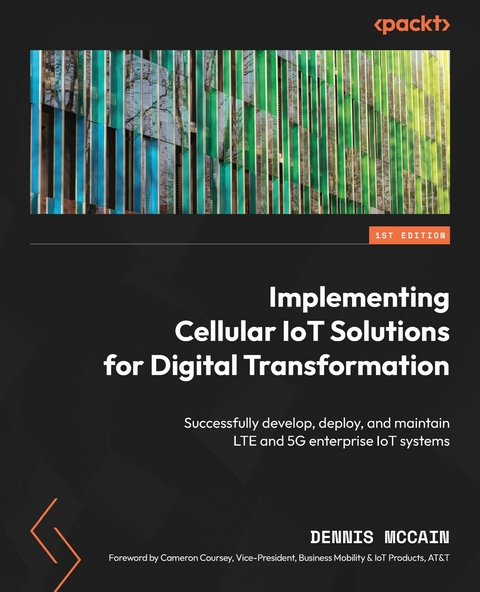
Implementing Cellular IoT Solutions for Digital Transformation (eBook)
202 Seiten
Packt Publishing (Verlag)
978-1-80461-584-3 (ISBN)
Even if you're an IoT technology manager with a sound understanding of wireless local area network technologies like Wi-Fi and Bluetooth, you may face many unique challenges when implementing a wireless wide area network (WWAN) IoT solution with cellular technologies with respect to choosing the optimal IoT device, cellular connectivity, and architecture. To help you overcome such roadblocks, this digital transformation book guides you in implementing a robust, end-to-end cellular IoT solution using best practices for all aspects of managing the IoT solution.
Starting with an introduction to the top IoT markets and solutions in the context of an enterprise's digital transformation, this book will show you how this leads to cost savings and new business models. You'll grasp all you need to know about the IoT system components, life cycle, and best practices for implementing an IoT solution. While the book explains all the leading IoT wireless technologies, the focus is on LTE and 5G cellular technologies. With a review of real-world cellular IoT solution case studies and future IoT trends, you'll be ready to work with wireless IoT technologies, devices, and architectures.
By the end of this book, you'll be able to identify the best wireless technologies for your IoT use cases and successfully implement cellular IoT solutions addressing key issues in the solution life cycle.
A pragmatic handbook on IoT technologies and markets that will guide you in implementing cellular IoT solutions as part of an enterprise's digital transformation affecting both operational cost savings and new business models.Purchase of the print or Kindle book includes a free eBook in the PDF format.Key FeaturesUnderstand all the critical aspects of a cellular IoT solution with this practical guideIdentify key enterprise IoT market requirements and IoT business casesDevelop robust end-to-end cellular IoT solutions with the help of best practices and case studiesBook DescriptionEven if you're an IoT technology manager with a sound understanding of wireless local area network technologies like Wi-Fi and Bluetooth, you may face many unique challenges when implementing a wireless wide area network (WWAN) IoT solution with cellular technologies with respect to choosing the optimal IoT device, cellular connectivity, and architecture. To help you overcome such roadblocks, this digital transformation book guides you in implementing a robust, end-to-end cellular IoT solution using best practices for all aspects of managing the IoT solution.Starting with an introduction to the top IoT markets and solutions in the context of an enterprise's digital transformation, this book will show you how this leads to cost savings and new business models. You'll grasp all you need to know about the IoT system components, life cycle, and best practices for implementing an IoT solution. While the book explains all the leading IoT wireless technologies, the focus is on LTE and 5G cellular technologies. With a review of real-world cellular IoT solution case studies and future IoT trends, you'll be ready to work with wireless IoT technologies, devices, and architectures.By the end of this book, you'll be able to identify the best wireless technologies for your IoT use cases and successfully implement cellular IoT solutions addressing key issues in the solution life cycle.What you will learnUnderstand how IoT enables an enterprise's digital transformationDiscover the applications of various IoT wireless technologiesExplore IoT devices, architectures, and real-world use casesDive deep into LTE and 5G cellular technologies and how they enable IoTBuild a privacy and security framework in an IoT solutionSelect the best components for a cellular IoT enterprise solutionOvercome challenges in the IoT solution life cycleExamine new cellular IoT technologies, trends, and business modelsWho this book is forThis book is for IoT technology managers, leaders, C-suite executives, and decision-makers considering or currently developing IoT solutions based on wireless/cellular technologies such as LTE and 5G. You'll be able to make the most of this book if you understand the importance of IoT connectivity in the context of its applications.
1
Transforming to an IoT Business
The majority of people are familiar with the Internet of Things (IoT), which was first coined in 1985 and was born according to Cisco Systems in 2008 when more things were connected to the internet than people. In practical terms, IoT is defined as physical objects that connect and exchange data with other devices and systems over the internet. Now, IoT is ubiquitous, especially in the consumer market, where home automation/monitoring is now quite common. As of 2020, there were over 12 billion connected devices with a forecast of more than 30.9 billion IoT devices worldwide by 2025 (source: Business Insider, IoT Analytics, Gartner, Intel, Statista). There were 5.8 billion connected automotive and enterprise IoT devices by the end of 2020, and it is expected that more than 15 billion enterprise IoT devices will be connected by 2029 (source: Gartner), which is why enterprise IoT is the focus of this book. While over 98% of business leaders have an understanding of IoT, statistics show that many are unclear of the exact definition of the term (source: Fierce Electronics), which undermines the full potential of enterprise IoT solutions and is the reason we decided to write this book. The enterprise market is where IoT is making the biggest impact in terms of digital transformation, with operational cost savings and new business models. By the end of this chapter, you will have a good understanding of the underlying IoT solution technologies and markets, as well as how IoT solutions can be used to transform a business with operational cost savings, improved efficiencies, and new business models.
In this chapter, we will cover the following main topics:
- Understanding IoT technologies
- Leveraging IoT for digital transformation
- Discovering the top IoT markets
Understanding IoT technologies
In this section, you will learn about the underlying IoT technologies while using a high-level IoT solution end-to-end architecture as a guide. This includes IoT devices, connectivity, data analytics, and applications. The goal of this section is to provide you with a practical understanding of an IoT solution that will form the basis for an enterprise’s digital transformation, as discussed in the next section.
At a high level, an IoT solution consists of four basic layers, as shown in the following figure:
Figure 1.1 – High-level IoT architecture
The device layer is the actual physical device or thing in IoT that is connected to the internet. It captures critical IoT sensor data such as temperature, humidity, light, and air quality for remote monitoring applications. We will explore IoT devices in more detail in Chapter 6, Reviewing Cellular IoT Devices with Use Cases, but some common IoT devices that gather this sensor data include gateways, routers, and asset trackers. This sensor data can include location data for assets such as cars and enterprise fleets, health data for remote patient monitoring (RPM), or video data for security. We will cover IoT device types in more detail in Chapter 2, Understanding IoT Devices and Architectures, and describe how an IoT device is the foundation for an IoT solution. We will also discuss the near real-time processing of data at the device layer, known as edge computing, which is a growing and important trend that is driving tremendous growth in enterprise IoT.
The connectivity layer is the wireless or wired connectivity, which is the gateway to the internet. This could be a wireless local area network (WLAN) technology such as Wi-Fi, Bluetooth, or Zigbee or a wireless wide area network (WWAN) technology such as cellular or LoRaWAN. As we will discuss in Chapter 2, Understanding IoT Devices and Architectures, and Chapter 3, Introducing IoT Wireless Technologies, WLAN technologies rely on a WAN gateway device to backhaul connectivity to the internet. Although several wireless technologies enable IoT, which we will present in Chapter 3, Introducing IoT Wireless Technologies, we will make the case that cellular technologies such as LTE and 5G are unique enablers for the new and transformative IoT business models, which is part of the reason why cellular IoT devices grew 18% year-over-year to reach 2 billion by the end of 2021 (source: IoT Analytics). More specifically, Low Power Wide Area (LPWA) cellular technologies such as LTE Category M (LTE-M) and Narrow Band IoT (NB-IoT) offer unique features in terms of lower cost and power that further enable new IoT applications. In Chapter 3, Introducing IoT Wireless Technologies, we will provide much more detail on both licensed and unlicensed wireless IoT technologies, especially LPWA, and how they enable the growth of enterprise IoT solutions and new IoT business models. In Part 2, we will do a deep dive into cellular IoT wireless technologies.
The data analytics layer is where the IoT device data is processed and is typically implemented in combination with the application layer in the domain of a Cloud Service Provider (CSP) such as Amazon Web Services (AWS) or Microsoft Azure. The data analytics layer is where the value of the IoT device data is realized in terms of data analytics and actionable data for an enterprise IoT solution. As mentioned earlier, for many IoT applications, much of the IoT data processing is moving from the data analytics layer in the cloud to the device, which is known as “edge” data processing. This enables more real-time and low-latency applications such as intelligent transportation (for example, autonomous vehicles), augmented/virtual reality, and video intelligence. We will go into more detail on IoT data processing in the context of IoT architectures in Chapter 2, Understanding IoT Devices and Architectures.
The application layer is the dashboard for the IoT solution that pulls together the IoT device data with the connectivity and processing into a meaningful presentation. For example, in the case of asset tracking, this would be a map showing the location and contiguous path of an asset such as a fleet vehicle or container, along with temperature and humidity sensing data/alerts along the way. Behind the application is where data processing takes place. This involves the time series data from the IoT device along with sensor and location data. In this example, the asset tracking application in combination with the underlying data processing provides not only a better user experience in monitoring the asset but also identifies patterns that drive business decisions around real operational cost savings. We will cover the IoT application protocols, including MQTT and CoAP, in more detail in Chapter 2, Understanding IoT Devices and Architectures.
We will review the end-to-end IoT solution architecture in more detail in Chapter 2, Understanding IoT Devices and Architectures, but at a high level, these four IoT layers are the basis for an enterprise IoT digital transformation in terms of improved customer experience, real-time insights leading to operational cost savings, and new service business lines. In the Understanding IoT markets section, we will discuss the top IoT markets, along with some example applications in each market, that helped create a digital transformation strategy that is being adopted by more and more businesses. While in 2018, 57% of businesses adopted IoT in some way, this increased to 94% in 2021 (source: Aruba Research Report, Microsoft). Moreover, 83% of organizations that employed IoT technology have reported a significant increase in business efficiency (source: Aruba Research Report, Microsoft). In the next section, we will learn how IoT can drive enterprise digital transformation.
Leveraging IoT for digital transformation
What is the role of IoT in enterprise digital transformation? In short, IoT solutions act as a connection between the physical assets of a business and the information technology (IT) infrastructure, leading to improved operational efficiencies as well as new and better customer experiences. To provide the impetus for implementing an IoT solution in your business, we will describe five areas where IoT can enable digital transformation in your business:
- Monitoring and managing assets and inventory.
- Increasing operational efficiencies and productivity.
- Creating smart...
| Erscheint lt. Verlag | 10.2.2023 |
|---|---|
| Sprache | englisch |
| Themenwelt | Mathematik / Informatik ► Informatik ► Netzwerke |
| Informatik ► Weitere Themen ► Hardware | |
| ISBN-10 | 1-80461-584-6 / 1804615846 |
| ISBN-13 | 978-1-80461-584-3 / 9781804615843 |
| Informationen gemäß Produktsicherheitsverordnung (GPSR) | |
| Haben Sie eine Frage zum Produkt? |
 EPUB (Ohne DRM)
Digital Rights Management: ohne DRM
Dieses eBook enthält kein DRM oder Kopierschutz. Eine Weitergabe an Dritte ist jedoch rechtlich nicht zulässig, weil Sie beim Kauf nur die Rechte an der persönlichen Nutzung erwerben.
Dateiformat: EPUB (Electronic Publication)
EPUB ist ein offener Standard für eBooks und eignet sich besonders zur Darstellung von Belletristik und Sachbüchern. Der Fließtext wird dynamisch an die Display- und Schriftgröße angepasst. Auch für mobile Lesegeräte ist EPUB daher gut geeignet.
Systemvoraussetzungen:
PC/Mac: Mit einem PC oder Mac können Sie dieses eBook lesen. Sie benötigen dafür die kostenlose Software Adobe Digital Editions.
eReader: Dieses eBook kann mit (fast) allen eBook-Readern gelesen werden. Mit dem amazon-Kindle ist es aber nicht kompatibel.
Smartphone/Tablet: Egal ob Apple oder Android, dieses eBook können Sie lesen. Sie benötigen dafür eine kostenlose App.
Geräteliste und zusätzliche Hinweise
Buying eBooks from abroad
For tax law reasons we can sell eBooks just within Germany and Switzerland. Regrettably we cannot fulfill eBook-orders from other countries.
aus dem Bereich