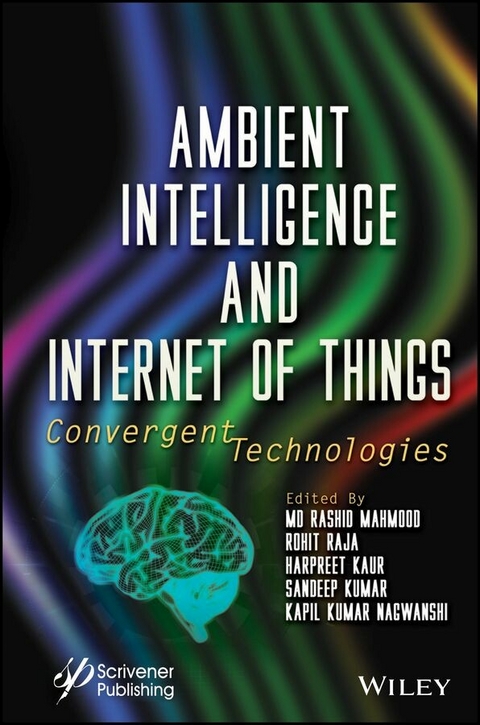
Ambient Intelligence and Internet Of Things (eBook)
John Wiley & Sons (Verlag)
978-1-119-82181-6 (ISBN)
The book explores long-term implementation techniques and research paths of ambient intelligence and the Internet of Things that meet the design and application requirements of a variety of modern and real-time applications.
Working environments based on the emerging technologies of ambient intelligence (AmI) and the Internet of Things (IoT) are available for current and future use in the diverse field of applications. The AmI and IoT paradigms aim to help people achieve their daily goals by augmenting physical environments using networks of distributed devices, including sensors, actuators, and computational resources. Because AmI-IoT is the convergence of numerous technologies and associated research fields, it takes significant effort to integrate them to make our lives easier. It is asserted that Am I can successfully analyze the vast amounts of contextual data obtained from such embedded sensors by employing a variety of artificial intelligence (AI) techniques and that it will transparently and proactively change the environment to conform to the requirements of the user. Over time, the long-term research goals and implementation strategies could meet the design and application needs of a wide range of modern and real-time applications.
The 13 chapters in Ambient Intelligence and Internet of Things: Convergent Technologies provide a comprehensive knowledge of the fundamental structure of innovative cutting-edge AmI and IoT technologies as well as practical applications.
Audience
The book will appeal to researchers, industry engineers, and students in artificial and ambient intelligence, the Internet of Things, intelligent systems, electronics and communication, electronics instrumentations, and computer science.
Md Rashid Mahmood, PhD, is a professor in the Department of Electronics and Communication Engineering, Guru Nanak Institutions Technical Campus, Hyderabad, India. He has published 50 research papers in international/national journals as well as 10 patents.
Rohit Raja, PhD, is an associate professor & Head, IT Department, Guru Ghasidas, Vishwavidyalaya, Bilaspur, (CG), India. He has published 80 research papers in international/national journals as well as 13 patents.
Harpreet Kaur, PhD, is an associate professor in the Department of Electronics and Communication Engineering, Guru Nanak Institutions Technical Campus, Hyderabad, India. Her research interests include vehicle detection and tracking in autonomous vehicles, and image processing.
Sandeep Kumar, PhD, is a professor in the Department of Computer Science and Engineering, Koneru Lakshmaiah Education Foundation, Vaddeswaram, AP, India. He has published 85 research papers in international/national journals as well as 9 patents.
Kapil Kumar Nagwanshi, PhD, is an associate professor at SoS E&T, Guru Ghasidas Vishwavidyalaya, Bilaspur, India. He has published more the 25 articles in SCI and Scopus-indexed Journals, and six patents were granted. His area of interest includes AI-ML, computer vision, and IoT.
AMBIENT INTELLIGENCE AND INTERNET OF THINGS The book explores long-term implementation techniques and research paths of ambient intelligence and the Internet of Things that meet the design and application requirements of a variety of modern and real-time applications. Working environments based on the emerging technologies of ambient intelligence (AmI) and the Internet of Things (IoT) are available for current and future use in the diverse field of applications. The AmI and IoT paradigms aim to help people achieve their daily goals by augmenting physical environments using networks of distributed devices, including sensors, actuators, and computational resources. Because AmI-IoT is the convergence of numerous technologies and associated research fields, it takes significant effort to integrate them to make our lives easier. It is asserted that Am I can successfully analyze the vast amounts of contextual data obtained from such embedded sensors by employing a variety of artificial intelligence (AI) techniques and that it will transparently and proactively change the environment to conform to the requirements of the user. Over time, the long-term research goals and implementation strategies could meet the design and application needs of a wide range of modern and real-time applications. The 13 chapters in Ambient Intelligence and Internet of Things: Convergent Technologies provide a comprehensive knowledge of the fundamental structure of innovative cutting-edge AmI and IoT technologies as well as practical applications. Audience The book will appeal to researchers, industry engineers, and students in artificial and ambient intelligence, the Internet of Things, intelligent systems, electronics and communication, electronics instrumentations, and computer science.
Md Rashid Mahmood, PhD, is a professor in the Department of Electronics and Communication Engineering, Guru Nanak Institutions Technical Campus, Hyderabad, India. He has published 50 research papers in international/national journals as well as 10 patents. Rohit Raja, PhD, is an associate professor & Head, IT Department, Guru Ghasidas, Vishwavidyalaya, Bilaspur, (CG), India. He has published 80 research papers in international/national journals as well as 13 patents. Harpreet Kaur, PhD, is an associate professor in the Department of Electronics and Communication Engineering, Guru Nanak Institutions Technical Campus, Hyderabad, India. Her research interests include vehicle detection and tracking in autonomous vehicles, and image processing. Sandeep Kumar, PhD, is a professor in the Department of Computer Science and Engineering, Koneru Lakshmaiah Education Foundation, Vaddeswaram, AP, India. He has published 85 research papers in international/national journals as well as 9 patents. Kapil Kumar Nagwanshi, PhD, is an associate professor at SoS E&T, Guru Ghasidas Vishwavidyalaya, Bilaspur, India. He has published more the 25 articles in SCI and Scopus-indexed Journals, and six patents were granted. His area of interest includes AI-ML, computer vision, and IoT.
1
Ambient Intelligence and Internet of Things: An Overview
Md Rashid Mahmood1*, Harpreet Kaur1, Manpreet Kaur1, Rohit Raja2 and Imran Ahmed Khan3
1Department of ECE, Guru Nanak Institutions Technical Campus, Hyderabad, India
2Department of IT, Guru Ghasidas Vishwavidyala, Bilaspur, India
3Department of ECE, Jamia Millia Islamia, New Delhi, India
Abstract
Ambient intelligence (AmI) is the ability of technology to make judgments and act on our behalf. AmI is a cutting-edge technology that has the potential to fundamentally alter the way we interact with machines and electronics in our environment. It does not ask the user questions but rather understands the context in which the user is operating. Ambient intelligence (AmI) uses sensors and devices in our homes and offices to gather information about the environment. The AmI system then makes inferences based on proximity, intent, and behavioral patterns. It reacts to the user via a smart device’s elegantly built natural interface. The Internet of Things (IoT) is a network of web-connected smart gadgets that collect data from their surroundings and use it to make decisions about their own lives. Ambient intelligence refers to what occurs when various devices connect, and more specifically, what they learn from one another. Ambient computing is a new kind of relationship between computers and employees. It gathers information for us when we ask for it, or even before we ask. Ambient intelligence aims to improve the way people and their environment interact with one another. Ambient intelligence (AI) is a subset of artificial intelligence (AI). Artificial intelligence mimics human cognitive processes such as perceiving, interpreting, and learning, among others. AmI is interlinked with the Internet of Things (IoT).
Keywords: Ambient intelligence, Internet of Things, artificial intelligence, human computer interaction
1.1 Introduction
Ambient intelligence, often known as AmI, is the ability of technology to make judgments and act on our behalf while taking our preferences into consideration depending on the data accessible to it from all of the linked sensors and devices surrounding the user. AmI is a highly intelligent, widespread, and intuitive system. It does not ask the user questions but rather understands the context in which the user is operating. It does not make its physical presence known but instead performs actions that are suited to the user’s needs. AmI is a cutting-edge technology that has the potential to fundamentally alter the way we interact with the machines and electronics in our environment. Ambient intelligence (AmI) is a term that is frequently used in conjunction with artificial intelligence (AI), the Internet of things (IoT), big data, machine learning (ML), networks, human-computer interaction (HCI), and pervasive, ubiquitous computing. On the other hand, artificial intelligence owes its success to the amazing growth of information and communication technology (ICTs) [1].
Intelligence is defined as the capacity to acquire knowledge and use it in novel settings. “Artificial” is anything created by humans, whereas “ambience” is what surrounds us. Additionally, we prefer to think of ambient intelligence (AmI) is an artificial construct since the mechanisms underlying natural AmI are the focus of biology and sociology. Numerous artificial intelligence technologies developed by computers are based on the concept of replicating brain functioning and human intellect.
Everyday life is made up of a combination of hardware, software, user experience, and machine/human-machine interaction and learning. In other words, it is the act of employing a computer, a device having far-field communication capabilities, or an internet-enabled gadget without necessarily being aware of doing so. For example, we no longer need to use a desktop computer in order to operate a computer. They are unseen to us, function in sync with us, and provide an overall seamless experience.
AmI uses a variety of IoT sensors and devices in our homes and workplaces to gather information about the environment and user context. The acquired data is then processed by the AmI system. The processing and analysis of collected data are used to identify user proximity, state, intent and behavioral patterns in the AmI system. Thereafter, it makes inferences based on what it has learned so far, what it has seen before, and any patterns it notices. Once it has determined the appropriate course of action, it reacts to the user via the smart device’s elegantly built natural interface.
There are countless ways in which ambient intelligence may improve our lives. Regardless of where we are in the office, living room, shopping mall, or driving, we should always be mindful of our surroundings. Technology will serve as a constant companion. Our health monitoring devices can measure our blood pressure, so it tells us not to eat those high-cholesterol food items. It can be inconvenient to divert the route because it knows that there was an accident on our regular way to work. As soon as we get home from work on a hot summer evening, it turns on the air conditioner to keep us cool.
Consider the following scenario: Peter returns home after a hectic day at work, and AmI systems assist him in relaxing.
- At his front entrance, Peter’s car is recognized by the system, and the parking door will open to allow him to enter it.
- At the next level, Peter is recognized by a facial recognition system, which allows him to enter his house.
- Peter’s facial expressions are captured by the AmI system, and the system determines that he is under stress.
- When Peter walks into the living room, the system automatically adjusts the lighting to suit his mood.
- AmI plays relaxing music from Peter’s music library, according to his preferences.
- The blinds and curtains are closed by AmI to keep the light from coming in from the windows.
- As soon as Peter gets on the couch, AmI plays a very important message from his wife. She says she will be home a little later from work.
- When I look at Peter’s calendar, it informs me that the conference call at 8.30 pm has been moved to 9:00 am tomorrow.
- AmI reminds Peter that his favourite reality show is on TV tonight by reading the TV schedule and asking if he wants to set a reminder for it.
Ambient intelligence (AmI) is interlinked with the Internet of Things (IoT). IoT refers to smart lighting, smart transportation, smart homes, smart villages, smart grids, etc., among other things, and the way these items communicate. Ambient intelligence refers to what occurs when various devices connect, and more specifically, what they learn from one another.
The Internet of Things (IoT) is a network of web-connected smart gadgets that collect data from their surroundings and use it to make decisions about their own lives. Interactions between Internet of Things devices and a gateway or other cutting-edge devices transmit sensitive data that may be analyzed remotely or on-site. These gadgets communicate with one another and respond to each other’s data. While people can communicate with robots, machines are capable of doing the majority of jobs without the need for human intervention.
It is expected that the Internet of Things will have an impact on society, the economy, and technology as it grows. Sensors and other ordinary items, as well as consumer devices, are becoming increasingly capable of storing and processing data. Despite this, there are a number of significant challenges that could hinder the Internet of Things from realizing its potential. The general public is well aware of the risks associated with Internet-connected gadgets, hacking, surveillance, and privacy violations. There is a new set of policy, legal, and development challenges that have evolved in recent years. The increasing use of Internet of Things (IoT) devices has the potential to transform our lives.
With the Internet of Things (IoT) devices such as Internet-enabled appliances, home automation components, and energy management gadgets, we are getting closer to having a smart house. In addition to other Internet-of-Things-enabled medical equipment, wearable fitness and health monitoring devices are transforming the way healthcare is delivered. The disabled and the elderly will benefit the most from this technology, as it will increase their freedom and quality of life while simultaneously cutting their expenditures [2].
To exchange data and manage message traffic, an Internet of Things device connects directly to a cloud service, such as an application service provider, through a secure connection. When an Internet of Things device connects to a cloud service through an application-layer gateway (ALG), the device-to-gateway model is utilized. On local gateway devices, features like data translation and protocol encoding are accessible.
Using this paradigm, smart devices can communicate with one another without using the Internet Protocol (IP). A gateway is required for IPv4 devices and services to function effectively. This strategy is most frequently used to incorporate new smart gadgets into current parental control systems. In order to conduct an analysis, data from various sources can be integrated with smart object data from the cloud service. A business can even benefit from ambient computing. It can help it work more efficiently, remove unnecessary steps in processes, and collect, analyze, and actively learn from...
| Erscheint lt. Verlag | 23.11.2022 |
|---|---|
| Sprache | englisch |
| Themenwelt | Mathematik / Informatik ► Informatik ► Theorie / Studium |
| Schlagworte | 5 G Networks • Actuators • Allg. Internet • Ambient Intelligence (AmI) • Artificial Intelligence • Artificial Intelligence (AI) • Big Data • Computer-Ratgeber • Computer Science • Data Fusing • Data Mining • Data Science • Deep learning • digital innovation • Electrical & Electronics Engineering • Elektrotechnik u. Elektronik • End-User Computing • Industrial Internet • Informatik • Information and Communication Technology (ICT) • Information Assistance • Information Technology (IT) • Intelligente Systeme u. Agenten • Intelligent Systems & Agents • Internet • Internet General • Internet of Things (IoT) • Künstliche Intelligenz • machine learning • Machine-to-Machine (M2M) communication • Multi-Device Cooperation • Multisource Data • Quantum Computing • sensors • Smart City • smart environments • Socio-Cyber-Physical Systems • Software Defined Networks (SDN) • waste management |
| ISBN-10 | 1-119-82181-9 / 1119821819 |
| ISBN-13 | 978-1-119-82181-6 / 9781119821816 |
| Informationen gemäß Produktsicherheitsverordnung (GPSR) | |
| Haben Sie eine Frage zum Produkt? |
 EPUB (Adobe DRM)
Kopierschutz: Adobe-DRM
Adobe-DRM ist ein Kopierschutz, der das eBook vor Mißbrauch schützen soll. Dabei wird das eBook bereits beim Download auf Ihre persönliche Adobe-ID autorisiert. Lesen können Sie das eBook dann nur auf den Geräten, welche ebenfalls auf Ihre Adobe-ID registriert sind.
Details zum Adobe-DRM
Dateiformat: EPUB (Electronic Publication)
EPUB ist ein offener Standard für eBooks und eignet sich besonders zur Darstellung von Belletristik und Sachbüchern. Der Fließtext wird dynamisch an die Display- und Schriftgröße angepasst. Auch für mobile Lesegeräte ist EPUB daher gut geeignet.
Systemvoraussetzungen:
PC/Mac: Mit einem PC oder Mac können Sie dieses eBook lesen. Sie benötigen eine
eReader: Dieses eBook kann mit (fast) allen eBook-Readern gelesen werden. Mit dem amazon-Kindle ist es aber nicht kompatibel.
Smartphone/Tablet: Egal ob Apple oder Android, dieses eBook können Sie lesen. Sie benötigen eine
Geräteliste und zusätzliche Hinweise
Buying eBooks from abroad
For tax law reasons we can sell eBooks just within Germany and Switzerland. Regrettably we cannot fulfill eBook-orders from other countries.
aus dem Bereich