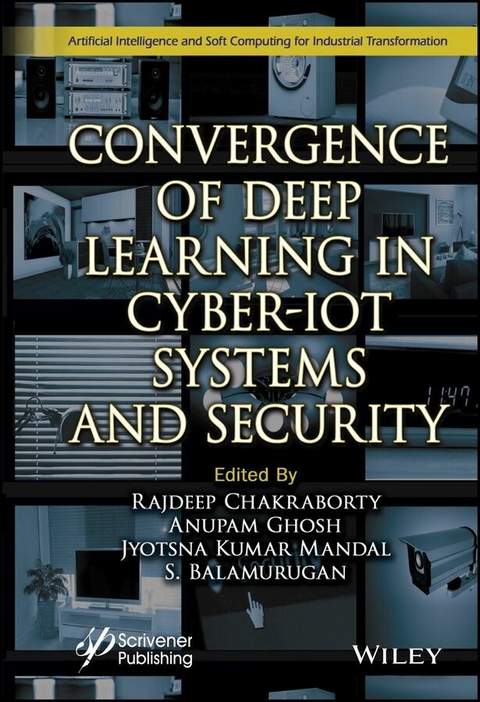
In-depth analysis of Deep Learning-based cyber-IoT systems and security which will be the industry leader for the next ten years.
The main goal of this book is to bring to the fore unconventional cryptographic methods to provide cyber security, including cyber-physical system security and IoT security through deep learning techniques and analytics with the study of all these systems.
This book provides innovative solutions and implementation of deep learning-based models in cyber-IoT systems, as well as the exposed security issues in these systems. The 20 chapters are organized into four parts. Part I gives the various approaches that have evolved from machine learning to deep learning. Part II presents many innovative solutions, algorithms, models, and implementations based on deep learning. Part III covers security and safety aspects with deep learning. Part IV details cyber-physical systems as well as a discussion on the security and threats in cyber-physical systems with probable solutions.
Audience
Researchers and industry engineers in computer science, information technology, electronics and communication, cybersecurity and cryptography.
Rajdeep Chakraborty, PhD, is an assistant professor in the Department of Computer Science and Engineering, Netaji Subhash Engineering College, Kolkata, India. His fields of interest are mainly in cryptography and computer security. He was awarded the Adarsh Vidya Saraswati Rashtriya Puraskar, National Award of Excellence 2019 conferred by Glacier Journal Research Foundation,
Anupam Ghosh, PhD, is a professor in the Department of Computer Science and Engineering, Netaji Subhash Engineering College, Kolkata, India. He has published more than 80 international papers in reputed international journals and conferences. His fields of interest are mainly in AI, machine learning, deep learning, image processing, soft computing, bioinformatics, IoT, and data mining.
Jyotsna Kumar Mandal, PhD, has more than 30 years of industry and academic experience. His fields of interest are coding theory, data and network security, remote sensing & GIS-based applications, data compression error corrections, information security, watermarking, steganography and document authentication, image processing, visual cryptography, MANET, wireless and mobile computing/security, unify computing, chaos theory, and applications.
S. Balamurugan, PhD, is the Director of Research and Development, Intelligent Research Consultancy Services (iRCS), Coimbatore, Tamilnadu, India. He is also Director of the Albert Einstein Engineering and Research Labs (AEER Labs), as well as Vice-Chairman, Renewable Energy Society of India (RESI), India. He has published 45 books, 200+ international journals/ conferences, and 35 patents.
CONVERGENCE OF DEEP LEARNING IN CYBER-IOT SYSTEMS AND SECURITY In-depth analysis of Deep Learning-based cyber-IoT systems and security which will be the industry leader for the next ten years. The main goal of this book is to bring to the fore unconventional cryptographic methods to provide cyber security, including cyber-physical system security and IoT security through deep learning techniques and analytics with the study of all these systems. This book provides innovative solutions and implementation of deep learning-based models in cyber-IoT systems, as well as the exposed security issues in these systems. The 20 chapters are organized into four parts. Part I gives the various approaches that have evolved from machine learning to deep learning. Part II presents many innovative solutions, algorithms, models, and implementations based on deep learning. Part III covers security and safety aspects with deep learning. Part IV details cyber-physical systems as well as a discussion on the security and threats in cyber-physical systems with probable solutions. Audience Researchers and industry engineers in computer science, information technology, electronics and communication, cybersecurity and cryptography.
Rajdeep Chakraborty, PhD, is an assistant professor in the Department of Computer Science and Engineering, Netaji Subhash Engineering College, Kolkata, India. His fields of interest are mainly in cryptography and computer security. He was awarded the Adarsh Vidya Saraswati Rashtriya Puraskar, National Award of Excellence 2019 conferred by Glacier Journal Research Foundation, Anupam Ghosh, PhD, is a professor in the Department of Computer Science and Engineering, Netaji Subhash Engineering College, Kolkata, India. He has published more than 80 international papers in reputed international journals and conferences. His fields of interest are mainly in AI, machine learning, deep learning, image processing, soft computing, bioinformatics, IoT, and data mining. Jyotsna Kumar Mandal, PhD, has more than 30 years of industry and academic experience. His fields of interest are coding theory, data and network security, remote sensing & GIS-based applications, data compression error corrections, information security, watermarking, steganography and document authentication, image processing, visual cryptography, MANET, wireless and mobile computing/security, unify computing, chaos theory, and applications. S. Balamurugan, PhD, is the Director of Research and Development, Intelligent Research Consultancy Services (iRCS), Coimbatore, Tamilnadu, India. He is also Director of the Albert Einstein Engineering and Research Labs (AEER Labs), as well as Vice-Chairman, Renewable Energy Society of India (RESI), India. He has published 45 books, 200+ international journals/ conferences, and 35 patents.
Preface
Deep learning (also known as deep structured learning) is part of a broader family of machine learning methods based on artificial neural networks with representation learning. Learning can be supervised, semi-supervised or unsupervised. Deep-learning architectures such as deep neural networks, deep belief networks, deep reinforcement learning, recurrent neural networks and convolutional neural networks have been applied to fields including computer vision, speech recognition, natural language processing, machine translation, bioinformatics, drug design, medical image analysis, material inspection and board game programs, where they have produced results comparable to and in some cases surpassing human expert performance. Artificial neural networks (ANNs) were inspired by information processing and distributed communication nodes in biological systems. ANNs have various differences from biological brains. Specifically, artificial neural networks tend to be static and symbolic, while the biological brain of most living organisms is dynamic (plastic) and analogue. The adjective “deep” in deep learning refers to the use of multiple layers in the network. Early work showed that a linear perceptron cannot be a universal classifier, but that a network with a nonpolynomial activation function with one hidden layer of unbounded width can. Deep learning is a modern variation which is concerned with an unbounded number of layers of bounded size, which permits practical application and optimized implementation, while retaining theoretical universality under mild conditions. In deep learning the layers are also permitted to be heterogeneous and to deviate widely from biologically informed connectionist models, for the sake of efficiency, trainability and understandability, whence the “structured” part.
Deep learning approaches are now used in every aspect of cyber systems and IoT systems. The main goal of this book is to bring to the fore unconventional cryptographic methods to provide cyber security, including cyber-physical system security and IoT security through deep learning techniques and analytics with the study of all these systems.
Thus, the book covers the evolution of deep learning from machine learning in the very first section. It also provides innovative projects and implementation on deep learning-based solutions in Cyber-IoT systems as well as detailed aspect on deep learning-based security issues in Cyber-IoT systems. Finally, this book also covers cyber physical system concepts and security issues. Therefore, we feel the book is well suited for students (UG & PG), research scholars, and enthusiastic readers who wants a good domain knowledge on deep learning.
Part I: Various Approaches from Machine Learning to Deep Learning
Chapter 1 discuss a method using web-assisted non-invasive detection of oral submucous fibrosis using IoHT. Oral cancer is another big threat and disease of human race. The early detection of oral cancer is of the upmost importance. This chapter starts with a detailed literature on oral cancer then it gives all the primary concepts to understand the proposed system of the authors. Then the chapter gives a proposed model to detect noninvasive oral submucous fibrosis which is web-assisted and for IoHT.
Chapter 2 provides a performance evaluation of machine learning and deep learning, the case study used in this chapter is house price prediction. After the introduction, the chapter starts with a detailed literature review of machine learning and deep learning. The authors used a very standard research methodology to carry out this study, which is discussed next. Authors used Gradient Boosting Regression, Support Vector Regression (SVM), Support Vector Regression (SVM), Multi Output Regression, Regression using Tensorflow – Keras and various classification models for their study. The authors concluded with very good performance analysis and results in both tabular and graphical forms.
Chapter 3 gives why it is important to study cyber physical systems, machine learning & deep learning. First, the author discusses cyber physical systems, machine learning & deep learning in detail. Then the author gives a detailed academic program in cyber physical systems, machine learning & deep learning throughout the world and in India. Finally, the author concludes with the importance to study cyber physical systems, machine learning & deep learning.
Chapter 4 proposes a hybrid model using machine learning techniques and semantic attribute to detect fake news, which is one of the important applications in this cyber and social media world. It uses NLP and applied to various datasets from Facebook, Twitter, Whatsapp, etc. The results are finally compared with existing literature and the proposed model is found to be 93% accurate.
Part II: Innovative Solutions based on Deep learning
Chapter 5 gives an online assessment system using Natural Language Processing (NLP) techniques. It starts with the importance of online assessment in the ‘home from work’ scenario due to the COVID-19 pandemic. The chapter then moves to a detailed literature on online assessments. Thereafter, the authors discuss some algorithms for online assessments. In the next section it proposes a system design for online assessment. Finally, implementation is shown and concluded with it’s novelty.
Chapter 6 gives a reference architecture to build deep Q learning-based intelligent IoT edge solutions. The chapter starts with a detailed overview of machine learning and deep learning. Then the chapter moves to dynamic programming features and deep Q learning in IoT and Azure. Thereafter, the authors give a proposed model and detailed result and analysis.
Chapter 7 provides an improved fuzzy logic-based solutions for air conditioning systems. Then the authors give a proposed system which is composed of Fuzzy variables, Fuzzy base class, Fuzzy Rule Base and Fuzzy rule viewer. The chapter then gives the simulated results of the proposed system and conclusion is drawn based on it’s novelty.
Chapter 8 has an important implementation to detect masked face to combat the pandemic situation. The chapter starts with a detailed related work on masked face recognition. Then it gives all the mathematical preliminaries required to understand the proposed system. Thereafter, it moves to the proposed system with algorithms, methods and applications followed by experimental results. It concludes with the novelty of the proposed system.
Chapter 9 is another deep learning approach to encounter COVID-19 pandemic situation. The chapter starts with the introduction of COVID19 situation and the need of deep learning-based solutions to encounter it. Here, the authors propose a medical imaging solution using deep learning where images of lungs are taken and COVID-19 infection positivity is predicted. The chapter also provides the method of COVID-19 variant tracing and biological protein structure. Moreover, this chapter gives selection drugs combination for a particular COVID-19 patient. It ends with detailed result and analysis of the proposed model.
Chapter 10 provides another online question answering system using Bengali language. It starts with the discussion on the existing literature then it moves towards a problem statement. The authors discuss the proposed model in a very structured way with algorithms. Thereafter, a detailed result and analysis is given and compared with existing work.
The chapter ends with analysis of error, some close observations, applications of the proposed model and scope for improvement as future work.
Part III: Security and Safety Aspects with Deep Learning
Chapter 11 gives a secure access mechanism for smart homes using biometric authentication and RFID authentication which can be implemented for IoT systems. The authors give a structured approach and framework for smart home access method with biometrics. The authors then discuss the same using RFID followed by proposed Control Scheme for Secure Access (CSFSC). The proposed system is discussed with mathematical equations and then it provides result of the proposed system.
Chapter 12 is a MQTT-based implementation of home automation system prototype with integrated Cyber-IoT infrastructure and also discusses deep learning-based security issues. After the introduction, literature review and importance of home automation, the author starts with proposed system architecture of home automation. Then it discusses the various security issues in home automation. Thereafter, the author moves to the implementation part of the proposed system and gives the detailed results with discussion.
Chapter 13 gives a malware detection framework using deep learning. Malware is a risk to the privacy of computer users which can cause an economic loss to organizations. Deep Learning is a subfield of machine learning which concentrates on human brains using artificial intelligence result analysis and conclusion.
Chapter 14 gives an application for women safety, namely “Patron for Women”. The authors first give relative research where the first application is a mobile-based women safety application. Secondly, the authors refer to another application which is android-based. Thirdly, it gives another android-based application namely, “Lifecraft” and, finally, “Abhaya and Sakshi”, another two-women safety applications are discussed. Then it provides a new methodology, system and model with deep learning for women safety. The...
| Erscheint lt. Verlag | 8.11.2022 |
|---|---|
| Reihe/Serie | Artificial Intelligence and Soft Computing for Industrial Transformation | Artificial Intelligence and Soft Computing for Industrial Transformation |
| Sprache | englisch |
| Themenwelt | Mathematik / Informatik ► Informatik ► Theorie / Studium |
| Schlagworte | AI • AI modeling • ai system • Artificial Intelligence • Artificial Neural Network • authentication mechanism in IoT security • binary analysis • binary codes • Client/Server-Technologie • Client/Server Technologies • cognitive cyber-physical system • Computer Science • convergence of deep learning • Convolution Neural Networks • cybercrime • cyber-IOT system and security • cyber-IoT systems • Cyber-Physical System • cyber-physical system and security • Cyber-Physical Systems • cyber security • Cybersicherheit • Cyber-Sicherheit • Cyberspace • cyber systems • deep and restricted Boltzmann machines • Deep Belief Networks • Deep learning • Deep Reinforcement Learning • domain name generation algorithms • Electrical & Electronics Engineering • Elektrotechnik u. Elektronik • Informatik • Intelligente Systeme u. Agenten • Intelligent Systems & Agents • Internet der Dinge • internet of things • internet traffic • Intrusion Detection • IOT • IoT grid • IoT security • IoT systems • IP-Spoofing • KI • Künstliche Intelligenz • long short- term memory • machine learning • malware detection • Penetration Testing • phishing attack • protocols for IoT security • Recurrent Neural Networks • security analysis tool • security protocol • Smart System • spam detection • Static Analysis • traffic analysis • Trusted systems • unconventional cryptographic methods • vulnerability |
| ISBN-13 | 9781119857662 / 9781119857662 |
| Informationen gemäß Produktsicherheitsverordnung (GPSR) | |
| Haben Sie eine Frage zum Produkt? |
 EPUB (Adobe DRM)
Kopierschutz: Adobe-DRM
Adobe-DRM ist ein Kopierschutz, der das eBook vor Mißbrauch schützen soll. Dabei wird das eBook bereits beim Download auf Ihre persönliche Adobe-ID autorisiert. Lesen können Sie das eBook dann nur auf den Geräten, welche ebenfalls auf Ihre Adobe-ID registriert sind.
Details zum Adobe-DRM
Dateiformat: EPUB (Electronic Publication)
EPUB ist ein offener Standard für eBooks und eignet sich besonders zur Darstellung von Belletristik und Sachbüchern. Der Fließtext wird dynamisch an die Display- und Schriftgröße angepasst. Auch für mobile Lesegeräte ist EPUB daher gut geeignet.
Systemvoraussetzungen:
PC/Mac: Mit einem PC oder Mac können Sie dieses eBook lesen. Sie benötigen eine
eReader: Dieses eBook kann mit (fast) allen eBook-Readern gelesen werden. Mit dem amazon-Kindle ist es aber nicht kompatibel.
Smartphone/Tablet: Egal ob Apple oder Android, dieses eBook können Sie lesen. Sie benötigen eine
Geräteliste und zusätzliche Hinweise
Buying eBooks from abroad
For tax law reasons we can sell eBooks just within Germany and Switzerland. Regrettably we cannot fulfill eBook-orders from other countries.
aus dem Bereich