


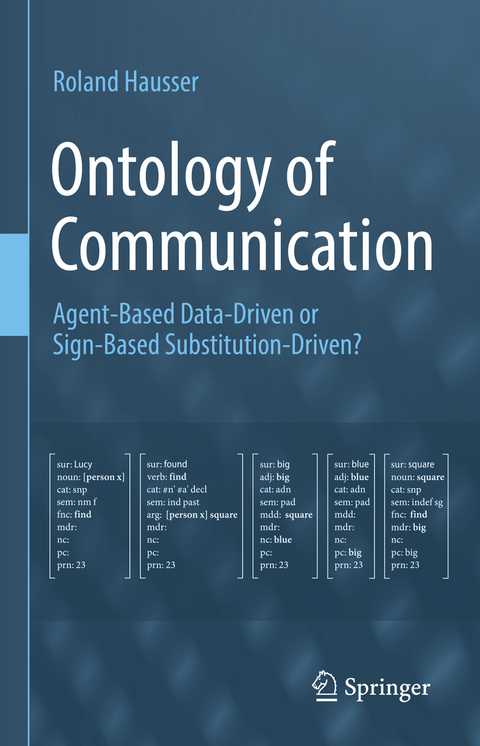
Ontology of Communication
Springer International Publishing (Verlag)
978-3-031-22738-7 (ISBN)
The motivation is to compare two approaches for an ontology of communication: agent-based data-driven vs. sign-based substitution-driven. Agent-based means: design of a cognitive agent with (i) an interface component for converting raw data into cognitive content (recognition) and converting cognitive content into raw data (action), (ii) an on-board, content-addressable memory (database) for the storage and content retrieval, (iii) separate treatments of the speak and the hear mode. Data-driven means: (a) mapping a cognitive content as input to the speak-mode into a language-dependent surface as output, (b) mapping a surface as input to the hear-mode into a cognitive content as output. Oppositely, sign-based means: no distinction between speak and hear mode, whereas substitution-driven means: using a single start symbol as input for generating infinitely many outputs, based on substitutions by rewrite rules.
Collecting recent research of the author, this beautiful, novel and original exposition begins with an introduction to DBS, makes a linguistic detour on subject/predicate gapping and slot-filler repetition, and moves on to discuss computational pragmatics, inference and cognition, grammatical disambiguation and other related topics. The book is mostly addressed to experts working in the field of computational linguistics, as well as toenthusiasts interested in the history and early development of this subject, starting with the pre-computational foundations of theoretical computer science and symbolic logic in the 30s.
lt;p>Roland Hausser is Professor Emeritus for Theoretical and Computational Linguistics at the University Erlangen-Nürnberg and former director of its Laboratory of Computational Linguistics (CLUE), between 1989 and 2011. After obtaining his PhD at the University of Texas at Austin, the author held various positions at Carnegie Mellon, Stanford University or Ludwig-Maximilians-Universität München.
Prof. Hausser has been active and made significant contributions in the fields of Theoretical and Computational Linguistics, Human-Computer Interaction, Formal Grammars and Database Semantics. His research resulted in around 40 journal papers and conference proceedings, and he is the author of the Springer books "Foundations of Computational Linguistics", "A Computational Model of Natural Language Communication" and "Computational Linguistics and Talking Robots".
Preface.- Background. - 1. Introduction.- 2. Laboratory Set-up of Database Semantics.- 3. Outline of DBS.- 4. Software Mechanisms of the Content Kinds.- 5. Comparison of Coordination and Gapping.- 6. Are Iterating Slot-Filler Structures Universal? - 7. Computational Pragmatics.- 8. Discontinuous Structures in DBS and PSG.- 9. Classical Syllogisms as Computational Inferences.- 10. Grounding of Concepts in Science.- 11. Function Words.- 12. Language vs. Nonlanguage Cognition.- 13. Grammatical Disambiguation.- 14. Database Semantics vs. Predicate Calculus.- 15. Agent-Based Memory as an On-Board Database.- 16. David Hume's 'Causation' in Database Semantics.- 17. Concepts in Computational Cognition.- 18. Paraphrase and Ambiguity.- 19. Recursion and Grammatical Disambiguation.- Name Index - Bibliography.
| Erscheinungsdatum | 05.01.2023 |
|---|---|
| Zusatzinfo | XVI, 258 p. 1 illus. |
| Verlagsort | Cham |
| Sprache | englisch |
| Maße | 155 x 235 mm |
| Gewicht | 537 g |
| Themenwelt | Geisteswissenschaften ► Sprach- / Literaturwissenschaft ► Sprachwissenschaft |
| Mathematik / Informatik ► Informatik | |
| Schlagworte | Agent-based Data-driven Ontology • Chomsky Generative Grammar • Computational Inference • Computational Pragmatics • Database Semantics • Grammatical Disambiguation • Phrase-Structure Grammar • Predicate Calculus • Sign-based Substitution-driven Ontology • talking robots |
| ISBN-10 | 3-031-22738-7 / 3031227387 |
| ISBN-13 | 978-3-031-22738-7 / 9783031227387 |
| Zustand | Neuware |
| Informationen gemäß Produktsicherheitsverordnung (GPSR) | |
| Haben Sie eine Frage zum Produkt? |
aus dem Bereich


