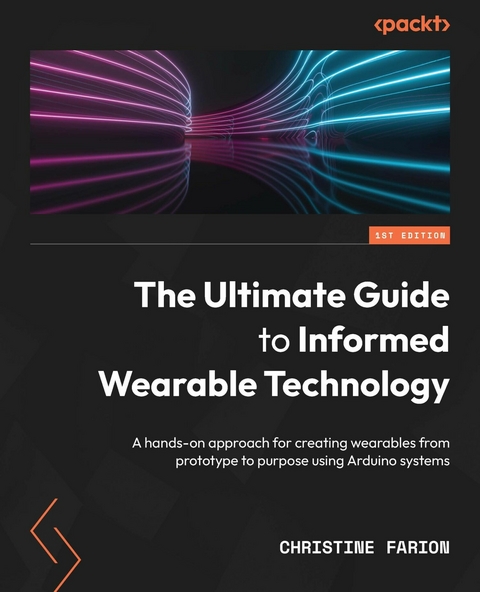
Ultimate Guide to Informed Wearable Technology (eBook)
526 Seiten
Packt Publishing (Verlag)
9781803244471 (ISBN)
Master wearable technology with this book including colored images and over 50 activities using Arduino and ESP32, build useful, stylish, and smart wearable devices, and create interactive circuits that react to us and our environment
Key Features
Learn wearable technology and build electronic circuits with fun activities using Arduino systems
Get an in-depth understanding of e-textiles and ESP32 microcontrollers to create interactive wearables
Apply a design innovation approach and best practices to address real-world issues
Book Description
Wearable circuits add interaction and purpose to clothing and other wearable devices that are currently widely used in medical, social, safety, entertainment, and sports fields. To develop useful and impressive prototypes and wearables, you'll need to be skilled in designing electronic circuits and working with wearable technologies.
This book takes you on an interesting journey through wearable technology, starting from electronic circuits, materials, and e-textile toolkits to using Arduino, which includes a variety of sensors, outputs, actuators, and microcontrollers such as Gemma M0 and ESP32. As you progress, you'll be carefully guided through creating an advanced IoT project. You'll learn by doing and create wearables with the help of practical examples and exercises. Later chapters will show you how to develop a hyper-body wearable and solder and sew circuits. Finally, you'll discover how to build a culture-driven wearable to track data and provide feedback using a Design Innovation approach.
After reading this book, you'll be able to design interactive prototypes and sew, solder, and program your own Arduino-based wearable devices with a purpose.
What you will learn
Construct sewable electronic circuits with conductive thread and materials
Discover the features of LilyPad, Gemma, Circuit Playground, and other boards
Use various components for listening, moving, sensing actions, and visualizing outputs
Control ESP32 development boards for IoT exploration
Understand why and how to prototype to create interactive wearables
Get skilled in sewing and soldering sensors to Arduino-based circuits
Design and build a hyper-body wearable that senses and reacts
Master a Design Innovation approach for creating wearables with a purpose
Who this book is for
This book is for electronics engineers, embedded system engineers and designers, and R&D engineers, who are beginners in the wearable technology domain as well as makers and hobbyists who have an interest in creative computing. It will also be useful for teachers, students, and researchers, who are learning interaction design, physical computing, technology, fashion, or arts. Having a basic understanding of Arduino-based systems will help in easily comprehending the contents of the book.
Master wearable technology with this book including colored images and over 50 activities using Arduino and ESP32, build useful, stylish, and smart wearable devices, and create interactive circuits that react to us and our environmentKey FeaturesLearn wearable technology and build electronic circuits with fun activities using Arduino systemsGet an in-depth understanding of e-textiles and ESP32 microcontrollers to create interactive wearablesApply a design innovation approach and best practices to address real-world issuesBook DescriptionWearable circuits add interaction and purpose to clothing and other wearable devices that are currently widely used in medical, social, safety, entertainment, and sports fields. To develop useful and impressive prototypes and wearables, you'll need to be skilled in designing electronic circuits and working with wearable technologies. This book takes you on an interesting journey through wearable technology, starting from electronic circuits, materials, and e-textile toolkits to using Arduino, which includes a variety of sensors, outputs, actuators, and microcontrollers such as Gemma M0 and ESP32. As you progress, you ll be carefully guided through creating an advanced IoT project. You ll learn by doing and create wearables with the help of practical examples and exercises. Later chapters will show you how to develop a hyper-body wearable and solder and sew circuits. Finally, you ll discover how to build a culture-driven wearable to track data and provide feedback using a Design Innovation approach. After reading this book, you ll be able to design interactive prototypes and sew, solder, and program your own Arduino-based wearable devices with a purpose.What you will learnConstruct sewable electronic circuits with conductive thread and materialsDiscover the features of LilyPad, Gemma, Circuit Playground, and other boardsUse various components for listening, moving, sensing actions, and visualizing outputsControl ESP32 development boards for IoT explorationUnderstand why and how to prototype to create interactive wearablesGet skilled in sewing and soldering sensors to Arduino-based circuitsDesign and build a hyper-body wearable that senses and reactsMaster a Design Innovation approach for creating wearables with a purposeWho this book is forThis book is for electronics engineers, embedded system engineers and designers, and R&D engineers, who are beginners in the wearable technology domain as well as makers and hobbyists who have an interest in creative computing. It will also be useful for teachers, students, and researchers, who are learning interaction design, physical computing, technology, fashion, or arts. Having a basic understanding of Arduino-based systems will help in easily comprehending the contents of the book.]]>
Preface
What are informed wearables and why should you care about them? Throughout this book, you’ll discover how wearables are changing lives. There are many fun, entertaining, and charming aspects to wearable devices. However, they can also be used in a way that can improve quality of life. This is the concept behind informed wearable technology. We will use Design Innovation techniques to learn how to discover the real needs of people. We will also learn how we can truly have an effect on and improve people’s lives.
Wearable circuits add interaction and purpose to clothing and items. Products are emerging from research fields into the industry and consumer realms. In recent years, e-textile components, compatible with Arduino, have appeared. These can be used to create socially driven on-body devices. Using Arduino and ESP32-based boards (and more), we can build wearables with purpose.
Reading this book will enable you to understand and implement creative, sewable circuits in your wearable tech projects. These soft circuits can be built for medical, social, safety, entertainment, and sporting fields, to name a few. Your skills will be enhanced through physical computing, bringing your ideas to life.
The Ultimate Guide to Informed Wearable Technology is a comprehensive introduction for those who are beginners to e-textiles and the Arduino platform that will have you up to speed and wearing circuits in no time. You will learn skills to bring your circuits to life, completing projects that you can use. By the end of the book, you will have the knowledge to start your own projects from scratch and the confidence to build and wear them. Let’s explore and create a future of informed wearable tech!
Disclaimer
All the projects developed in this book are for educational and prototyping purposes only. We advise all activities to be done with precaution and appropriate safety measures where needed. Soldering, sewing, using conductive textiles, and connecting electronics require attention and care, therefore, we strongly advise following the instructions given in the book with precaution or under guidance, if needed. The author or Packt cannot be held responsible for any damages in the form of physical/monetary loss, or any kind of loss occurred as a result of building projects that are presented in this book
Who this book is for
This book is for electronics engineers, embedded system engineers/designers, R&D engineers, and developers who are beginners in the wearable tech domain, as well as makers and hobbyists who have an interest in creative computing.
The book will be also useful for artists, creatives, teachers, students, and researchers studying interaction design, physical computing, technology, art, and fashion.
A basic knowledge of wearable technology is not required to work with the content of the book. However, having knowledge of Arduino-based systems may help you to follow the exercises in the book. References will be provided for those new to these systems.
What this book covers
Chapter 1, Introduction to the World of Wearables, looks at the context of wearables and their evolution. We will explore past projects and the application of wearables in a variety of different domains, for medical, safety, entertainment, and fitness purposes. Understanding the definitions and constraints of the tools we have will help us develop interesting and useful wearable tech. We take a look at current research – for example, how designers and engineers are creating medical devices worn on-body to collect essential information for health care. How did we go from research to creating assistive devices for visually impaired people? Do we need to be aware of ethical considerations and privacy when designing for and with people? This chapter will help to inspire you and make you think about ethical considerations for your wearables.
Chapter 2, Understanding and Building Electronic Sewable Circuits, introduces you to electronic circuit basics. We start at the beginning, understanding electricity, and move through to using switches in a circuit. Once the basics are covered, we will build some electronic circuits with LEDs for practice. Understanding these basics will set you up for applying your electronics skills to a sewable circuit. We will use conductive materials and conductive thread, alongside other alternative materials, to understand the introductory concepts and make working circuits in fabrics. We will use conductive materials to create switches and buttons, creating simple and fun projects! You will learn through doing. This will be the foundation for your continued learning.
Chapter 3, Exploring e-textile Toolkits: LilyPad, Flora, Circuit Playground, and More, focuses on learning about e-textile toolkits. You will create starter circuits that you can build upon. We begin by exploring LilyPad components, and then Flora and Circuit Playground. You’ll create circuits to see how e-textile toolkits can kick-start your projects. This is followed by exploring the range of Gemma, Flora, Circuit Playground, and other exciting e-textile boards. We will also examine their differences and why you might choose one board over another. Once you have a grasp of these boards and their capabilities, we can begin sewing some electronic circuits. This will lead to using the Arduino IDE to program interactive elements into your designs.
Chapter 4, Implementing Arduino Code Using Gemma M0 and Circuit Playground, focuses on learning by building a practical application with a Gemma M0 or Circuit Playground if you want to expand the capabilities of your circuit. We will explore flex sensors and discover how they have been used in research. You’ll learn more about the Arduino IDE, which we’ll use to program your wearable. This will be followed by a test of our circuits. You’ll add flexibility to your wearable with an off-the-shelf flex sensor or one you’ve made. We finish the chapter by hooking up and programming a Gemma M0 with Flex and a Servo motor!
Chapter 5, Working with Sensors: All about Inputs!, examines what sensors can be added to our projects, what protocols we use to add them to our circuits, and how we can use the data they provide. Most of the wearables we create will sense something – our touch, the sound, the light, and so on. For example, we might use a temperature sensor to collect temperature data and, when the temperature reaches a programmed level, provide heat or cooling to the body. We will also look at some alternative ways to use a sensor. Also, you will have the knowledge needed to use the protocols (SPI and I2C) to connect sensors to our Arduino-based boards. You’ll also be able to use and install a library in the Arduino IDE to add functionality to code.
Chapter 6, Exploring Reactions Through Outputs, explores outputs. Getting a response through and with our wearable is exciting! The world of outputs and actuators can help us to do that. This chapter describes the outputs that bring your projects to life. We experiment with light, from LEDs to NeoPixels and more. Displays can also tell us a lot, so we look at OLEDs, TFTs, and other displays for our wearables. We will also learn about sound, movement, and temperature. In this chapter, you will learn about the outputs that can add huge value to a wearable. Defining the types of outputs and why they are useful is followed by putting them into practice and creating circuits that react to the inputs they receive. By the end of this chapter, you will know about a range of outputs that you can add to your own wearable designs and be able to code your circuit board to react, displaying visual effects, auditory properties, and haptic response.
Chapter 7, Moving Forward with Circuit Design Using ESP32, delves deeper into circuit design, using alternative microcontrollers. These are circuit boards that aren’t specifically “sewable,” but we can use them for wearables. Looking at the ESP32, a powerful and adaptive microcontroller board, using it will add more interactivity to our sewable circuits. We will prepare the Arduino IDE so that we can program it, and we will write a first sketch. Then, we will advance our knowledge by connecting it to Wi-Fi. We will then work through several activities, including making a touch-activated wearable as a mental health and well-being exploration. This will collect current data from a website through an API. Lastly, you’ll understand what an API is, how we connect to one, and how we can update information with it. You’ll have completed another wearable item too!
Chapter 8, Learning How to Prototype and Make Electronics Wearable, looks at prototyping, which is essential for all your circuits. In this chapter, you will learn the theory behind prototyping. We will understand the advantages of prototyping in different ways to get different outcomes. These methods will contribute to creating informed wearables that are functional and desirable for the people we are designing for. We will look at the Houde and Hill model, as well as Quick and Dirty methods of prototyping. You’ll see examples created during prototyping sessions. By the end of this chapter, you...
| Erscheint lt. Verlag | 31.10.2022 |
|---|---|
| Sprache | englisch |
| Themenwelt | Mathematik / Informatik ► Informatik |
| Technik ► Elektrotechnik / Energietechnik | |
| ISBN-13 | 9781803244471 / 9781803244471 |
| Informationen gemäß Produktsicherheitsverordnung (GPSR) | |
| Haben Sie eine Frage zum Produkt? |
 EPUB (Ohne DRM)
Digital Rights Management: ohne DRM
Dieses eBook enthält kein DRM oder Kopierschutz. Eine Weitergabe an Dritte ist jedoch rechtlich nicht zulässig, weil Sie beim Kauf nur die Rechte an der persönlichen Nutzung erwerben.
Dateiformat: EPUB (Electronic Publication)
EPUB ist ein offener Standard für eBooks und eignet sich besonders zur Darstellung von Belletristik und Sachbüchern. Der Fließtext wird dynamisch an die Display- und Schriftgröße angepasst. Auch für mobile Lesegeräte ist EPUB daher gut geeignet.
Systemvoraussetzungen:
PC/Mac: Mit einem PC oder Mac können Sie dieses eBook lesen. Sie benötigen dafür die kostenlose Software Adobe Digital Editions.
eReader: Dieses eBook kann mit (fast) allen eBook-Readern gelesen werden. Mit dem amazon-Kindle ist es aber nicht kompatibel.
Smartphone/Tablet: Egal ob Apple oder Android, dieses eBook können Sie lesen. Sie benötigen dafür eine kostenlose App.
Geräteliste und zusätzliche Hinweise
Buying eBooks from abroad
For tax law reasons we can sell eBooks just within Germany and Switzerland. Regrettably we cannot fulfill eBook-orders from other countries.
aus dem Bereich