


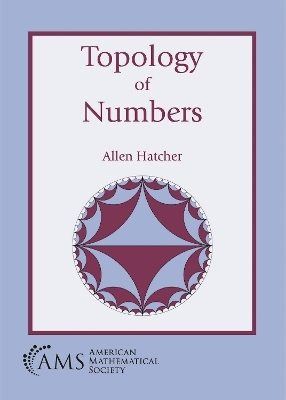
Topology of Numbers
Seiten
2023
American Mathematical Society (Verlag)
978-1-4704-5611-5 (ISBN)
American Mathematical Society (Verlag)
978-1-4704-5611-5 (ISBN)
Provides an introduction to number theory at the undergraduate level, emphasizing geometric aspects of the subject. The geometric approach is exploited to explore in depth the classical topic of quadratic forms with integer coefficients, a central topic of the book.
This book serves as an introduction to number theory at the undergraduate level, emphasizing geometric aspects of the subject. The geometric approach is exploited to explore in some depth the classical topic of quadratic forms with integer coefficients, a central topic of the book. Quadratic forms of this type in two variables have a very rich theory, developed mostly by Euler, Lagrange, Legendre, and Gauss during the period 1750-1800. In this book their approach is modernized by using the splendid visualization tool introduced by John Conway in the 1990s called the topograph of a quadratic form. Besides the intrinsic interest of quadratic forms, this theory has also served as a stepping stone for many later developments in algebra and number theory.
The book is accessible to students with a basic knowledge of linear algebra and arithmetic modulo $n$. Some exposure to mathematical proofs will also be helpful. The early chapters focus on examples rather than general theorems, but theorems and their proofs play a larger role as the book progresses.
This book serves as an introduction to number theory at the undergraduate level, emphasizing geometric aspects of the subject. The geometric approach is exploited to explore in some depth the classical topic of quadratic forms with integer coefficients, a central topic of the book. Quadratic forms of this type in two variables have a very rich theory, developed mostly by Euler, Lagrange, Legendre, and Gauss during the period 1750-1800. In this book their approach is modernized by using the splendid visualization tool introduced by John Conway in the 1990s called the topograph of a quadratic form. Besides the intrinsic interest of quadratic forms, this theory has also served as a stepping stone for many later developments in algebra and number theory.
The book is accessible to students with a basic knowledge of linear algebra and arithmetic modulo $n$. Some exposure to mathematical proofs will also be helpful. The early chapters focus on examples rather than general theorems, but theorems and their proofs play a larger role as the book progresses.
Allen Hatcher, Cornell University, Ithaca, NY.
A preview
The Farey diagram
Continued fractions
Symmetries of the Farey diagram
Quadratic forms
Classification of quadratic forms
Representations by quadratic forms
The class group for quadratic forms
Quadratic fields
Tables
Glossary of nonstandard terminology
Bibliography
Index
| Erscheinungsdatum | 01.12.2022 |
|---|---|
| Reihe/Serie | Miscellaneous Book Series |
| Verlagsort | Providence |
| Sprache | englisch |
| Maße | 178 x 254 mm |
| Gewicht | 363 g |
| Themenwelt | Mathematik / Informatik ► Mathematik ► Arithmetik / Zahlentheorie |
| Mathematik / Informatik ► Mathematik ► Geometrie / Topologie | |
| ISBN-10 | 1-4704-5611-7 / 1470456117 |
| ISBN-13 | 978-1-4704-5611-5 / 9781470456115 |
| Zustand | Neuware |
| Informationen gemäß Produktsicherheitsverordnung (GPSR) | |
| Haben Sie eine Frage zum Produkt? |
Mehr entdecken
aus dem Bereich


aus dem Bereich
Mengeneigenschaften im Muster der Universellen Gleichmäßigkeit im …
Buch | Spiralbindung (2025)
White, J (Verlag)
CHF 208,55
unlock your imagination with the narrative of numbers
Buch | Softcover (2024)
Advantage Media Group (Verlag)
CHF 27,90
Buch | Softcover (2025)
Princeton University Press (Verlag)
CHF 108,20


