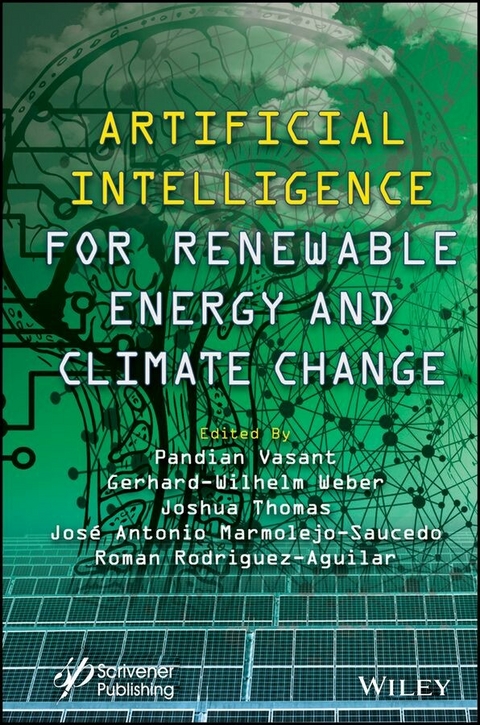
Written and edited by a global team of experts in the field, this groundbreaking new volume presents the concepts and fundamentals of using artificial intelligence in renewable energy and climate change, while also covering the practical applications that can be utilized across multiple disciplines and industries, for the engineer, the student, and other professionals and scientists.
Renewable energy and climate change are two of the most important and difficult issues facing the world today. The state of the art in these areas is changing rapidly, with new techniques and theories coming online seemingly every day. It is important for scientists, engineers, and other professionals working in these areas to stay abreast of developments, advances, and practical applications, and this volume is an outstanding reference and tool for this purpose.
The paradigm in renewable energy and climate change shifts constantly. In today's international and competitive environment, lean and green practices are important determinants to increase performance. Corresponding production philosophies and techniques help companies diminish lead times and costs of manufacturing, improve delivery on time and quality, and at the same time become more ecological by reducing material use and waste, and by recycling and reusing. Those lean and green activities enhance productivity, lower carbon footprint and improve consumer satisfaction, which in reverse makes firms competitive and sustainable.
This practical, new groundbreaking volume:
- Features coverage on a wide range of topics such as classical and nature-inspired optimization and optimal control, hybrid and stochastic systems
- Is ideally designed for engineers, scientists, industrialist, academicians, researchers, computer and information technologists, sustainable developers, managers, environmentalists, government leaders, research officers, policy makers, business leaders and students
- Is useful as a practical tool for practitioners in the fields of sustainable and renewable energy sustainability
- Includes wide coverage of how artificial intelligence can be used to impact the struggle against global warming and climate change
Pandian Vasant, PhD, is Editor-in-Chief of the International Journal of Energy Optimization and Engineering and senior research associate at MERLIN Research Centre of Ton Duc Thang University, HCMC, Vietnam. He has 31 years of teaching experience and has co-authored over 300 publications, including research articles in journals, conference proceedings, presentations and book chapters. He has also been a guest editor for various scientific and technical journals.
Gerhard-Wilhelm Weber, PhD, is a professor at Poznan University of Technology, Poznan, Poland. He received his PhD in mathematics, and economics / business administration, from RWTH Aachen. He held professorships by proxy at University of Cologne, and TU Chemnitz, Germany.
J. Joshua Thomas, PhD, has been a senior lecturer at KDU Penang University College, Malaysia since 2008. He obtained his PhD in intelligent systems techniques in 2015 from University Sains Malaysia, Penang, and is an editorial board member for the International Journal of Energy Optimization and Engineering. He has also published more than 30 papers in leading international conference proceedings and peer reviewed journals.
Jose A. Marmolejo Saucedo, PhD, is a professor at Pan-American University, Mexico. He received his PhD in operations research at the National Autonomous University of Mexico and has co-authored numerous research articles in scientific and scholarly journals, conference proceedings, presentations, books, and book chapters.
Roman Rodriguez-Aguilar, PhD, is a professor in the School of Economic and Business Sciences of the 'Universidad Panamericana' in Mexico. He received his PhD at the School of Economics at the National Polytechnic Institute, Mexico and has co-authored multiple research articles in scientific and scholarly journals, conference proceedings, presentations, and book chapters.
ARTIFICIAL INTELLIGENCE FOR RENEWABLE ENERGY AND CLIMATE CHANGE Written and edited by a global team of experts in the field, this groundbreaking new volume presents the concepts and fundamentals of using artificial intelligence in renewable energy and climate change, while also covering the practical applications that can be utilized across multiple disciplines and industries, for the engineer, the student, and other professionals and scientists. Renewable energy and climate change are two of the most important and difficult issues facing the world today. The state of the art in these areas is changing rapidly, with new techniques and theories coming online seemingly every day. It is important for scientists, engineers, and other professionals working in these areas to stay abreast of developments, advances, and practical applications, and this volume is an outstanding reference and tool for this purpose. The paradigm in renewable energy and climate change shifts constantly. In today s international and competitive environment, lean and green practices are important determinants to increase performance. Corresponding production philosophies and techniques help companies diminish lead times and costs of manufacturing, improve delivery on time and quality, and at the same time become more ecological by reducing material use and waste, and by recycling and reusing. Those lean and green activities enhance productivity, lower carbon footprint and improve consumer satisfaction, which in reverse makes firms competitive and sustainable. This practical, new groundbreaking volume: Features coverage on a wide range of topics such as classical and nature-inspired optimization and optimal control, hybrid and stochastic systems Is ideally designed for engineers, scientists, industrialist, academicians, researchers, computer and information technologists, sustainable developers, managers, environmentalists, government leaders, research officers, policy makers, business leaders and students Is useful as a practical tool for practitioners in the fields of sustainable and renewable energy sustainability Includes wide coverage of how artificial intelligence can be used to impact the struggle against global warming and climate change
Pandian Vasant, PhD, is Editor-in-Chief of the International Journal of Energy Optimization and Engineering and senior research associate at MERLIN Research Centre of Ton Duc Thang University, HCMC, Vietnam. He has 31 years of teaching experience and has co-authored over 300 publications, including research articles in journals, conference proceedings, presentations and book chapters. He has also been a guest editor for various scientific and technical journals. Gerhard-Wilhelm Weber, PhD, is a professor at Poznan University of Technology, Poznan, Poland. He received his PhD in mathematics, and economics / business administration, from RWTH Aachen. He held professorships by proxy at University of Cologne, and TU Chemnitz, Germany. J. Joshua Thomas, PhD, has been a senior lecturer at KDU Penang University College, Malaysia since 2008. He obtained his PhD in intelligent systems techniques in 2015 from University Sains Malaysia, Penang, and is an editorial board member for the International Journal of Energy Optimization and Engineering. He has also published more than 30 papers in leading international conference proceedings and peer reviewed journals. Jose A. Marmolejo Saucedo, PhD, is a professor at Pan-American University, Mexico. He received his PhD in operations research at the National Autonomous University of Mexico and has co-authored numerous research articles in scientific and scholarly journals, conference proceedings, presentations, books, and book chapters. Roman Rodriguez-Aguilar, PhD, is a professor in the School of Economic and Business Sciences of the "Universidad Panamericana" in Mexico. He received his PhD at the School of Economics at the National Polytechnic Institute, Mexico and has co-authored multiple research articles in scientific and scholarly journals, conference proceedings, presentations, and book chapters.
Preface
Our novel book offer was accepted by Scrivener Publishing for its broadly appealing, meaningful and timely properties and its promise on a worldwide stage. Thereto, also its analytical and applied characteristics contributed. This compendium and handbook together with our inquiries on renewable energy, on generation and distribution, supply and use of power are remarkable incentives which could become scholarly resources that investigate the efficient usage of contemporary electrical resources and natural renewable sources. These ought to have a positive effect on sustainable development in our urban and rural regions, in sea and sky, hence, for agility and communication, mobility and collaboration, for peace inside and between our peoples and countries, and all of our living beings and everything in the world.
The dynamics of Renewable Energy and Climate Change, and Supply Chain Management (SCM) has transformed and accelerated over the years; paradigms shifted and new ones have emerged and been added to respond to those switching and changing accompanied by an increasing economic, ecologic and social concerns and pressures. In today’s international and competitive environment, Lean and Green practices in economies are most important determinants to increase the performances. Corresponding production philosophies and techniques help companies to advance their performances in terms of diminishing lead times and costs of manufacturing, to improve delivery on time and quality, at the same time becoming more ecological by reducing material use and waste, and by recycling and reusing. Those lean and green activities enhance productivity, lower carbon footprint and improve consumer satisfaction, which in reverse makes firms competitive and sustainable.
In previous decades, interest and awareness about clean energy have exponentially grown, together with a steadily growing concern about our natural neighborhoods and habitats, and about our well-being and health, our resources and atmosphere, our spaces and times. This progress has also been due to a reduction in the cost of both installed capacity of converters and generated energy. Such successes stories were possible by advances in modern technologies for the converter production, enhancements in efficiency in use of energy incoming, optimization of converter operation and data analysis based on records during the system operations with the chances of production planning.
From our editorial sides, this handbook was hoped to become a most valuable reference book from 2021 onwards in the areas of modern renewable energy and climate change by the help of Operational Research (OR), Artificial Intelligence (AI), Creative Arts and Sciences. Given all the hard work from the authors’ and our sides, the research and application project has become successful in gathering and integrating emerging findings and outcomes of the state-of-the-art and inventions about and electronic and electrical, energetic and informational, recoverable and renewable, creational and recreational sources and their swift and mobile usages with care and responsibility. Now, the thus given work and compendium of scientific investigation on questions of renewable power and energy supply for cities and rural areas is a remarkable scholarly treasure which discloses the efficient employment of those modern-times resources that have a helpful influence on sustainable development of our megalopolises and our countryside, hence on migratory movements into big cities and eventually on social peace in and among our peoples.
For this book’s international orientation it has turned into a unique resource that outlines newest progress achieved around the globe in related domains of OR, AI, renewable power, electronical, informational and transformational technologies. It is on the way of becoming accepted and classical at a worldwide stage because of its comprehensive contents ensured by analytical, applied and life-friendly approaches towards the whole creation.
Artificial Intelligence for Renewable Energy and Climate Change, is a hand-picked collection of creative research on and with methods and applications of mathematics, machine and deep learning (ML and DL) in the realms of business and management, economics and finance, natural sciences and engineering. While featuring topics including data-hybridization, computational modeling, and artificial neural networks, this book is designed and suitable for engineers and IT experts, analysts and data scientists, engineers and investigators, academicians and philanthropes, policy makers and caretakers, experienced ones and the youth, for whoever seeks for contemporary research on Intelligent Optimization in emerging smart-technological, energetic, environmental and creative industries.
The rise in population and the concurrently growing consumption rate necessitates the evolution of clean energy systems to adopt current analytic and computational technologies such as big-data, IoTs and 5G technology to increase production at a faster and smoother scale. While existing technologies may help in energy processing, there is a need for studies that seek to understand how modern approaches like OR, AI, ML, DL, hybrid technologies and advancements in mathematics can aid to sustain clean energy and climate change processes while utilizing energy sources efficiently and productively.
This book on Artificial Intelligence for Renewable Energy and Climate Change is an essential publication that examines the benefits and barriers of implementing computational models to clean energy systems, global warming, climate change, and energy sources as well as how these models can produce more cost-effective and sustainable solutions. Featuring coverage on a wide range of topics such as classical and nature-inspired optimization and optimal control, hybrid and stochastic systems, this book is ideally designed for engineers, scientists, industrialist, academicians, researchers, computer and information technologists, sustainable developers, managers, environmentalists, government leaders, research officers, policy makers, business leaders and students. This book aims to become a delight for practitioners in the fields of sustainable and renewable energy sustainability and their outstanding impacts on how to face global warming and climate change.
Invited subjects of this compendium welcome but are not limited to the following:
- ∘ Artificial intelligence,
- ∘ Machine intelligence, Deep intelligence,
- ∘ Metaheuristic algorithms,
- ∘ Hydropower, Renewable electricity, Solar PV, Bio power,
- ∘ Geothermal power, Ocean power, Wind power,
- ∘ Bio-gas, Hydrogen,
- ∘ Global warming, Climate change,
- ∘ Renewable energy,
- ∘ Hybrid technology,
- ∘ CO2 minimization,
- ∘ Evolutionary algorithms, Swarm intelligence,
- ∘ Computational intelligence, Soft computing,
- ∘ Operational research, Data mining, Hybrid optimization,
- ∘ Bioenergy Recycling, Biofuel supply chains,
- ∘ Energy management policy, Energy efficiency, Energy-saving technology,
- ∘ Small hydropower plants, Thermal treatments,
- ∘ Remote sensing,
- ∘ Optimization theory and applications,
- ∘ Optimal control theory and applications,
- ∘ Stochastic optimal control theory and applications.
This book is grouped into 2 parts, namely: Section I – Renewable Energy, and Section II - Climate Change.
Subsequently, we provide a short introduction of the fourteen chapters of this work.
In the first chapter “Artificial Intelligence for Sustainability: Opportunities and Challenges”, the author Amany Alshawi focuses on AI in the sustainable practices across the environmental sector and related industries. AI uses tools and methods such as ML effective monitoring and prediction. A main establishment is on AI opportunities and multiple multilevel systemic approaches to systems in designing new techniques while considering the psychological and sociological factors as well as the economic values.
The second chapter “Recent Applications of Machine Learning In Solar Energy Prediction”, authored by N. Kapilan, R. P. Reddy and Vidhya P, among the renewable energy sources addresses solar energy which is preferred as its potential is high. But there are few challenges due to variability and uncertainty with solar radiation which results in lower energy conversion, intermittent power supply. They discuss basic concepts of solar energy, energy conversion methods and different types of ML used in solar photovoltaic systems, ML algorithms, challenges and opportunities in solar energy production.
In the third chapter called “Mathematical Analysis on Power Generation – Part I”, the author G. Udhaya Sankar addresses Seebeck and Peltier effects which are used to generate current and heat in a thermocouple, respectively; current from heat and heat from current. It is possible to produce light from electricity and electricity from light. They are the basics for theory of photovoltaic theory. The author derives a formula providing a linear relationship between product of current with voltage and heat in a thermocouple.
The fourth chapter named “Mathematical Analysis on Power Generation – Part...
| Erscheint lt. Verlag | 21.7.2022 |
|---|---|
| Sprache | englisch |
| Themenwelt | Mathematik / Informatik ► Informatik ► Theorie / Studium |
| Schlagworte | 5G technology • AI • Ant Optimization • Artificial Intelligence • Big Data Analytics • Bioenergy recycling • Biofuel supply chains • Biogas • Bio power • block chain • climate change • Climatology & Palaeoclimatology • Cloud Computing • CO2 minimization • Computational Intelligence • Computer Science • Data Mining • data technology • Deep learning • Deep Neural Network • drone technology • earth sciences • Energie • Energy • energy efficiency • Energy management policy • Energy-saving Technology • Erneuerbare Energie • evolutionary algorithm • evolutionary algorithms • Financial Technology • Fuzzy Logic • Geothermal Power • Geowissenschaften • global warming • Hybrid Optimization • Hybrid Technology • Hydrogen • hydropower • Industry 4.0 • Informatik • IOT • KI • Klimatologie • Klimatologie u. Paläoklimatologie • Klimawandel • Künstliche Intelligenz • machine learning • Metaheuristic Algorithms • ocean power • Operational Research • optimal control theory • optimization theory • Other Renewable Energy • Remote Sensing • Renewable Electricity • renewable energy • Robotics • Small hydropower plants • smart energy • Smart Farming • Smart Technology • Soft Computing • Solar PV • Sonstige Erneuerbare Energien • stochastic optimal control theory • Swarm intelligence • thermal treatments • Wind Power |
| ISBN-13 | 9781119771500 / 9781119771500 |
| Informationen gemäß Produktsicherheitsverordnung (GPSR) | |
| Haben Sie eine Frage zum Produkt? |
 EPUB (Adobe DRM)
Kopierschutz: Adobe-DRM
Adobe-DRM ist ein Kopierschutz, der das eBook vor Mißbrauch schützen soll. Dabei wird das eBook bereits beim Download auf Ihre persönliche Adobe-ID autorisiert. Lesen können Sie das eBook dann nur auf den Geräten, welche ebenfalls auf Ihre Adobe-ID registriert sind.
Details zum Adobe-DRM
Dateiformat: EPUB (Electronic Publication)
EPUB ist ein offener Standard für eBooks und eignet sich besonders zur Darstellung von Belletristik und Sachbüchern. Der Fließtext wird dynamisch an die Display- und Schriftgröße angepasst. Auch für mobile Lesegeräte ist EPUB daher gut geeignet.
Systemvoraussetzungen:
PC/Mac: Mit einem PC oder Mac können Sie dieses eBook lesen. Sie benötigen eine
eReader: Dieses eBook kann mit (fast) allen eBook-Readern gelesen werden. Mit dem amazon-Kindle ist es aber nicht kompatibel.
Smartphone/Tablet: Egal ob Apple oder Android, dieses eBook können Sie lesen. Sie benötigen eine
Geräteliste und zusätzliche Hinweise
Buying eBooks from abroad
For tax law reasons we can sell eBooks just within Germany and Switzerland. Regrettably we cannot fulfill eBook-orders from other countries.
aus dem Bereich