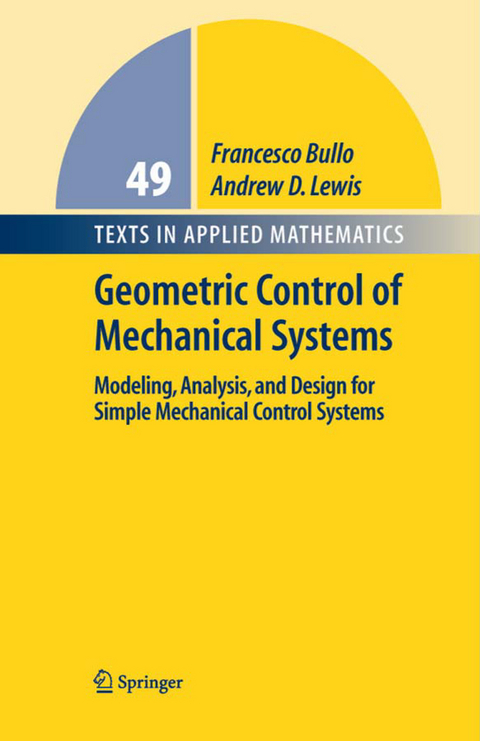
Geometric Control of Mechanical Systems
Springer-Verlag New York Inc.
978-0-387-22195-3 (ISBN)
The primary emphasis of this book is the modeling, analysis, and control of mechanical systems. The methods and results presented can be applied to a large class of mechanical control systems, including applications in robotics, autonomous vehicle control, and multi-body systems. The book is unique in that it presents a unified, rather than an inclusive, treatment of control theory for mechanical systems. A distinctive feature of the presentation is its reliance on techniques from differential and Riemannian geometry.
The book contains extensive examples and exercises, and will be suitable for a growing number of courses in this area. It begins with the detailed mathematical background, proceeding through innovative approaches to physical modeling, analysis, and design techniques. Numerous examples illustrate the proposed methods and results, while the many exercises test basic knowledge and introduce topics not covered in the main body of the text.
The audience of this book consists of two groups. The first group is comprised of graduate students in engineering or mathematical sciences who wish to learn the basics of geometric mechanics, nonlinear control theory, and control theory for mechanical systems. Readers will be able to immediately begin exploring the research literature on these subjects. The second group consists of researchers in mechanics and control theory. Nonlinear control theoreticians will find explicit links between concepts in geometric mechanics and nonlinear control theory. Researchers in mechanics will find an overview of topics in control theory that have relevance to mechanics.
Part I: Modeling of mechanical systems; Introductory examples and problems; Linear and multilinear algebra; Differential geometry; Simple mechanical control systems; Lie groups, systems on groups, and symmetries.- Part II: Analysis of mechanical control systems; Stability; Controllability; Low-order controllability and kinematic reduction ; Perturbation analysis.- Part III: A sampling of design methodologies; Linear and nonlinear potential shaping for stabilization; Stabilization and tracking for fully actuated systems; Stabilization and tracking using oscillatory controls; Motion planning for underactuated systems; Appendices; Time-dependent vector fields; Some proofs.
From the reviews:"The book deals with the geometric theory of mathematical modeling, analysis, and control of ‘simple’ mechanical systems … . The text is written with great care and lucidity, includes many exercises, and has clearly benefited from being used in various undergraduate and graduate courses. The book will certainly become a main reference in this area … ." (A. J. van der Schaft, Mathematical Reviews, 2005h)“Those who are interested in robotic mechanical systems will almost certainly enjoy reading this book. … intended to be used both as a textbook for graduate students, and at the same time as background material for researchers active in the field of geometric control theory or geometric mechanics. … authors provide an efficient geometric model for modeling mechanical control systems is brilliant. Precisely this fact makes this book very pleasant to read. In my opinion, it will become a standard reference work in the subject.” (Bavo Langerock, Bulletin of the Belgian Mathematical Society, Vol. 15 (1), 2008)
| Reihe/Serie | Texts in Applied Mathematics ; 49 |
|---|---|
| Zusatzinfo | XXIV, 727 p. |
| Verlagsort | New York, NY |
| Sprache | englisch |
| Maße | 155 x 235 mm |
| Themenwelt | Mathematik / Informatik ► Informatik ► Theorie / Studium |
| Mathematik / Informatik ► Mathematik | |
| ISBN-10 | 0-387-22195-6 / 0387221956 |
| ISBN-13 | 978-0-387-22195-3 / 9780387221953 |
| Zustand | Neuware |
| Informationen gemäß Produktsicherheitsverordnung (GPSR) | |
| Haben Sie eine Frage zum Produkt? |
aus dem Bereich