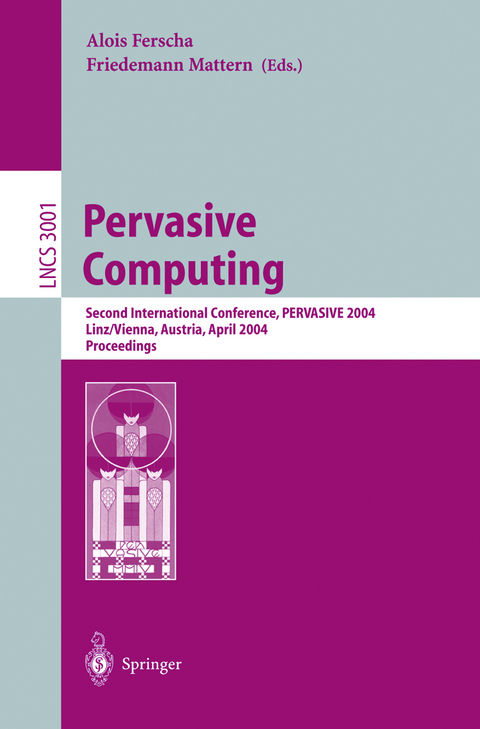
Pervasive Computing
Springer Berlin (Verlag)
9783540218357 (ISBN)
Friedemann Mattern ist seit 1999 an der ETH Zürich als Leiter des Fachgebiets Verteilte Systeme" tätig; im Oktober 2002 gründete er dort das Institut für Pervasive Computing. Mattern studierte Informatik in Bonn und promovierte an der Universität Kaiserslautern. Zwischen 1991 und 1999 hatte er Professuren an der Universität des Saarlandes und an der Technischen Universität Darmstadt inne. Er ist an mehreren Industriekooperationen und Forschungsprojekten zum Thema Ubiquitous und Pervasive Computing beteiligt und ist Mitbegründer des von der ETH Zürich und der Universität St. Gallen gemeinsam getragenen M-Lab-Kompetenzzentrums, das die betriebswirtschaftlichen Auswirkungen des Ubiquitous Computing erforscht.
Activity Recognition.- Activity Recognition from User-Annotated Acceleration Data.- Recognizing Workshop Activity Using Body Worn Microphones and Accelerometers.- "Are You with Me?" - Using Accelerometers to Determine If Two Devices Are Carried by the Same Person.- Context Computing.- Context Cube: Flexible and Effective Manipulation of Sensed Context Data.- A Context-Aware Communication Platform for Smart Objects.- Siren: Context-aware Computing for Firefighting.- Near Body Interfaces.- Spectacle-Based Design of Wearable See-Through Display for Accommodation-Free Viewing.- A Compact Battery-Less Information Terminal for Real World Interaction.- Software.- INCA: A Software Infrastructure to Facilitate the Construction and Evolution of Ubiquitous Capture & Access Applications.- Sensors.- Activity Recognition in the Home Using Simple and Ubiquitous Sensors.- Automatic Calibration of Body Worn Acceleration Sensors.- Reject-Optional LVQ-Based Two-Level Classifier to Improve Reliability in Footstep Identification.- Issues with RFID Usage in Ubiquitous Computing Applications.- Security.- A Fault-Tolerant Key-Distribution Scheme for Securing Wireless Ad Hoc Networks.- ProxNet: Secure Dynamic Wireless Connection by Proximity Sensing.- Tackling Security and Privacy Issues in Radio Frequency Identification Devices.- Architectures and Systems.- Towards Wearable Autonomous Microsystems.- Ubiquitous Chip: A Rule-Based I/O Control Device for Ubiquitous Computing.- eSeal - A System for Enhanced Electronic Assertion of Authenticity and Integrity.- Algorithms.- A Distributed Precision Based Localization Algorithm for Ad-Hoc Networks.- Adaptive On-Device Location Recognition.- Accommodating Transient Connectivity in Ad Hoc and Mobile Settings.- New Interfaces.- Microbiology Trayand Pipette Tracking as a Proactive Tangible User Interface.- Augmenting Collections of Everyday Objects: A Case Study of Clothes Hangers As an Information Display.- MirrorSpace: Using Proximity as an Interface to Video-Mediated Communication.- SearchLight - A Lightweight Search Function for Pervasive Environments.
| Erscheint lt. Verlag | 7.4.2004 |
|---|---|
| Reihe/Serie | Lecture Notes in Computer Science |
| Zusatzinfo | XVIII, 362 p. |
| Verlagsort | Berlin |
| Sprache | englisch |
| Maße | 152 x 229 mm |
| Gewicht | 580 g |
| Themenwelt | Mathematik / Informatik ► Informatik ► Theorie / Studium |
| Mathematik / Informatik ► Informatik ► Web / Internet | |
| Informatik ► Weitere Themen ► Hardware | |
| Schlagworte | Ad-Hoc Networking • algorithms • Ambient Intelligence • authentication • context-aware computing • Embedded Systems • Intelligent interfaces • Middleware • mobile computing • Pervasive Computing • security • smart applications • ubiquitous computing • Wearable Devices |
| ISBN-13 | 9783540218357 / 9783540218357 |
| Zustand | Neuware |
| Informationen gemäß Produktsicherheitsverordnung (GPSR) | |
| Haben Sie eine Frage zum Produkt? |
aus dem Bereich