


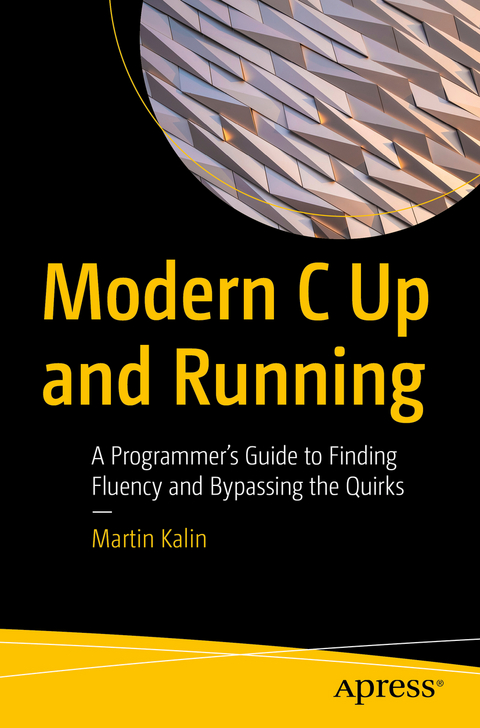
Modern C Up and Running
A Programmer's Guide to Finding Fluency and Bypassing the Quirks
Seiten
2022
Apress (Verlag)
978-1-4842-8675-3 (ISBN)
Apress (Verlag)
978-1-4842-8675-3 (ISBN)
Learn how to program in modern C, from the basics through the advanced topics required for proficiency. This book is the fastest path to C fluency for anyone experienced in a general-purpose programming language. From start to finish, code examples highlight the idioms and best practices behind efficient, robust programs in a variety of areas.
The book opens with a thorough coverage of syntax, built-in data types and operations, and program structure. C has quirks and presents challenges, which are covered in detail. The coverage of advanced features is what sets this book apart from others. Among the advanced topics covered are floating-point representation in the IEEE 754 standard; embedded assembly language in C code for overflow detection; regular expressions, assertions, and internationalization; WebAssembly through C; and software libraries for C and other clients.
Memory efficiency and safety are the two major challenges in C programming, andyou’ll explore these challenges through a series of C examples. Arrays and structures, which are the means to high-level data representation, are covered in connection with pointers, which provide efficiency. The book again uses code examples in covering networking and wire-level security; concurrency (multiprocessing and multithreading); instruction-level parallelism; and interprocess communication through shared memory and files, pipes, message queues, and signals.
Many books introduce C, but few also explain how to use it properly and optimally. Essential C does just that.
What You'll Learn
Accelerate your path to C mastery with this book for experienced programmers
Refresh your approach to program structure and data types
Dive into aggregates and pointers using modern C language
Revisit storage classes and scope
Dive into concurrency (multiprocessing and multithreading) and instruction-level parallelism
Finish with regular expressions, assertions, signals, locales and more
Who This Book Is For
Professional programmers or software developers who has prior experience with C or in general wanting an accelerated learning guide to modern C programming language.
The book opens with a thorough coverage of syntax, built-in data types and operations, and program structure. C has quirks and presents challenges, which are covered in detail. The coverage of advanced features is what sets this book apart from others. Among the advanced topics covered are floating-point representation in the IEEE 754 standard; embedded assembly language in C code for overflow detection; regular expressions, assertions, and internationalization; WebAssembly through C; and software libraries for C and other clients.
Memory efficiency and safety are the two major challenges in C programming, andyou’ll explore these challenges through a series of C examples. Arrays and structures, which are the means to high-level data representation, are covered in connection with pointers, which provide efficiency. The book again uses code examples in covering networking and wire-level security; concurrency (multiprocessing and multithreading); instruction-level parallelism; and interprocess communication through shared memory and files, pipes, message queues, and signals.
Many books introduce C, but few also explain how to use it properly and optimally. Essential C does just that.
What You'll Learn
Accelerate your path to C mastery with this book for experienced programmers
Refresh your approach to program structure and data types
Dive into aggregates and pointers using modern C language
Revisit storage classes and scope
Dive into concurrency (multiprocessing and multithreading) and instruction-level parallelism
Finish with regular expressions, assertions, signals, locales and more
Who This Book Is For
Professional programmers or software developers who has prior experience with C or in general wanting an accelerated learning guide to modern C programming language.
Martin Kalin has a Ph.D. from Northwestern University and is a professor in the College of Computing and Digital Media at DePaul University. He has co-written a series of books on C and C++ and written a book on Java for programmers. He enjoys commercial programming and has co-developed large distributed systems in process scheduling and product configuration.
1. Program Structure.- 2. Basic Data Types.- 3. Aggregates and Pointers.- 4. Storage Classes.- 5. Input and Output.- 6. Networking.- 7. Concurrency and Parallelism.- 8. Miscellaneous Topics.
| Erscheinungsdatum | 12.10.2022 |
|---|---|
| Zusatzinfo | 1 Illustrations, black and white |
| Verlagsort | Berkley |
| Sprache | englisch |
| Maße | 155 x 235 mm |
| Themenwelt | Informatik ► Programmiersprachen / -werkzeuge ► C / C++ |
| Mathematik / Informatik ► Informatik ► Theorie / Studium | |
| ISBN-10 | 1-4842-8675-8 / 1484286758 |
| ISBN-13 | 978-1-4842-8675-3 / 9781484286753 |
| Zustand | Neuware |
| Informationen gemäß Produktsicherheitsverordnung (GPSR) | |
| Haben Sie eine Frage zum Produkt? |
Mehr entdecken
aus dem Bereich
aus dem Bereich
von der Analyse bis zur Dokumentation
Buch | Hardcover (2024)
Carl Hanser (Verlag)
CHF 55,95


