Zum Hauptinhalt springen
Nicht aus der Schweiz? Besuchen Sie lehmanns.de

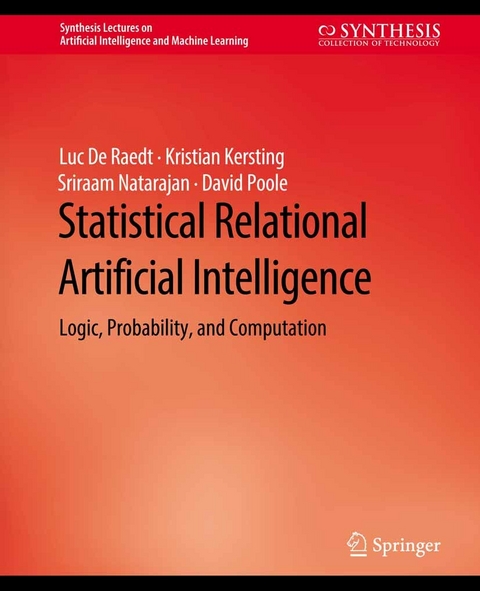
Statistical Relational Artificial Intelligence (eBook)

Logic, Probability, and Computation
eBook Download: PDF
2022
XIV, 175 Seiten
Springer International Publishing (Verlag)
978-3-031-01574-8 (ISBN)
Lese- und Medienproben

Statistical Relational Artificial Intelligence - Luc De Raedt, Kristian Kersting, Sriraam Natarajan, David Poole
Systemvoraussetzungen
53,49 inkl. MwSt
(CHF 52,25)
Der eBook-Verkauf erfolgt durch die Lehmanns Media GmbH (Berlin) zum Preis in Euro inkl. MwSt.
  • Download sofort lieferbar
  • Zahlungsarten anzeigen
An intelligent agent interacting with the real world will encounter individual people, courses, test results, drugs prescriptions, chairs, boxes, etc., and needs to reason about properties of these individuals and relations among them as well as cope with uncertainty. Uncertainty has been studied in probability theory and graphical models, and relations have been studied in logic, in particular in the predicate calculus and its extensions. This book examines the foundations of combining logic and probability into what are called relational probabilistic models. It introduces representations, inference, and learning techniques for probability, logic, and their combinations. The book focuses on two representations in detail: Markov logic networks, a relational extension of undirected graphical models and weighted first-order predicate calculus formula, and Problog, a probabilistic extension of logic programs that can also be viewed as a Turing-complete relational extension of Bayesian networks.

Luc De Raedt is a full professor of computer science at the KU Leuven (Belgium), where he is director of the Lab for Declarative Languages and Artificial Intelligence, and where he also obtained his Ph.D. He is also a former professor of computer science of the Albert-Ludwigs-University Freiburg (Germany) and chair of its lab for Natural Language Processsing and Machine Learning. Luc De Raedt's research interests are in artificial intelligence, machine learning, and data mining, as well as their applications. He is currently working on probabilistic logic learning (sometimes called statistical relational learning), which combines probabilistic reasoning methods with logical representations and machine learning, the integration of constraint programming with data mining and machine learning principles, the development of programming languages for machine learning, and analyzing graph and network data. He is also interested in applications of these methods to chemo- and bio-informatics, to natural language processing, vision, robotics, and action and activity learning. He was program (co)-chair of the 7th ECML Machine Learning (1994, Catania, Sicily), the 5th ILP (1995, Leuven, Belgium), the first ECMLPKDD (2001, Freiburg, Germany), the 22nd ICML Learning (2005, Bonn, Germany) and the 20th ECAI (2012, Montpellier, France). He is an area/action editor of TPLP, JMLR, MLJ, AIJ, and formerly of JAIR. He is also a member of the editorial boards of NGC, AI Communications, Informatica, DMKD, and the Journal of Applied Logic. He was an elected and founding member of the board of the International Machine Learning Society from 2004-2011. In 2005, he was elected as an ECCAI fellow and four of his students have won the ECCAI dissertation award for the best European dissertation in AI.
Sriraam Natarajan is an assistant professor at Indiana University. He was previously an assistant professor at Wake Forest School of Medicine, a post-doctoral research associate at University of Wisconsin-Madison, and graduated with his Ph.D. from Oregon State University. His research interests lie in the field of artificial intelligence, with emphasis on machine learning, statistical relational learning and AI, reinforcement learning, graphical models, and biomedical applications. He has received the Young Investigator award from U.S. Army Research Office. He is the organizer of the key workshops in the field of Statistical Relational Learning and has co-organized the AAAI 2010, the UAI 2012, AAAI 2013, and AAAI 2014 workshops on Statistical Relational AI (StarAI), ICML 2012 Workshop on Statistical Relational Learning, and the ECML PKDD 2011 and 2012 workshops on Collective Learning and Inference on Structured Data (Co-LISD). He is also the co-chair of the AAAI student abstract and posters at AAAI 2014 and AAAI 2015.
David Poole is a professor of computer science at the University of British Columbia. He has a Ph.D. from the Australian National University. He is known for his work on assumption-based reasoning, diagnosis, relational probabilistic models, combining logic and probability, algorithms for probabilistic inference, representations for automated decision making, probabilistic reasoning with ontologies, and semantic science. He is a co-author of a new AI textbook, Artificial Intelligence: Foundations of Computational Agents (Cambridge University Press, 2010), co-author of an older AI textbook, Computational Intelligence: A Logical Approach (Oxford University Press, 1998), co-chair of AAAI-10 (twenty-Fourth AAAI Conference on Artificial Intelligence), and co-editor of the Proceedings of the Tenth Conference in Uncertainty in Artificial Intelligence (Morgan Kaufmann, 1994). He is a former associate editor of the Journal of AI Research, an the AI Journal, and the editorial board of AI Magazine. He is the chair of the Association for Uncertainty in Artificial Intelligence and is a Fellow of the Association for the Advancement Artificial Intelligence (AAAI). He is the winner of the Canadian AI Association (CAIAC) 2013 Lifetime Achievement Award. In the 2014â€'15 academic year he was a Leverhulme Trust visiting professor at the University of Oxford.
Erscheint lt. Verlag 31.5.2022
Reihe/Serie Synthesis Lectures on Artificial Intelligence and Machine Learning
Synthesis Lectures on Artificial Intelligence and Machine Learning
Zusatzinfo XIV, 175 p.
Sprache englisch
Original-Titel Statistical Relational Artificial Intelligence
Themenwelt Informatik Theorie / Studium Künstliche Intelligenz / Robotik
Mathematik / Informatik Mathematik
ISBN-10 3-031-01574-6 / 3031015746
ISBN-13 978-3-031-01574-8 / 9783031015748
Informationen gemäß Produktsicherheitsverordnung (GPSR)
Haben Sie eine Frage zum Produkt?
PDFPDF (Wasserzeichen)

DRM: Digitales Wasserzeichen
Dieses eBook enthält ein digitales Wasser­zeichen und ist damit für Sie persona­lisiert. Bei einer missbräuch­lichen Weiter­gabe des eBooks an Dritte ist eine Rück­ver­folgung an die Quelle möglich.

Dateiformat: PDF (Portable Document Format)
Mit einem festen Seiten­layout eignet sich die PDF besonders für Fach­bücher mit Spalten, Tabellen und Abbild­ungen. Eine PDF kann auf fast allen Geräten ange­zeigt werden, ist aber für kleine Displays (Smart­phone, eReader) nur einge­schränkt geeignet.

Systemvoraussetzungen:
PC/Mac: Mit einem PC oder Mac können Sie dieses eBook lesen. Sie benötigen dafür einen PDF-Viewer - z.B. den Adobe Reader oder Adobe Digital Editions.
eReader: Dieses eBook kann mit (fast) allen eBook-Readern gelesen werden. Mit dem amazon-Kindle ist es aber nicht kompatibel.
Smartphone/Tablet: Egal ob Apple oder Android, dieses eBook können Sie lesen. Sie benötigen dafür einen PDF-Viewer - z.B. die kostenlose Adobe Digital Editions-App.

Buying eBooks from abroad
For tax law reasons we can sell eBooks just within Germany and Switzerland. Regrettably we cannot fulfill eBook-orders from other countries.

Mehr entdecken
aus dem Bereich
Die Grundlage der Digitalisierung

von Knut Hildebrand; Michael Mielke; Marcus Gebauer

eBook Download (2025)
Springer Fachmedien Wiesbaden (Verlag)
CHF 29,30
Die materielle Wahrheit hinter den neuen Datenimperien

von Kate Crawford

eBook Download (2024)
C.H.Beck (Verlag)
CHF 17,55