Cyber-Physical Systems (eBook)
336 Seiten
John Wiley & Sons (Verlag)
9781119836629 (ISBN)
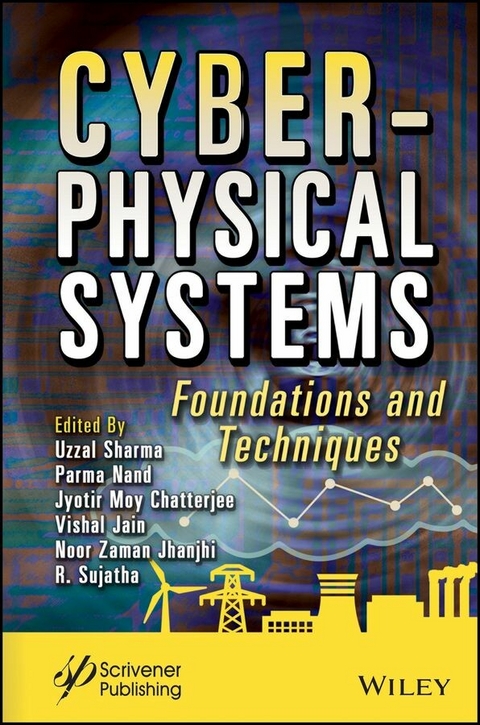
The 13 chapters in this book cover the various aspects associated with Cyber-Physical Systems (CPS) such as algorithms, application areas, and the improvement of existing technology such as machine learning, big data and robotics.
Cyber-Physical Systems (CPS) is the interconnection of the virtual or cyber and the physical system. It is realized by combining three well-known technologies, namely "Embedded Systems," "Sensors and Actuators," and "Network and Communication Systems." These technologies combine to form a system known as CPS. In CPS, the physical process and information processing are so tightly connected that it is hard to distinguish the individual contribution of each process from the output. Some exciting innovations such as autonomous cars, quadcopter, spaceships, sophisticated medical devices fall under CPS.
The scope of CPS is tremendous. In CPS, one sees the applications of various emerging technologies such as artificial intelligence (AI), Internet of Things (IoT), machine learning (ML), deep learning (DL), big data (BD), robotics, quantum technology, etc. In almost all sectors, whether it is education, health, human resource development, skill improvement, startup strategy, etc., one sees an enhancement in the quality of output because of the emergence of CPS into the field.
Audience
Researchers in Information technology, artificial intelligence, robotics, electronics and electrical engineering.
Uzzal Sharma, PhD, is an assistant professor (senior), Department of Computer Applications, School of Technology, Assam Don Bosco University, Guwahati, India. Parma Nand, PhD, in Computer Science & Engineering from Indian Institute of Technology, Roorkee, and has more than 27 years of experience, both in industry and academia. Jyotir Moy Chatterjee is an assistant professor in the Information Technology department at Lord Buddha Education Foundation (LBEF), Kathmandu, Nepal. Vishal Jain, PhD, is an associate professor in the Department of Computer Science and Engineering, School of Engineering and Technology, Sharda University, Greater Noida, U. P. India. Noor Zaman Jhanjhi, PhD, is an associate professor, Director of the Center for Smart Society 5.0 at the School of Computer Science and Engineering, Faculty of Innovation and Technology, Taylor's University, Malaysia. R. Sujatha, PhD, is an associate professor in the School of Information Technology and Engineering in Vellore Institute of Technology, Vellore, India.
| Erscheint lt. Verlag | 7.6.2022 |
|---|---|
| Sprache | englisch |
| Themenwelt | Informatik ► Theorie / Studium ► Künstliche Intelligenz / Robotik |
| Schlagworte | Artificial Intelligence • Computer Science • Electrical & Electronics Engineering • Elektrotechnik u. Elektronik • Embedded Systems • Embedded Systems & Smart Cards • Embedded Systems u. Smart Cards • Informatik • Künstliche Intelligenz • Sensoren, Instrumente u. Messung • Sensors, Instrumentation & Measurement |
| ISBN-13 | 9781119836629 / 9781119836629 |
| Informationen gemäß Produktsicherheitsverordnung (GPSR) | |
| Haben Sie eine Frage zum Produkt? |
 PDF (Adobe DRM)
Kopierschutz: Adobe-DRM
Adobe-DRM ist ein Kopierschutz, der das eBook vor Mißbrauch schützen soll. Dabei wird das eBook bereits beim Download auf Ihre persönliche Adobe-ID autorisiert. Lesen können Sie das eBook dann nur auf den Geräten, welche ebenfalls auf Ihre Adobe-ID registriert sind.
Details zum Adobe-DRM
Dateiformat: PDF (Portable Document Format)
Mit einem festen Seitenlayout eignet sich die PDF besonders für Fachbücher mit Spalten, Tabellen und Abbildungen. Eine PDF kann auf fast allen Geräten angezeigt werden, ist aber für kleine Displays (Smartphone, eReader) nur eingeschränkt geeignet.
Systemvoraussetzungen:
PC/Mac: Mit einem PC oder Mac können Sie dieses eBook lesen. Sie benötigen eine
eReader: Dieses eBook kann mit (fast) allen eBook-Readern gelesen werden. Mit dem amazon-Kindle ist es aber nicht kompatibel.
Smartphone/Tablet: Egal ob Apple oder Android, dieses eBook können Sie lesen. Sie benötigen eine
Geräteliste und zusätzliche Hinweise
Buying eBooks from abroad
For tax law reasons we can sell eBooks just within Germany and Switzerland. Regrettably we cannot fulfill eBook-orders from other countries.
aus dem Bereich