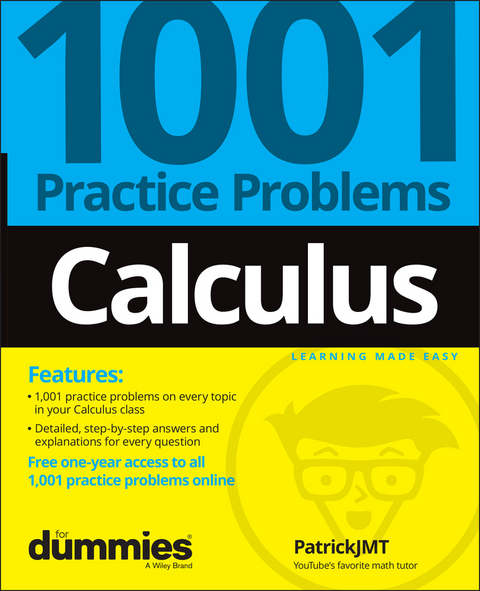
Calculus: 1001 Practice Problems For Dummies (+ Free Online Practice) (eBook)
John Wiley & Sons (Verlag)
978-1-119-88367-8 (ISBN)
Practice your way to a higher grade in Calculus!
Calculus is a hands-on skill. You've gotta use it or lose it. And the best way to get the practice you need to develop your mathematical talents is Calculus: 1001 Practice Problems For Dummies.
The perfect companion to Calculus For Dummies-and your class- this book offers readers challenging practice problems with step-by-step and detailed answer explanations and narrative walkthroughs. You'll get free access to all 1,001 practice problems online so you can create your own study sets for extra-focused learning.
Readers will also find:
- A useful course supplement and resource for students in high school and college taking Calculus I
- Free, one-year access to all practice problems online, for on-the-go study and practice
- An excellent preparatory resource for faster-paced college classes
Calculus: 1001 Practice Problems For Dummies (+ Free Online Practice) is an essential resource for high school and college students looking for more practice and extra help with this challenging math subject.
Calculus: 1001 Practice Problems For Dummies (9781119883654) was previously published as 1,001 Calculus Practice Problems For Dummies (9781118496718). While this version features a new Dummies cover and design, the content is the same as the prior release and should not be considered a new or updated product.
Patrick Jones has a master's degree in Mathematics from the University of Louisville. He has taught at University of Louisville, Vanderbilt University, and Austin Community College. Jones now primarily spends his time expanding his Youtube video library as PatrickJMT.
Patrick Jones has a master's degree in Mathematics from the University of Louisville. He has taught at University of Louisville, Vanderbilt University, and Austin Community College. Jones now primarily spends his time expanding his Youtube video library as PatrickJMT.
Introduction 1
Part 1: The Questions 5
Chapter 1: Algebra Review 7
Chapter 2: Trigonometry Review 17
Chapter 3: Limits and Rates of Change 29
Chapter 4: Derivative Basics 43
Chapter 5: The Product, Quotient, and Chain Rules 49
Chapter 6: Exponential and Logarithmic Functions and Tangent Lines 55
Chapter 7: Implicit Differentiation 59
Chapter 8: Applications of Derivatives 63
Chapter 9: Areas and Riemann Sums 75
Chapter 10: The Fundamental Theorem of Calculus and the Net Change Theorem 79
Chapter 11: Applications of Integration 87
Chapter 12: Inverse Trigonometric Functions, Hyperbolic Functions, and L'Hôpital's Rule 101
Chapter 13: U-Substitution and Integration by Parts 109
Chapter 14: Trigonometric Integrals, Trigonometric Substitution, and Partial Fractions 115
Chapter 15: Improper Integrals and More Approximating Techniques 123
Part 2: The Answers 127
Chapter 16: Answers and Explanations 129
Index 581
Chapter 1
Algebra Review
Performing well in calculus is impossible without a solid algebra foundation. Many calculus problems that you encounter involve a calculus concept but then require many, many steps of algebraic simplification. Having a strong algebra background will allow you to focus on the calculus concepts and not get lost in the mechanical manipulation that's required to solve the problem.
The Problems You’ll Work On
In this chapter, you see a variety of algebra problems:
- Simplifying exponents and radicals
- Finding the inverse of a function
- Understanding and transforming graphs of common functions
- Finding the domain and range of a function using a graph
- Combining and simplifying polynomial expressions
What to Watch Out For
Don't let common mistakes trip you up. Some of the following suggestions may be helpful:
- Be careful when using properties of exponents. For example, when multiplying like bases, you add the exponents, and when dividing like bases, you subtract the exponents.
- Factor thoroughly in order to simplify expressions.
- Check your solutions for equations and inequalities if you're unsure of your answer. Some solutions may be extraneous!
- It's easy to forget some algebra techniques, so don't worry if you don't remember everything! Review, review, review.
Simplifying Fractions
1–13 Simplify the given fractions by adding, subtracting, multiplying, and/or dividing.
1.
2.
3.
4.
5.
6.
7.
8.
9.
10.
11.
12.
13.
Simplifying Radicals
14–18 Simplify the given radicals. Assume all variables are positive.
14.
15.
16.
17.
18.
Writing Exponents Using Radical Notation
19–20 Convert between exponential and radical notation.
19. Convert to radical notation. (Note: The final answer can have more than one radical sign.)
20. Convert to exponential notation.
The Horizontal Line Test
21–23 Use the horizontal line test to identify one-to-one functions.
21. Use the horizontal line test to determine which of the following functions is a one-to-one function and therefore has an inverse.
(A)
(B)
(C)
(D)
(E)
22. Use the horizontal line test to determine which of the following functions is a one-to-one function and therefore has an inverse.
(A)
(B)
(C)
(D)
(E)
23. Use the horizontal line test to determine which of the following functions is a one-to-one function and therefore has an inverse.
(A)
(B)
(C)
(D)
(E)
Find Inverses Algebraically
24–29 Find the inverse of the one-to-one function algebraically.
24.
25.
26.
27.
28.
29.
The Domain and Range of a Function and Its Inverse
30–32 Solve the given question related to a function and its inverse.
30. The set of points is on the graph of f(x), which is a one-to-one function. Which points belong to the graph of ?
31. f(x) is a one-to-one function with domain and range . What are the domain and range of ?
32. Suppose that f(x) is a one-to-one function. What is an expression for the inverse of ?
Linear Equations
33–37 Solve the given linear equation.
33.
34.
35.
36.
37.
Quadratic Equations
38–43 Solve the quadratic equation.
38. Solve .
39. Solve by completing the square.
40. Solve by completing the square.
41. Solve .
42. Solve .
43. Solve .
Solving Polynomial Equations by Factoring
44–47 Solve the polynomial equation by factoring.
44.
45.
46.
47.
Absolute Value Equations
48–51 Solve the given absolute value equation.
48.
49.
50.
51.
Solving Rational Equations
52–55 Solve the given rational equation.
52.
53.
54.
55.
Polynomial and Rational Inequalities
56–59 Solve the given polynomial or rational inequality.
56. x2 - 4x - 32 < 0
57.
58.
59.
Absolute Value Inequalities
60–62 Solve the absolute value inequality.
60.
61.
62.
Graphing Common Functions
63–77 Solve the given question related to graphing common functions.
63. What is the slope of the line that goes through the points and ?
64. What is the equation of the line that has a slope of 4 and goes through the point ?
65. What is the equation of the line that goes through the points and ?
66. Find the equation of the line that goes through the point and is parallel to the line .
67. Find the equation of the line that goes through the point and is perpendicular to the line that goes through the points and .
68. What is the equation of the graph of after you stretch it vertically by a factor of 2, shift the graph 3 units to the right, and then shift it 4 units upward?
69. Find the vertex form of the parabola that passes through the point and has a vertex at .
70. Find the vertex form of the parabola that passes through the point and has a vertex at .
71. A parabola has the vertex form . What is the vertex form of this parabola if it’s shifted 6 units to the right and 2 units down?
72. What is the equation of the graph of after you compress the graph horizontally by a factor of 2, reflect it across the y-axis, and shift it down 5 units?
73. What is the equation of the graph of after you stretch the graph horizontally by a factor of 5, reflect it across the x-axis, and shift it up 3 units?
74. Find the equation of the third-degree polynomial that goes through the points , , , and .
75. Find the equation of the fourth-degree polynomial that goes through the point and has the roots –1, 2, and 3, where 3 is a repeated root.
76. A parabola crosses the x-axis at the points and . If the point is on the parabola, what is the equation of the parabola?
77. A parabola crosses the x-axis at the points and , and the point is on the parabola. What is the equation of the parabola?
Domain and Range from a Graph
78–80 Find the domain and range of the function with the given graph.
78.
...| Erscheint lt. Verlag | 5.5.2022 |
|---|---|
| Sprache | englisch |
| Themenwelt | Mathematik / Informatik ► Mathematik ► Analysis |
| Schlagworte | Analysis • Calculus • calculus fd • calculus for dummies • Calculus practice • Calculus Practice Problems • calculus practice questions • calculus workbook • college calculus questions • dummies guide to calculus • Einführende Analysis • high school calculus questions • Introductory Calculus • Mathematics • Mathematics Special Topics • Mathematik • online calculus practice • online calculus practice problems • online calculus practice questions • Spezialthemen Mathematik |
| ISBN-10 | 1-119-88367-9 / 1119883679 |
| ISBN-13 | 978-1-119-88367-8 / 9781119883678 |
| Informationen gemäß Produktsicherheitsverordnung (GPSR) | |
| Haben Sie eine Frage zum Produkt? |
 EPUB (Adobe DRM)
Kopierschutz: Adobe-DRM
Adobe-DRM ist ein Kopierschutz, der das eBook vor Mißbrauch schützen soll. Dabei wird das eBook bereits beim Download auf Ihre persönliche Adobe-ID autorisiert. Lesen können Sie das eBook dann nur auf den Geräten, welche ebenfalls auf Ihre Adobe-ID registriert sind.
Details zum Adobe-DRM
Dateiformat: EPUB (Electronic Publication)
EPUB ist ein offener Standard für eBooks und eignet sich besonders zur Darstellung von Belletristik und Sachbüchern. Der Fließtext wird dynamisch an die Display- und Schriftgröße angepasst. Auch für mobile Lesegeräte ist EPUB daher gut geeignet.
Systemvoraussetzungen:
PC/Mac: Mit einem PC oder Mac können Sie dieses eBook lesen. Sie benötigen eine
eReader: Dieses eBook kann mit (fast) allen eBook-Readern gelesen werden. Mit dem amazon-Kindle ist es aber nicht kompatibel.
Smartphone/Tablet: Egal ob Apple oder Android, dieses eBook können Sie lesen. Sie benötigen eine
Geräteliste und zusätzliche Hinweise
Buying eBooks from abroad
For tax law reasons we can sell eBooks just within Germany and Switzerland. Regrettably we cannot fulfill eBook-orders from other countries.
aus dem Bereich