


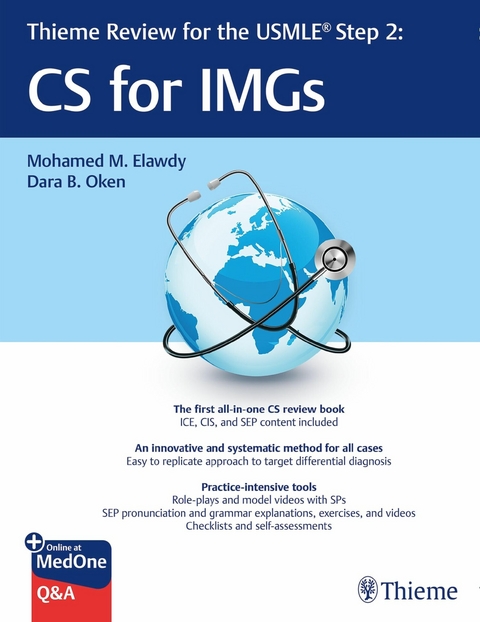
Thieme Review for the USMLE® Step 2: CS for IMGs (eBook)
324 Seiten
Georg Thieme Verlag KG
978-1-63853-694-9 (ISBN)
1 The Basics, Component 1, Integrated Clinical Encounter
Keywords: integrated clinical encounter, medical history, physical examination, patient note
1.1 Introduction
The Clinical Skills exam has three parts: Integrated Clinical Encounter (ICE), Communication and Interpersonal Skills (CIS), and Spoken English Proficiency (SEP). Please read the U.S. Medical Licensing Examination (USMLE) Bulletin of Information at www.usmle.org to find out more about how the CS exam is scored.
The ICE focuses on how you apply basic medical knowledge rather than simply measuring the quantity of your medical knowledge. The ICE tests how you come up with a possible diagnosis through the history-taking and physical examination (PE). It also assesses your ability to convey data to another physician through a Patient Note (PN).
The CS exam is different from other USMLE Step 1 and Step 2 CK tests, which use multiple choice questions to test the prospective physician’s medical knowledge and in which a high level of medical knowledge is required for a passing mark. The CS exam instead is an interactive exam, with an actor playing the role of a patient. Only basic medical knowledge about the most common diseases in the Emergency Room (ER) and the family medicine clinic is needed. Therefore, asking sophisticated questions and searching for rare differential diagnoses (DDs) will not help you pass the exam.
The clinical encounters on the CS exam strive to mimic reality. For example, the CS Exam Center has been built to resemble a large clinic. The patients have problems similar to what doctors frequently encounter. However, it is not quite real and different in a few aspects.
Each clinical encounter is limited to 15 minutes. This gives you only enough time to take a relevant history and to do a focused clinical exam, not a detailed one, as you would do in a real clinic.
The second difference is that the patients are healthy people, acting as if they were sick. They are called “SPs,” which stands for Standardized Patients (SPs). The SPs complain of medical problems and conditions, but there are no physical manifestations (pallor, tachycardia, murmurs, edema in the lower limbs, high temperature, etc.). However, you are expected to act as if there were. At times, some of the SPs will have fabricated physical manifestations such as fake scars, ecchymosis, or erythema. Again, you are expected to behave as if these were real. Do NOT ignore them; treat these fake signs as real. After all, the encounter is a role-play to mimic a reality.
Each examinee will have 12 clinical encounters during the day of the exam. There are three subcomponents to each encounter of the ICE—the history and the PE) that are graded by the SP, in addition to the PN that is graded by a physician.
1.2 Section A: Medical History
Taking the patient’s history is an important part of the CS exam (▶Video 1.1). You should have already learned the fundamentals of history in medical school. The purpose of this book, therefore, is to help you learn the art of efficiently taking the patient history by tailoring your questions to fit well within the CS exam. This is because time is of the essence. You cannot afford to ask superfluous questions.
Passing this subcomponent requires you to know when to shorten or expand your investigation into the patient’s complaint. Though you will not ask all the history questions to each SP, during the course of the exam you will likely spread the questions over the 12 SPs.
An example of tailoring your questions to fit a patient is when interviewing an SP who has epigastric pain, focusing on the symptoms that are related to the gastrointestinal (GI) system (nausea, vomiting, heartburn, bowel movements, dark stool, and vomiting of blood). You would not waste time asking questions about headaches, hearing loss, joint pain, etc.
In a case with a chief complaint (CC) of ankle pain, ask about symptoms that are relevant to the joint problem, such as about swelling, redness, hotness, and possible complications such as sensory or motor deficit and limb disabilities, which are areas of concern, rather than symptoms that are related to the chest, GI system, or a detailed obstetrics and gynecology (OB/Gyn). You need to focus on the task at hand (i.e., the cause of the CC).
A general OB/Gyn history is essential for all females in all cases, while a detailed one should be taken in OB/Gyn cases (suspected abortion, ectopic pregnancy, vaginal bleeding and amenorrhea, etc.).
For the purposes of the CS exam, the patient history can be divided into two main categories: history of present illness (HPI) and the past history and others.
Video 1.1 This video will teach you how to tailor the medical history to satisfy CS requirements and time limitation. The emphasis is on the analysis of the most common complaints in the CS. https://www.thieme.de/de/q.htm?p=opn/cs/20/3/11453119-17a31cb2
1.2.1 History of Present Illness
This is the most important part of the history because it is:
• Dynamic: It changes. Each case and complaint is unique.
• The SP’s first impression of you as a doctor: It breaks the ice of taking the history, a time when both patient and doctor may feel nervous and be uncomfortable.
• Crucial: You rely on the information you get from this part to arrive at a preliminary diagnosis.
• Upon seeing the Doorway Information before you enter the examination room, brainstorm three to four possible causes as a presumptive diagnosis. Jot them down on your scratch paper. It is highly recommended that you do this to increase your focus and concentration before starting the case. Make sure you start the HPI interview with open questions, such as “What brings you in to the hospital today?”
The HPI has two components: analysis of two subcomponents (CC and possible causes) and review of two systems (local system and general systems). Follow the order below (1–4) for taking the history and documenting it in the PN. For example, a case with a CC of low back pain is taken.
Analysis of the two subcomponents:
1. Analysis of CC (back pain as an example).
2. Analysis of the possible DD (muscle strain, fracture spine, disk herniation, etc.).
Review of two systems (local and general):
3. Symptoms related to the local affected system: these are the symptoms that have not been mentioned by the SP, but which could be linked to the same system (sensory and motor function, range of motion, urinary and bowel control, etc.).
4. Review of systems (ROS) including OB/Gyn history, sleep, appetite, weight, etc.
Analysis of Chief Complaint
Only the most frequent complaints will be discussed in this section; other complaints will be dealt with in their individual, case-specific chapters.
Pain is the most common complaint on the CS exam. Therefore, memorize and rehearse questions related to pain.
Use this mnemonic device to help you remember the categories that you should ask about: LIQOR AAA: It stands for Location, Intensity, Quality, Onset + course + duration, Radiation, Aggravating factors, Alleviating factors, Associations. Or
Onset, course, and duration
Location and Radiation
CSF (Character, Severity, and Frequency):
Aggravating and Alleviating Factors
Associations
In ▶Table 1.1, Intensity corresponds with Severity, and Quality corresponds with Character and Frequency. (More than one question may be given for each category.)
Other common complaints that SPs are likely to have are fever, nausea and vomiting, diarrhea, cough, or bleeding. The relevant questions to ask for each common complaint are:
Fever:
• How long have you had a fever?
• Did you check your temperature at home?
• What was your temperature when you took it at home?
• Have you taken any medicine for the fever? If yes, what did you take?
• Has the fever come down since you took the medicine?
Nausea and vomiting:
• Do you feel nauseous?
• Have you been vomiting?/Are you able to keep things down?
• How many times a day do you vomit?
• Have you noticed any blood in the vomit?
• What is the color of the vomit?
For any body fluids or excretions (vomit, diarrhea, sputum, etc.), use the formula Onset + ABCD:
A = Amount: Could you estimate the amount of …?
B = Blood: Have you noticed blood in your …?
C = Color: What color is it? Is it bright or dark...
| Erscheint lt. Verlag | 16.9.2020 |
|---|---|
| Verlagsort | Stuttgart |
| Sprache | englisch |
| Themenwelt | Informatik ► Weitere Themen ► Bioinformatik |
| Medizin / Pharmazie ► Allgemeines / Lexika | |
| Medizin / Pharmazie ► Medizinische Fachgebiete | |
| Medizin / Pharmazie ► Studium | |
| Sozialwissenschaften ► Pädagogik | |
| Schlagworte | Clinical Encounter Language • Communication and Interpersonal Skills (CIS) • CS for IMGs • IMGs • Integrated Clinical Encounter (ICE) • International Medical Graduate • Medical English • Spoken English Proficiency (SEP) • Step 2 CS • USMLE • USMLE CS • USMLE Step 2 CS |
| ISBN-10 | 1-63853-694-5 / 1638536945 |
| ISBN-13 | 978-1-63853-694-9 / 9781638536949 |
| Informationen gemäß Produktsicherheitsverordnung (GPSR) | |
| Haben Sie eine Frage zum Produkt? |
 EPUB (Wasserzeichen)
DRM: Digitales Wasserzeichen
Dieses eBook enthält ein digitales Wasserzeichen und ist damit für Sie personalisiert. Bei einer missbräuchlichen Weitergabe des eBooks an Dritte ist eine Rückverfolgung an die Quelle möglich.
Dateiformat: EPUB (Electronic Publication)
EPUB ist ein offener Standard für eBooks und eignet sich besonders zur Darstellung von Belletristik und Sachbüchern. Der Fließtext wird dynamisch an die Display- und Schriftgröße angepasst. Auch für mobile Lesegeräte ist EPUB daher gut geeignet.
Systemvoraussetzungen:
PC/Mac: Mit einem PC oder Mac können Sie dieses eBook lesen. Sie benötigen dafür die kostenlose Software Adobe Digital Editions.
eReader: Dieses eBook kann mit (fast) allen eBook-Readern gelesen werden. Mit dem amazon-Kindle ist es aber nicht kompatibel.
Smartphone/Tablet: Egal ob Apple oder Android, dieses eBook können Sie lesen. Sie benötigen dafür eine kostenlose App.
Geräteliste und zusätzliche Hinweise
Buying eBooks from abroad
For tax law reasons we can sell eBooks just within Germany and Switzerland. Regrettably we cannot fulfill eBook-orders from other countries.


