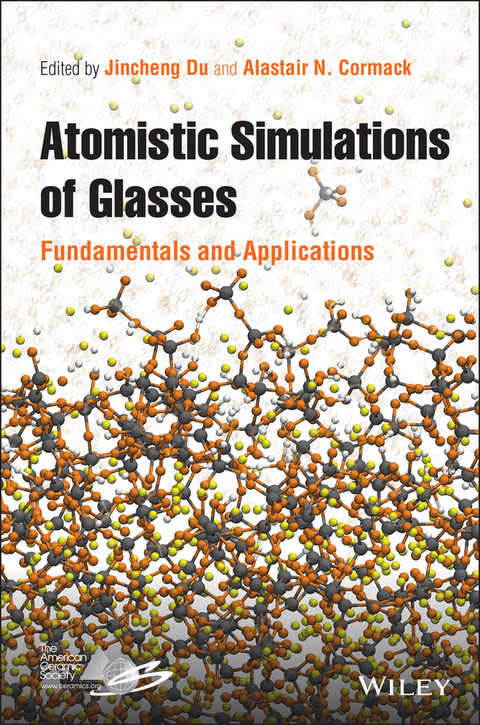
Atomistic Simulations of Glasses (eBook)
John Wiley & Sons (Verlag)
978-1-118-94024-2 (ISBN)
A complete reference to computer simulations of inorganic glass materials
In Atomistic Simulations of Glasses: Fundamentals and Applications, a team of distinguished researchers and active practitioners delivers a comprehensive review of the fundamentals and practical applications of atomistic simulations of inorganic glasses. The book offers concise discussions of classical, first principles, Monte Carlo, and other simulation methods, together with structural analysis techniques and property calculation methods for the models of glass generated from these atomistic simulations, before moving on to practical examples of the application of atomistic simulations in the research of several glass systems.
The authors describe simulations of silica, silicate, aluminosilicate, borosilicate, phosphate, halide and oxyhalide glasses with up-to-date information and explore the challenges faced by researchers when dealing with these systems. Both classical and ab initio methods are examined and comparison with experimental structural and property data provided. Simulations of glass surfaces and surface-water reactions are also covered.
Atomistic Simulations of Glasses includes multiple case studies and addresses a variety of applications of simulation, from elucidating the structure and properties of glasses for optical, electronic, architecture applications to high technology fields such as flat panel displays, nuclear waste disposal, and biomedicine. The book also includes:
- A thorough introduction to the fundamentals of atomistic simulations, including classical, ab initio, Reverse Monte Carlo simulation and topological constraint theory methods
- Important ingredients for simulations such as interatomic potential development, structural analysis methods, and property calculations are covered
- Comprehensive explorations of the applications of atomistic simulations in glass research, including the history of atomistic simulations of glasses
- Practical discussions of rare earth and transition metal-containing glasses, as well as halide and oxyhalide glasses
- In-depth examinations of glass surfaces and silicate glass-water interactions
Perfect for glass, ceramic, and materials scientists and engineers, as well as physical, inorganic, and computational chemists, Atomistic Simulations of Glasses: Fundamentals and Applications is also an ideal resource for condensed matter and solid-state physicists, mechanical and civil engineers, and those working with bioactive glasses. Graduate students, postdocs, senior undergraduate students, and others who intend to enter the field of simulations of glasses would also find the book highly valuable.
Jincheng Du, PhD, is Professor of materials science and engineering at the University of North Texas. He is Chair of the TC27 Technical Committee on Atomistic Simulation with the International Commission of Glass and is the Editor of the Journal of the American Ceramic Society.
Alastair N. Cormack, PhD, Professor at the New York State College of Ceramics at Alfred University. He is a leading authority in the field of computer modeling of materials, focusing on the atomic-scale physics and chemistry of ceramics and glass.
A complete reference to computer simulations of inorganic glass materials In Atomistic Simulations of Glasses: Fundamentals and Applications, a team of distinguished researchers and active practitioners delivers a comprehensive review of the fundamentals and practical applications of atomistic simulations of inorganic glasses. The book offers concise discussions of classical, first principles, Monte Carlo, and other simulation methods, together with structural analysis techniques and property calculation methods for the models of glass generated from these atomistic simulations, before moving on to practical examples of the application of atomistic simulations in the research of several glass systems. The authors describe simulations of silica, silicate, aluminosilicate, borosilicate, phosphate, halide and oxyhalide glasses with up-to-date information and explore the challenges faced by researchers when dealing with these systems. Both classical and ab initio methods are examined and comparison with experimental structural and property data provided. Simulations of glass surfaces and surface-water reactions are also covered. Atomistic Simulations of Glasses includes multiple case studies and addresses a variety of applications of simulation, from elucidating the structure and properties of glasses for optical, electronic, architecture applications to high technology fields such as flat panel displays, nuclear waste disposal, and biomedicine. The book also includes: A thorough introduction to the fundamentals of atomistic simulations, including classical, ab initio, Reverse Monte Carlo simulation and topological constraint theory methods Important ingredients for simulations such as interatomic potential development, structural analysis methods, and property calculations are covered Comprehensive explorations of the applications of atomistic simulations in glass research, including the history of atomistic simulations of glasses Practical discussions of rare earth and transition metal-containing glasses, as well as halide and oxyhalide glasses In-depth examinations of glass surfaces and silicate glass-water interactions Perfect for glass, ceramic, and materials scientists and engineers, as well as physical, inorganic, and computational chemists, Atomistic Simulations of Glasses: Fundamentals and Applications is also an ideal resource for condensed matter and solid-state physicists, mechanical and civil engineers, and those working with bioactive glasses. Graduate students, postdocs, senior undergraduate students, and others who intend to enter the field of simulations of glasses would also find the book highly valuable.
Jincheng Du, PhD, is Professor of materials science and engineering at the University of North Texas. He is Chair of the TC27 Technical Committee on Atomistic Simulation with the International Commission of Glass and is the Editor of the Journal of the American Ceramic Society. Alastair N. Cormack, PhD, Professor at the New York State College of Ceramics at Alfred University. He is a leading authority in the field of computer modeling of materials, focusing on the atomic-scale physics and chemistry of ceramics and glass.
List of Abbreviations
| Acronym or Abbreviation | What it stands for |
|---|
| 3QMAS NMR | triple quantum magic angle spinning nuclear magnetic resonance |
| a‐Si | amorphous silicon |
| AIMD | ab initio molecular dynamics |
| ASTM | American Society for Testing and Materials |
| AXS | anomalous X‐ray scattering |
| BAD | bond angle distribution |
| BAFS | barium aluminum fluorosilicate glass |
| BB | bond‐bending |
| BKS | van Beest–Kramer–van Santen |
| BMH | Born–Mayer–Huggins potential |
| BO | bridging oxygen |
| BOMD | Born–Oppenheimer molecular dynamics |
| BS | bond‐stretching |
| CAS | calcium aluminosilicates |
| CMAS | calcium magnesium aluminosilicates |
| CN | coordination number of atoms |
| CNAS | calcium sodium aluminosilicates |
| COMB | charge optimized many‐body potential |
| CPMD | Car–Parrinello molecular dynamics |
| CRN | continuous random network |
| CS | corner‐sharing |
| DBO | double‐bonded oxygen |
| DBX | Dell, Bray, and Xiao |
| DCR | diffuse charge reactive potentials |
| DFC | differential correlation function |
| DFT | density functional theory |
| DL_POLY | Daresbury Laboratory general purpose molecular dynamic simulation package |
| DOS | density of states |
| DT | Delaunay tetrahedron |
| ECMR | experimentally constrained molecular relaxation |
| EDFA | erbium‐doped fiber amplifier |
| EDOS | electronic density of states |
| EFG | electric field gradient |
| EMD | equilibrium molecular dynamics |
| EPR | electron paramagnetic resonance |
| EPSR | empirical potential structure relaxation |
| ES | edge‐sharing |
| EXAFS | extended X‐ray absorption fine structure |
| FD | fluid dynamics |
| FEAR | force‐enhanced atomic refinement |
| FEM | finite element analysis |
| FF | force field |
| FFT | fast Fourier transform |
| FFV | fractional free volume |
| FP | fluoride phosphate glass |
| FSDP | first sharp diffraction peak |
| FTIR | Fourier‐transform infrared |
| FV | free volume |
| FWHM | full width at half maximum |
| g‐SiO2 | glassy silica |
| GAP | Gaussian approximation potential |
| GFA | glass‐forming ability |
| GGA | generalized gradient approximation |
| GIPAW | gauge‐including projector augmented wave |
| GST | Ge2Sb2Te5 |
| GULP | General Utility Lattice Program |
| GW | Hedin's GW method for electronic structure properties |
| HF | Hartree–Fock |
| HOMO | highest occupied molecular orbital |
| HSE06 | Hyed–Scuseria–Ernzerhof hybrid functional |
| IPR | inverse participation ratio |
| IR | infrared |
| IRO | intermediate‐range ordering |
| ISG | international simple glass |
| kMC, KMC | kinetic Monte Carlo |
| KNCMFATS | potassium, sodium, calcium, magnesium iron, and titanium oxide containing silicates |
| l‐P | liquid phosphorus |
| l‐Si | liquid silicon |
| l‐SiO2 | liquid silica |
| L–J, LJ | Lennard–Jones |
| LAMMPS | large‐scale atomic/molecular massively parallel simulator |
| LD‐DFT | ligand field density functional theory |
| LDA | local density approximation |
| LED | light emitting diode |
| LRO | Long‐range order |
| LUMO | lowest unoccupied molecular orbital |
| MAE | mixed alkali effect |
| MAS | magic angle spinning |
| MAS–NMR | magic angle spinning nuclear magnetic resonance |
| MC | Monte Carlo |
| MD | molecular dynamics |
| MFA | mean‐field approximation |
| ML | machine‐learning |
| MM | molecular mechanics |
| MP2 | 2nd order Møller–Plesset perturbation theory |
| MQ | melt quench |
| MQ‐MAS | multiple‐quantum magic angle spinning |
| MRN | modified random network |
| msd, MSD | mean square displacement |
| NAPF | sodium alumino‐phospho‐fluorides |
| NAS | sodium aluminosilicates |
| NBO | non‐bridging oxygen |
| NBOHC | non‐bridging oxygen hole centers |
| NC | network connectivity |
| ND | neutron diffraction |
| NEMD | non‐equilibrium molecular dynamics |
| NMR | nuclear magnetic resonance |
| NPT | constant number of atoms N, constant pressure P, constant temperature T ensemble |
| NVE | constant number of atoms N, constant volume V and constant energy E ensemble |
| NVT | constant number of atoms N, constant volume V and constant temperature T ensemble |
| OLCAO | orthogonalized linear combination of atomic orbitals |
| OLP | overlapping polarons tunneling |
| ONIOM | own N‐layer integrated molecular orbital molecular mechanics |
| PAF | principal axis frame |
| PALS | positron annihilation lifetime spectroscopy |
| PAW | projected augmented wave |
| PBC | periodic boundary conditions |
| PBE | Perdew–Burke‐Ernzerhof (exchange‐correlation functional) |
| PBG | phosphate‐based glasses |
| PD | persistence diagram |
| PES | potential energy surface |
| PME | particle mesh Ewald |
| PMMCS | Pedone‐Malavasi‐Menziani‐Cormack‐Segre potentials |
| POHC | phosphorous oxygen hole center |
| PP | pseudo potential or principal peak |
| QE | Quantum Espresso, an open‐source electronic structure calculation code |
| QM | quantum mechanical |
| QPM | quasi‐periodic models |
| QSPR | quantitative... |
| Erscheint lt. Verlag | 29.3.2022 |
|---|---|
| Sprache | englisch |
| Themenwelt | Informatik ► Grafik / Design ► Digitale Bildverarbeitung |
| Mathematik / Informatik ► Informatik ► Theorie / Studium | |
| Naturwissenschaften ► Chemie | |
| Technik ► Maschinenbau | |
| Schlagworte | Anorganische Strukturen • Ceramics • Chemie • Chemistry • computer simulation of glasses • computer simulation of inorganic glasses • Glas • glass computer simulation • glass corrosion </p> • glass simulation applications • glass simulation fundamentals • glass surfaces • glass-water reactions • Inorganic Structures • Keramik (Techn.) • Keramischer Werkstoff • keramische Werkstoffe • <p>glass simulation • Materials Science • Materialwissenschaften • Materialwissenschaften / Theorie, Modellierung u. Simulation • Phase separation • Theory, Modeling & Simulation |
| ISBN-10 | 1-118-94024-5 / 1118940245 |
| ISBN-13 | 978-1-118-94024-2 / 9781118940242 |
| Informationen gemäß Produktsicherheitsverordnung (GPSR) | |
| Haben Sie eine Frage zum Produkt? |
 EPUB (Adobe DRM)
Kopierschutz: Adobe-DRM
Adobe-DRM ist ein Kopierschutz, der das eBook vor Mißbrauch schützen soll. Dabei wird das eBook bereits beim Download auf Ihre persönliche Adobe-ID autorisiert. Lesen können Sie das eBook dann nur auf den Geräten, welche ebenfalls auf Ihre Adobe-ID registriert sind.
Details zum Adobe-DRM
Dateiformat: EPUB (Electronic Publication)
EPUB ist ein offener Standard für eBooks und eignet sich besonders zur Darstellung von Belletristik und Sachbüchern. Der Fließtext wird dynamisch an die Display- und Schriftgröße angepasst. Auch für mobile Lesegeräte ist EPUB daher gut geeignet.
Systemvoraussetzungen:
PC/Mac: Mit einem PC oder Mac können Sie dieses eBook lesen. Sie benötigen eine
eReader: Dieses eBook kann mit (fast) allen eBook-Readern gelesen werden. Mit dem amazon-Kindle ist es aber nicht kompatibel.
Smartphone/Tablet: Egal ob Apple oder Android, dieses eBook können Sie lesen. Sie benötigen eine
Geräteliste und zusätzliche Hinweise
Buying eBooks from abroad
For tax law reasons we can sell eBooks just within Germany and Switzerland. Regrettably we cannot fulfill eBook-orders from other countries.
aus dem Bereich